
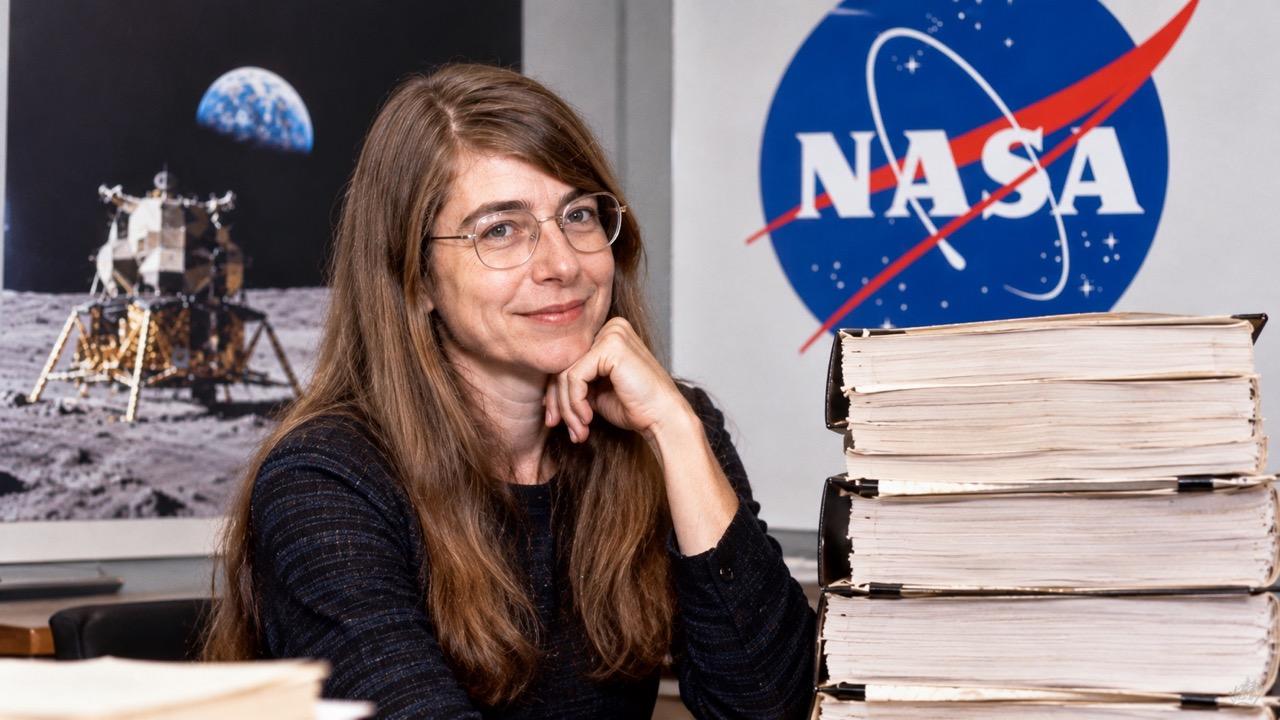
- Margaret Hamilton, the computer scientist who led the team behind critical Apollo flight software, died Sept. 30 at age 90. Her work helped Apollo 11 continue its lunar landing after the onboard computer became overloaded.
Margaret Hamilton is trending after the death of the pioneering computer scientist whose software helped guide NASA's Apollo missions to the Moon. The Massachusetts Institute of Technology announced Oct. 7 that Hamilton died Sept. 30 at the age of 90. She spent more than two decades at MIT and became one of the most influential figures in the early development of software engineering.
Hamilton is best known for leading the Software Engineering Division at MIT's Instrumentation Laboratory, which developed the onboard flight software used by Apollo command and lunar modules. The work became especially important during the Apollo 11 landing in July 1969, when the spacecraft's computer encountered a potentially dangerous overload.
Her contribution was not simply writing code for one historic mission. Hamilton helped establish practices around reliability, priority processing, and fault recovery that became fundamental to modern software development.
What Did Margaret Hamilton Do for NASA?
Hamilton joined MIT in 1959, initially working in its meteorology department on software used for weather prediction. She later worked at MIT Lincoln Laboratory on the SAGE air-defense system before joining the Apollo effort. When MIT's Instrumentation Laboratory received a NASA contract in 1961 to work on Apollo's guidance system, Hamilton became part of the effort to build software for an entirely new kind of mission.
She eventually led the team responsible for Apollo's onboard flight software. According to NASA, the software supported the command and lunar modules and incorporated concepts including priority scheduling, asynchronous operations, and fault recovery.
The technology was extraordinarily constrained by modern standards. The Apollo Guidance Computer had just 4 kilobytes of read-write memory and 72 kilobytes of read-only memory, according to the National Air and Space Museum. Apollo software was stored using a physical "core rope" system in which wires were threaded through magnetic cores to encode the program.
Hamilton's approach placed reliability at the center of the design. That became critical during Apollo 11's final descent. The lunar module's computer began issuing 1201 and 1202 alarms after becoming overloaded. Rather than allowing lower-priority tasks to interfere with the essential landing operations, Hamilton's software architecture enabled the computer to prioritize the work needed to keep the mission moving.
NASA has also documented another software intervention approximately three minutes before touchdown. The software overrode a command that would have shifted the computer's processing priority toward a radar system whose switch had been activated because of an incorrect written procedure. NASA said the software's response allowed the landing to continue safely.
The episode became one of the clearest examples of why Hamilton emphasized software designed to anticipate errors rather than simply execute instructions under ideal conditions.
Why Is Margaret Hamilton Trending Now?
Hamilton's death has brought renewed attention to a career that helped define an industry that barely existed when she began working. MIT described her as a computing pioneer and noted that she authored more than 130 publications. After the Apollo program, she continued working in software and eventually founded Higher Order Software in 1976 and Hamilton Technologies in 1986.
She also became closely associated with the phrase "software engineering." The term is widely used today, but it was not an established professional discipline during the Apollo era. Hamilton pushed for software development to be treated with the same engineering discipline applied to hardware and other critical systems. Draper, the organization that emerged from MIT's Instrumentation Laboratory, credits her with coining the term as part of that effort.
Her legacy also reaches beyond the Apollo program. In 2016, President Barack Obama awarded Hamilton the Presidential Medal of Freedom, the nation's highest civilian honor. The White House recognized her leadership in creating the onboard software that allowed Apollo's lunar module to land safely and cited her role in advancing software engineering.
The National Air and Space Museum also holds the Margaret Hamilton Apollo Flight Guidance Computer Software Collection, containing reports, memoranda, and other records documenting the flight-guidance software developed by her team.
Hamilton's story has gained renewed relevance as the technology industry moves deeper into an era dominated by artificial intelligence, autonomous systems and increasingly complex software.
The modern space economy now includes commercial launch providers, satellite networks, lunar infrastructure and software systems operating far beyond Earth. Companies such as SpaceX have also made space technology a major focus for investors through the SpaceX IPO.
Hamilton's contribution represents an earlier stage of that technological evolution, when computing resources were measured in kilobytes and software was often treated as secondary to hardware.
Her Apollo work demonstrated the opposite. Software could determine whether a complex machine recovered from an unexpected failure and continued performing its most important task. More than five decades later, that principle remains central to the design of systems where a software failure can have consequences far beyond a computer screen.
Hamilton's death has therefore revived interest not only in the woman standing beside the famous stacks of Apollo code, but in the engineering philosophy behind that photograph.