
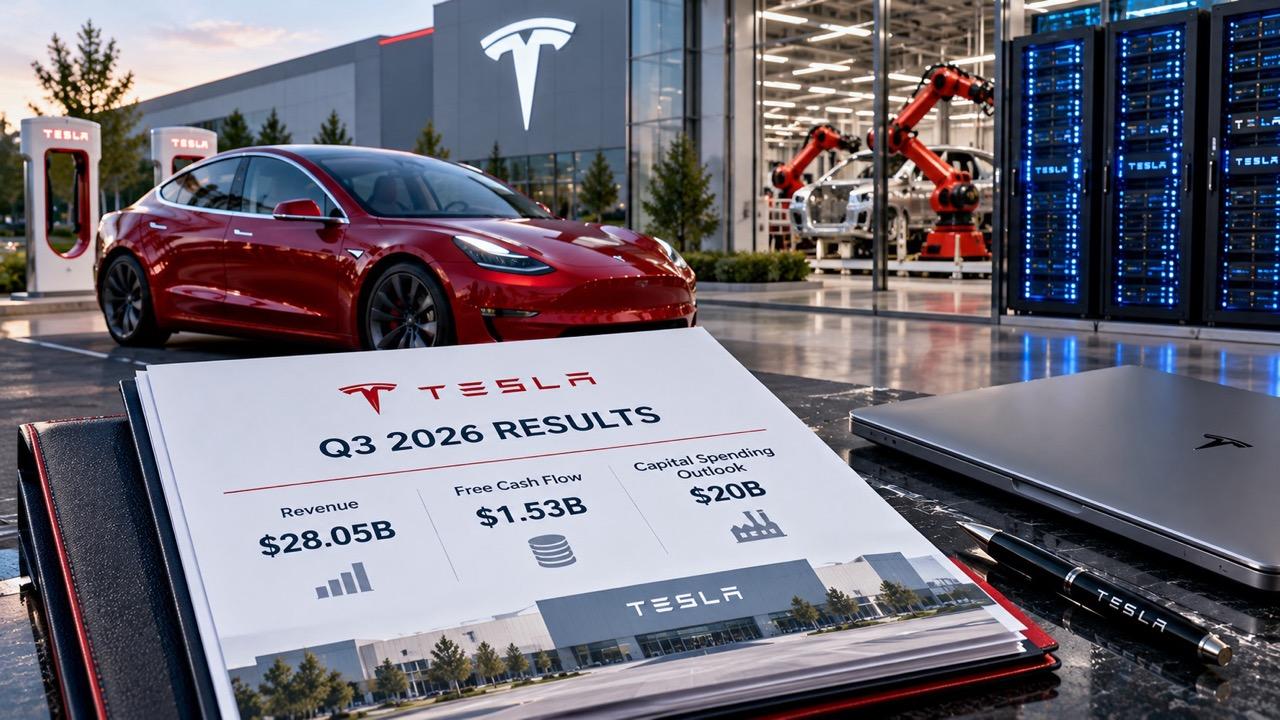
Tesla Inc. (NASDAQ: TSLA) generated $1.53 billion in free cash flow during the third quarter, surprising investors who had expected a substantial cash burn. But behind that improvement, net income fell 43% to $787 million, operating income dropped 56% and the electric-vehicle maker cut its 2026 capital spending forecast from more than $25 billion to $20 billion. The results reveal a company balancing weaker near-term profitability against an ambitious push into AI, robotics and autonomous driving.
Tesla’s third-quarter financial update, released on October 21, showed revenue of $28.05 billion, essentially flat from $28.10 billion a year earlier. Adjusted earnings reached 48 cents per share, above the roughly 44-cent analyst estimate cited by Yahoo Finance.
The headline earnings beat did not tell the full story. Tesla reported just 22 cents in GAAP earnings per share, down from 39 cents a year earlier. Its operating margin narrowed to 2.6% from 5.8%, indicating that the business retained far less operating profit from each dollar of sales.
Tesla shares fell in after-hours trading after rising during Wednesday’s regular session. Investors were weighing the surprise in cash generation against the company’s lower annual investment forecast and the possibility that some large growth projects may take longer to scale.
Tesla’s Core Business Tells a Weaker Story Than Cash Flow
The divergence between cash flow and earnings is central to understanding Tesla’s latest results. Free cash flow reached $1.53 billion, compared with $3.99 billion in the third quarter of 2025. The figure was still substantially better than analysts’ expectations for a multibillion-dollar cash outflow, but it was not evidence that Tesla’s underlying profitability had strengthened across the board.
The main reason for the surprise was capital expenditure. Tesla spent $4.73 billion on capital projects during the quarter, more than double the $2.25 billion spent a year earlier but well below the roughly $7.5 billion that analysts had expected. Operating cash flow came in at $6.26 billion, providing enough cash to cover investment spending and leave a positive balance.
That result stands in contrast to the second quarter, when Tesla generated negative free cash flow of $1.09 billion as investment spending climbed. Investors had been watching closely to see whether rising spending on AI computing, robotics and autonomous vehicles would force the company to use more of its cash reserves. The cash-flow pressures surrounding Tesla’s robotaxi expansion framed that concern ahead of the report.
The third-quarter revenue mix also shows why the earnings picture remains uneven. Automotive revenue fell 3% to $20.56 billion, while energy generation and storage revenue declined 16% to $2.88 billion. Services and other revenue rose 33% to $4.61 billion, helped by activities including charging, repairs and other customer services.
Tesla delivered 486,532 vehicles during the quarter, up from the previous quarter but about 2% below the year-earlier period. The company’s energy storage deployments reached 13.7 gigawatt-hours, demonstrating continued deployment activity even as revenue from the segment declined. Deliveries and deployments matter, but they do not directly determine quarterly revenue or profit because vehicle pricing, product mix, costs and accounting treatment also affect the results.
Gross profit increased 9% to $5.49 billion, and GAAP gross margin improved to 19.6% from 18.0% a year earlier. However, operating expenses rose 39% to $4.78 billion, leaving operating income down 56% at $718 million. The combination shows that better gross profitability was more than offset by higher expenses further down the income statement.
Tesla’s financial position remains substantial. Cash, cash equivalents and short-term investments reached $45.45 billion at quarter-end, up 9% from a year earlier. That liquidity gives the company room to continue funding its expansion, but it does not remove the need for investments to generate returns over time.
Lower Capex Gives Tesla More Cash but Raises Questions About Growth
Tesla lowered its 2026 capital expenditure outlook to about $20 billion from a previous forecast of more than $25 billion. The move came as Chief Executive Elon Musk continues to emphasize AI, robotics, robotaxis and manufacturing expansion as the company’s future growth engines.
The reduced forecast helps explain the positive free-cash-flow surprise, but it also raises questions about the timing of Tesla’s planned projects. The company is investing in AI computing capacity and new manufacturing lines while developing its Cybercab robotaxi and Optimus humanoid robot. A slower spending profile could reflect project timing or a more disciplined investment schedule; it does not, by itself, prove that Tesla has abandoned those initiatives.
Tesla said production had begun on high-volume Optimus lines at its Fremont factory and that Cybercab had joined the robotaxi fleet in Austin. The company is also expanding the infrastructure needed to support AI development. These initiatives could create new sources of revenue if they reach commercial scale, but they require capital and execution before their eventual financial contribution can be measured.
The company reported that more than 75% of new-vehicle deliveries in North America included a paid Full Self-Driving (Supervised) subscription at delivery. The figure suggests a growing role for software in Tesla’s customer offering, although it should not be confused with evidence that fully autonomous driving has been achieved. Drivers must remain attentive and ready to take control.
Those ambitions come as investors scrutinize whether major technology companies can translate heavy AI investment into profitable growth. The pressure extends beyond Tesla: AI-related earnings reports are facing greater scrutiny over spending and returns as markets ask whether rapidly expanding infrastructure will generate durable cash flow.
Tesla’s capital spending decision also arrives amid discussion of a possible merger with SpaceX. Musk said the companies had established special committees to explore a combination, while cautioning that the proposal faces substantial hurdles and may never proceed. The possibility adds another layer of uncertainty around how Tesla could fund and organize its longer-term ambitions.
For investors, the key issue is whether Tesla can sustain positive free cash flow without sacrificing the pace of development needed to compete in AI and autonomous driving. A lower investment bill makes current cash flow look better, but sustained growth will depend on the company converting those investments into products and services that generate meaningful revenue.
Tesla’s third-quarter results are therefore a mixed signal. The positive cash-flow figure provides near-term financial relief, while falling net income and operating profit show that the core business still faces pressure. The next test is whether Tesla can restore stronger operating performance as its investment cycle continues.