

Assets are things you own with economic value. Liabilities are amounts you owe. Your savings account and home belong on the asset side of your personal balance sheet; your credit card balance and mortgage belong on the liability side.
The difference is your net worth: total assets minus total liabilities. But net worth alone cannot tell you whether next month's bills are affordable. To make the distinction useful, track three separate questions: what you own, what you owe, and how money moves through your household.
Assets vs. liabilities at a glance
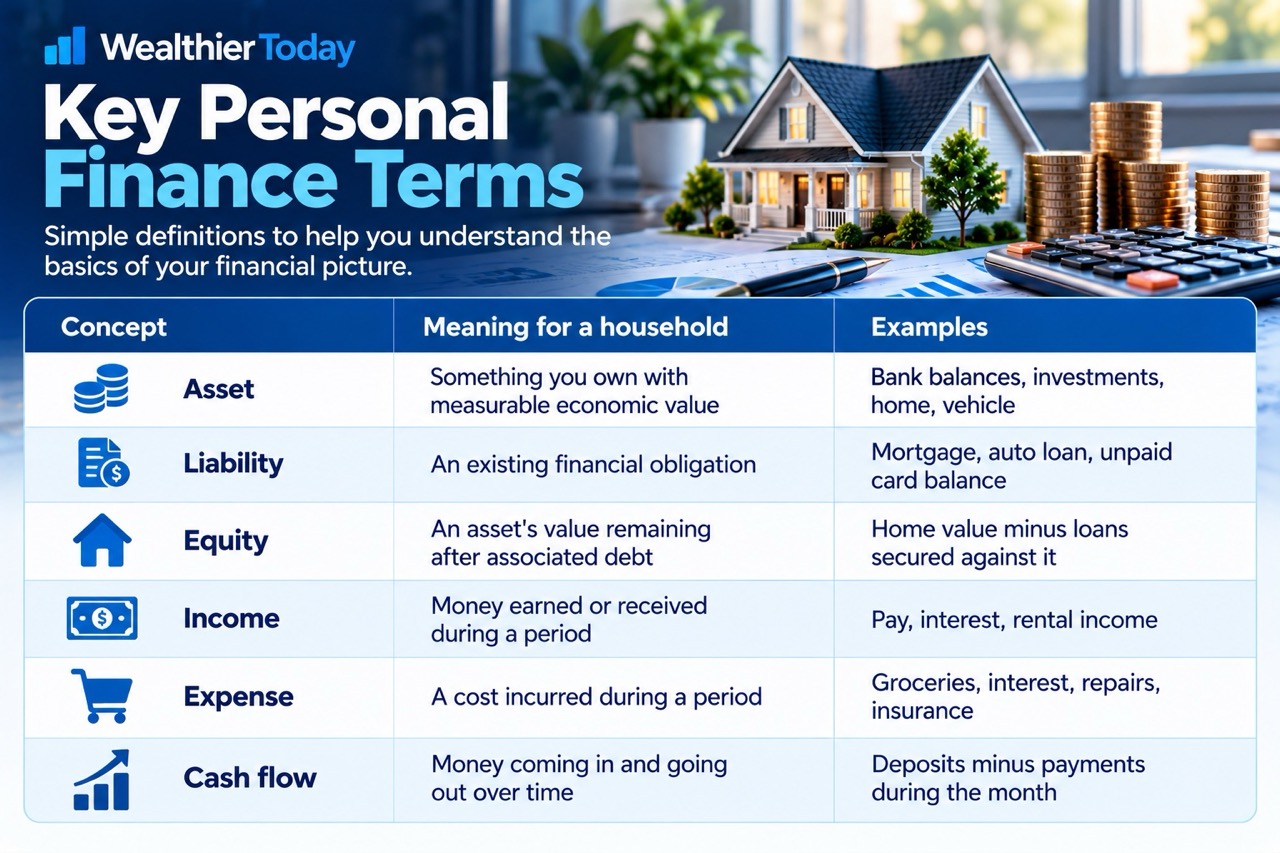
FINRA distinguishes a household's net-worth calculation from its monthly cash flow. Both belong in a financial review because owning valuable property does not necessarily produce money for immediate expenses. FINRA financial foundations.
These categories describe different features of the same transaction. A grocery purchase charged to a credit card creates an expense and a liability. Paying that card later moves cash out and reduces the liability; it does not create a second grocery expense.
An asset can cost money and lose value
The saying “assets put money in your pocket; liabilities take money out” can encourage useful thinking about cash flow. It is not a reliable definition for preparing a balance sheet.
A car can lose resale value, require repairs, and remain an asset. A home can have no rental income and remain an asset. Conversely, a loan used to buy a profitable business remains a liability even when borrowing turns out well.
Use separate labels for separate decisions:
- Value: What could this asset reasonably be sold for?
- Income: Does it produce cash, and how dependable is that cash?
- Cost: What does ownership require each month or year?
- Liquidity: How quickly could you sell it, and at what cost?
- Purpose: Does it support your work, housing, enjoyment, or long-term goals?
A necessary vehicle does not need to appreciate to justify its purchase. Its usefulness should still be weighed against payment obligations and operating costs. Our guide to good debt and bad debt examines that borrowing decision; the balance sheet records what happened afterward.
Home value, mortgage debt, and home equity
Suppose a home is worth $350,000 and has an outstanding $260,000 mortgage, with no other liens. Its equity is $90,000.
In a complete balance sheet, record the $350,000 asset and $260,000 liability. Do not add another $90,000 “home equity” asset: that would count the same value twice. You can instead use a compact equity-only summary, but then you must omit that mortgage from the liabilities being subtracted in that summary.
Likewise, listing only $90,000 of equity and subtracting the $260,000 mortgage again would understate net worth. Keeping gross asset values and debts in separate columns is usually easier to audit.
A car with negative equity
A hypothetical car worth $15,000 with $18,000 left to repay contributes negative $3,000 to net worth. The vehicle is still an asset; the related liability is simply larger.
Before selling or trading it, obtain a lender payoff quote. The CFPB notes that payoff amounts can differ from statement balances and that rolling negative equity into another auto loan raises borrowing costs. CFPB guide to trading in a financed car.
Build a personal balance sheet on one date
Pick a snapshot date, such as the last day of a month. Use account balances and debt figures from that date as closely as possible. Mixing an old loan balance with a new bank balance can make progress look better or worse than it is.
The SEC's introductory worksheet follows the basic sequence: list assets, list liabilities, and calculate the difference. Investor.gov financial worksheet.
The following is an original hypothetical household worksheet, with all amounts in dollars. Copy the categories into a spreadsheet and replace the figures with your own.
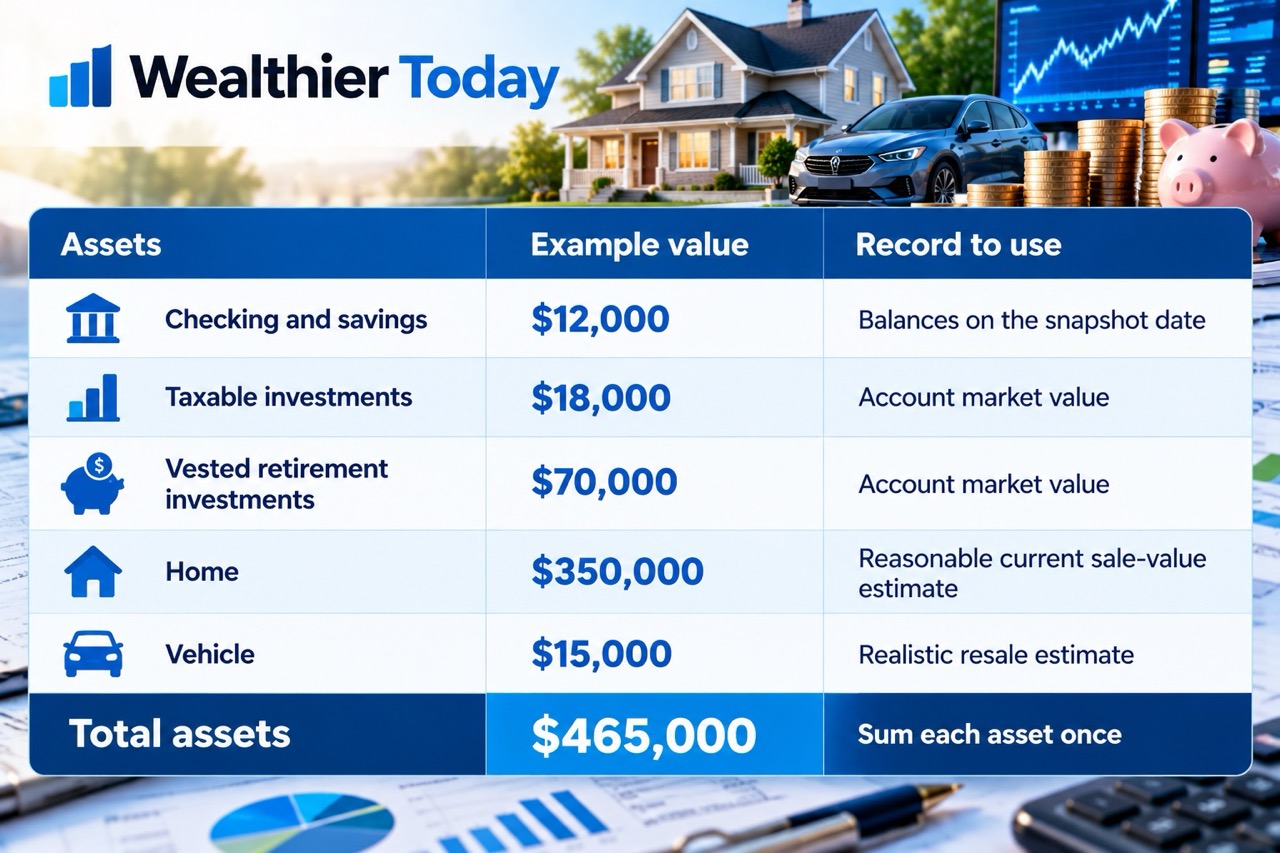
Net worth = $465,000 − $305,000 = $160,000.
That total includes a home, retirement assets, and a vehicle. It does not mean the household has $160,000 available to spend.
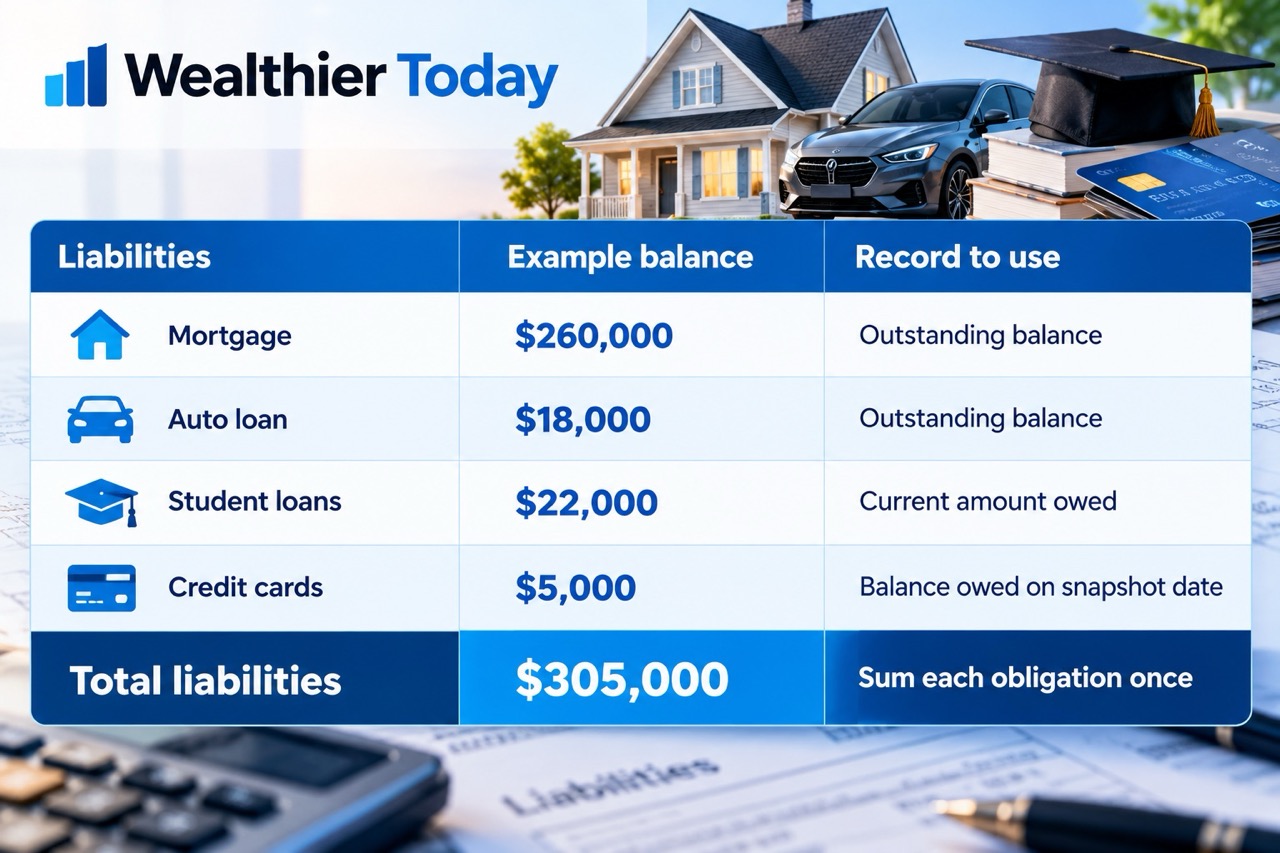
Decide what belongs in the worksheet
Include card balances even if you intend to pay them in full. The cash set aside to pay them is already counted as an asset; excluding the debt would overstate your position.
Include personal loans, buy-now-pay-later balances, and known unpaid obligations that are yours to pay. Record disputed or uncertain amounts separately for follow-up. Do not add every future grocery bill or all future mortgage interest to today's debt balance; future spending belongs in a forecast.
For jointly held property, use a consistent scope. A whole-household statement counts the shared asset and shared debt once. An individual statement needs an ownership and obligation allocation that reflects the actual arrangement. For complex joint debts, guarantees, divorce, or business ownership, obtain legal or accounting help before treating a simple percentage as your legal responsibility.
For possessions, use realistic resale estimates rather than replacement cost or the original receipt. It is reasonable to omit small household items from a practical tracking sheet if you apply that convention consistently. Avoid spending hours pricing items that will not change a decision.
Read net worth alongside liquidity and cash flow
Return to the hypothetical household with $160,000 of net worth. Suppose its $12,000 in cash includes $4,000 earmarked for near-term bills. That leaves $8,000 before considering other earmarks or emergencies.
If essential monthly outflows are $4,000, that available reserve covers two months under the assumption that no income arrives and costs stay unchanged. The $90,000 of home equity cannot directly pay a utility bill without a sale or financing transaction.
Now suppose monthly take-home income is $5,400 and total monthly outflows are $5,700. The household has negative $300 monthly cash flow despite positive net worth. Continuing that pattern uses savings or adds debt.
These are three distinct results:
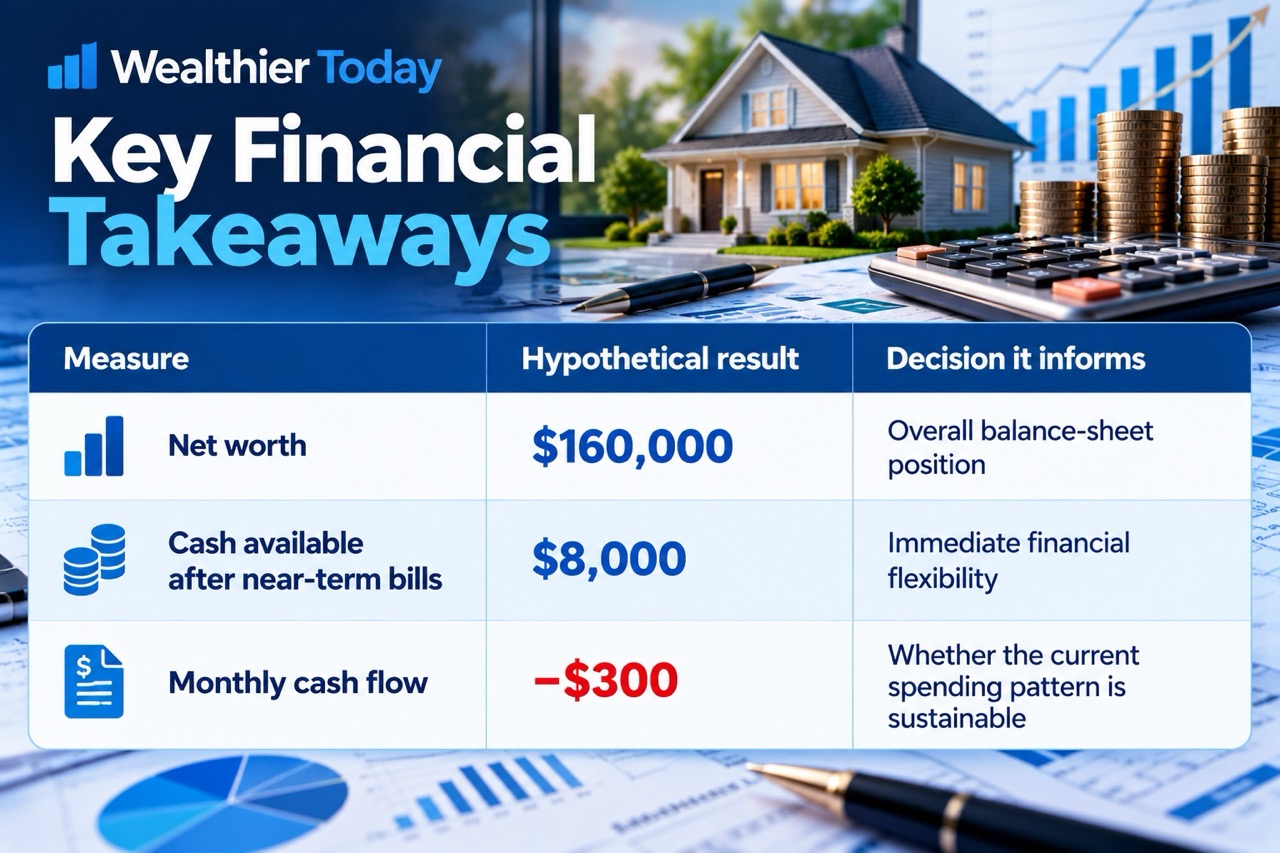
The CFPB provides separate bill-calendar, debt-log, and cash-flow-budget tools because timing and obligations require their own records. CFPB Your Money, Your Goals toolkit.
Use our paycheck budgeting guide to find the source of a recurring shortfall. The portfolio runway calculator can explore spending scenarios, but enter assets you actually plan to draw from; do not automatically treat your home or car as a spendable portfolio.
What paying down debt really changes
Paying principal with existing savings reduces assets and liabilities together. Imagine paying $2,000 from the worksheet's cash toward card principal, ignoring fees and additional interest:
- Assets fall from $465,000 to $463,000.
- Liabilities fall from $305,000 to $303,000.
- Net worth remains $160,000.
This can still be a good financial move. You have less debt, may owe less future interest, and may eventually free up monthly payments. You also have less liquid cash immediately afterward. Those effects matter even when net worth is unchanged on payment day.
For mortgages, distinguish principal from interest and other charges. The CFPB explains that principal reduces the loan balance, while interest does not build equity. CFPB mortgage repayment explanation. Use the mortgage calculator to examine that split over time.
If debt is paid using newly earned income, the income can improve net worth after expenses. The payment itself is still a transfer from cash to reduced debt. Keeping these steps separate prevents counting the same improvement twice.
Turn the worksheet into a monthly decision
Update balances on a consistent schedule and explain large changes. A $10,000 increase driven by a higher estimated home price means something different from saving $10,000 out of income. Both affect measured wealth; only one necessarily added liquid financial assets.
Choose the next action from the constraint you find:
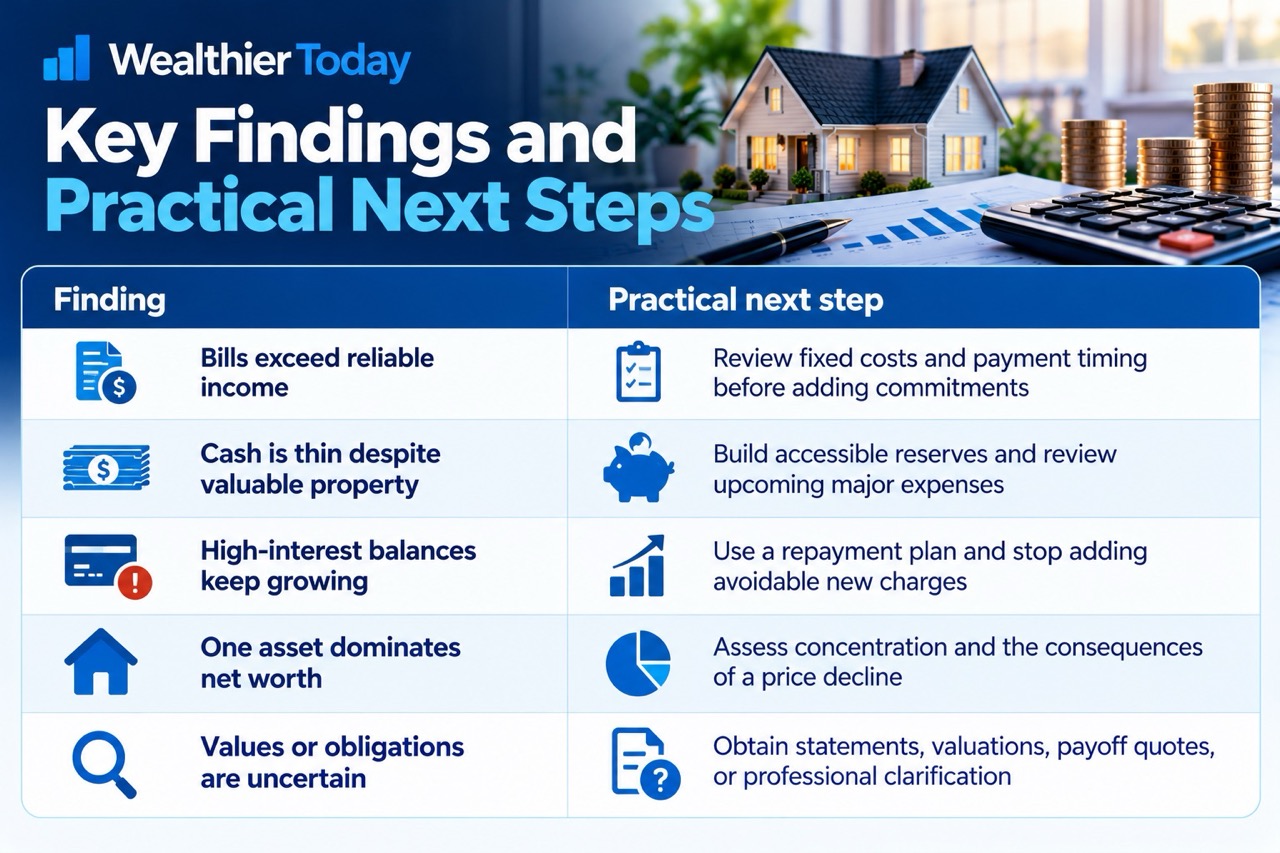
Our debt payoff guide helps turn the liability list into a repayment sequence. Keep this worksheet as the record of your position, and keep the budget as the plan for changing it. The useful outcome is a specific action you can afford, followed by a consistent check of whether it improved your finances.
Frequently asked questions
What is the difference between assets and liabilities?
Assets are resources you own with economic value, such as savings, investments, a home, or a car. Liabilities are obligations you owe, such as a mortgage, credit card balance, or student loan. Subtract liabilities from assets to calculate net worth on a particular date.
Is a house an asset or a liability?
A house you own is an asset. Its mortgage and other outstanding loans secured against it are liabilities. Maintenance, insurance, and property taxes affect cash flow. A home can be an asset while still being expensive to keep and difficult to turn into spendable cash.
Is a car an asset if it loses value?
Yes. A car you own is an asset at its realistic current resale value, even if that value declines. An outstanding auto loan is a separate liability. When the debt exceeds the vehicle's value, you have negative equity in the car.
Does paying off debt immediately increase net worth?
Paying principal with existing cash reduces an asset and a liability by the same amount, so that transaction alone leaves net worth unchanged. It can reduce future interest expense and improve future cash flow. Paying interest is different because it generally does not reduce principal.
Should retirement accounts count toward net worth?
Include the current value of retirement assets you own in a standard net-worth statement. Keep them separate from immediately available cash, and note withdrawal restrictions and potential taxes. A retirement account balance is not necessarily the amount you could spend after withdrawing it.
Continue reading
More resources
- InvestingWhat is Investing?Saving helps you achieve your financial goals. Investing helps you grow your savings.Read next
- Lending & BorrowingCredit & Debt: Good Debt vs Bad Debt and How to Use It WiselyDebt can build wealth or drain it. Learn how to tell good debt from bad debt, understand the real cost of interest, and use borrowing strategically to invest in your future.Read next
- MoneyWhat Is Wealth Management? Services, Fees, and How It WorksWealth management is holistic financial planning for people with complex finances—covering investments, taxes, estates, retirement, and risk. Learn services, typical fees, asset minimums, and how to choose a fiduciary.Read next
- Lending & BorrowingCredit Cards With Low Interest Rates and High Cash Back: Finding the Best BalanceNo single card perfectly combines the absolute lowest ongoing interest rates with the highest cash back rewards, but it's time to learn the real trade-offs.Read next