

Money market accounts (MMAs) sit in a useful middle ground: they generally pay more interest than traditional brick-and-mortar savings accounts while offering easier access to your cash than a certificate of deposit (CD). For beginners building an emergency fund or saving for short-term goals, they can be a simple upgrade from letting cash sit in a low-yield account.
This guide walks you through exactly what MMAs are, how they compare to alternatives, the practical steps to open one, and how to choose wisely so your cash works harder without unnecessary complexity or risk.
What Is a Money Market Account?
A money market account is a deposit account at a bank or credit union. Your money is pooled with other depositors, and the institution uses it for lending and other activities, paying you a portion back as interest.
Key characteristics:
- Variable interest rates that typically adjust with market conditions.
- FDIC or NCUA insurance up to $250,000 per depositor, per institution (principal protection).
- Limited transaction features — many include check-writing and/or a debit/ATM card (subject to any bank-imposed limits).
- Minimum balance requirements are common, both to open the account and to earn the highest advertised APY or avoid fees.
- Tiered rates — larger balances often qualify for higher yields.
MMAs are not the same as money market funds (mutual funds sold through brokerages). MMAs are bank deposits with government insurance on principal. Money market funds are investments without that same deposit insurance (though they aim to maintain a stable $1 share price).
Money Market Account vs. Other Cash Options
Choosing the right place for your cash depends on your time horizon, how much access you need, and whether you want to optimize for yield or simplicity.
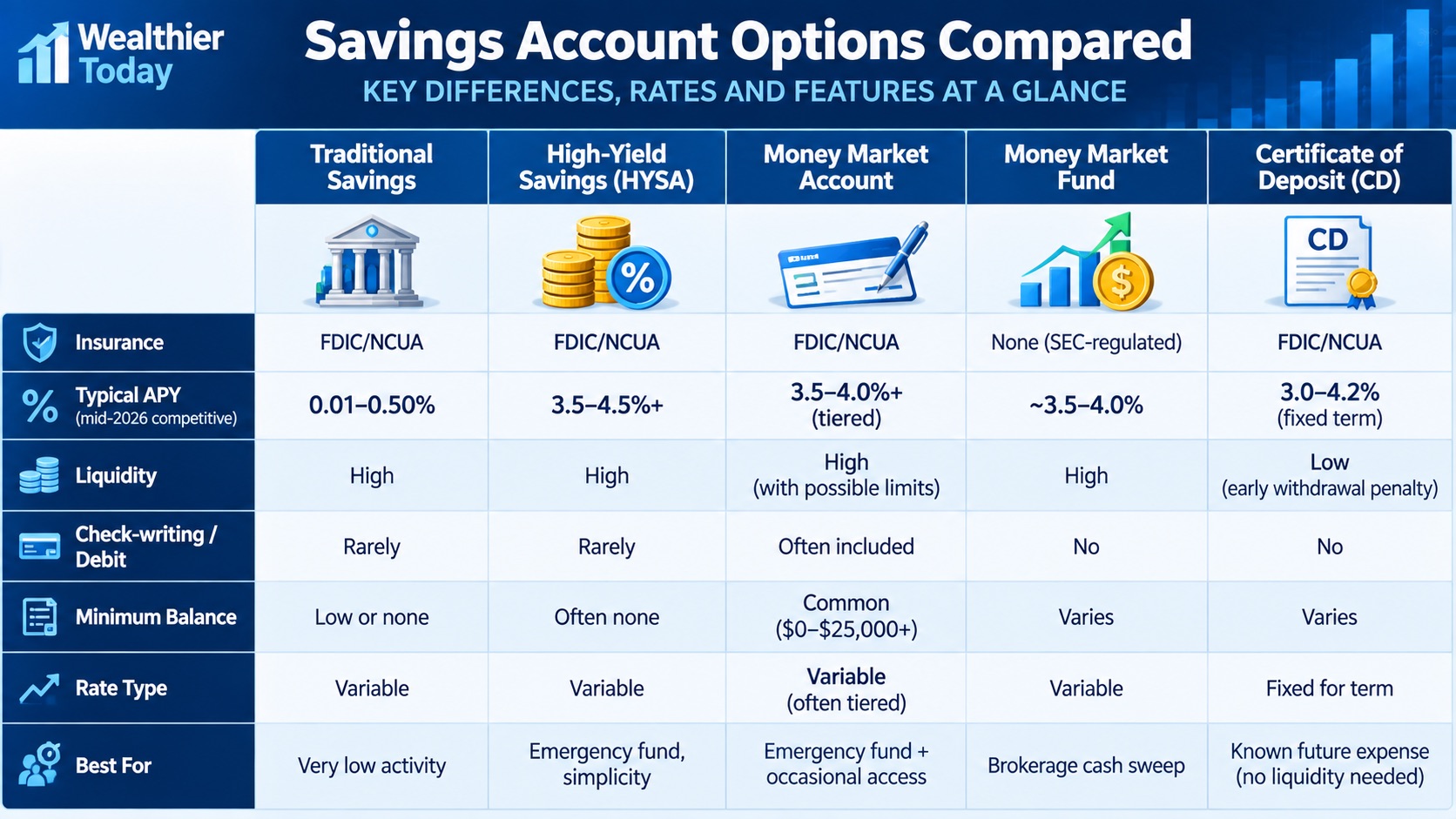
Key takeaways from the comparison:
- If you rarely need to write checks or swipe a debit card from your savings, a strong HYSA may be simpler and equally (or more) competitive on rate.
- MMAs shine when you want some spending flexibility without moving money to checking first.
- Never confuse an MMA (safe, insured deposit) with a money market fund (investment product with different risks).
Pros and Cons of Money Market Accounts
Pros
- Generally higher yields than traditional bank savings.
- Convenient access via checks or debit (when offered).
- Principal safety through federal deposit insurance.
- Easy to open and manage online in most cases.
- No early withdrawal penalties like CDs.
Cons
- Rates are variable and can decline when the Federal Reserve cuts rates (as seen in 2025).
- Many accounts have minimum balance requirements that trigger lower rates or fees if breached.
- Transaction limits may still apply at some institutions.
- Not ideal for long-term wealth building (inflation can erode purchasing power over many years).
- Opportunity cost if a higher-yielding alternative exists that meets your liquidity needs.
How to Choose the Right Money Market Account
Use this checklist before applying:
- Compare total value, not just headline APY — Look at the rate you will actually earn based on your expected balance. Tiered rates can make a big difference.
- Minimums and fees — What is the opening deposit? What ongoing balance is required to earn the top rate or avoid monthly fees?
- Access features — Do you need check-writing or a debit card? How many transactions are allowed before fees?
- Insurance and institution strength — Confirm FDIC or NCUA coverage. Read recent customer reviews for service and reliability.
- Online experience — Most people open and manage these accounts digitally. Test the app/website if possible.
- Credit union vs. bank — Credit unions sometimes offer better rates but may require membership (often easy to qualify for via donation or location/employer ties).
- Current rate environment — In mid-2026, after Federal Reserve cuts in 2025, competitive MMAs were in the 3.5–4.0%+ APY range. Always verify current offers directly.
Pro tip: Use aggregator sites for initial research, then go straight to the bank or credit union website to confirm terms and apply. Rates and requirements change frequently.
Step-by-Step: How to Open a Money Market Account
Opening an MMA is straightforward and usually takes 10–20 minutes online.
-
Shop and decide
Use the checklist above. Narrow it to 2–3 strong options that match your balance and access needs. -
Gather your information
- Government-issued photo ID (driver’s license or passport)
- Social Security number
- Current address and contact details
- Employment and income information (sometimes requested)
- Routing and account number if funding from an existing bank
-
Complete the application
Most institutions let you apply fully online or via app. You’ll create login credentials and answer basic questions. Credit unions may ask you to establish membership first.
-
Fund the account
Link an external checking or savings account for an ACH transfer (usually free and takes 1–3 business days). Some allow immediate funding via debit card, wire, or check. Meet any minimum opening deposit. -
Set up post-opening
- Enable online banking and mobile app access
- Turn on low-balance alerts
- Order checks or request a debit card if offered
- Add a beneficiary or payable-on-death (POD) designation for estate planning
- Link the account to your budgeting tools or main checking account
-
Monitor and optimize
Check your rate periodically. If it drops significantly or a better option appears, transferring to a new MMA is usually simple and penalty-free.
Common Beginner Mistakes to Avoid
- Opening an account with high minimums you’re unlikely to maintain consistently.
- Assuming all MMAs include robust check-writing and debit access (some online versions are more limited).
- Confusing money market accounts (insured deposits) with money market funds (investments).
- Ignoring tiered rate structures and accidentally earning far less than advertised.
- Leaving money in a near-zero traditional savings account out of habit when better options exist.
- Not reading the fee schedule — especially monthly maintenance or excessive transaction fees.
Money Market Accounts in Your Overall Financial Plan
MMAs work best as part of a deliberate cash strategy rather than a default parking spot.
Good uses:
- Emergency fund (typically 3–6 months of essential expenses) where you want some liquidity without full checking features.
- Short-term goals (6–24 months) such as a home down payment, vehicle, or major home repair.
- A “buffer” account between checking and longer-term investments.
Less ideal uses:
- Long-term growth (stocks, bonds, or retirement accounts have historically delivered much higher returns).
- Money you won’t touch for 3+ years (consider CDs or other vehicles for portions you can lock up).
2026 context: With interest rates lower than the 2023–2024 peak but still well above pre-2022 levels, competitive MMAs and HYSAs remain attractive places to hold cash you need to keep safe and accessible. Many people maintain both a core emergency fund in a high-yield option and smaller “opportunity” buckets in accounts with convenient access.
Final Thoughts
A money market account is not a magic wealth-building tool, but it is a simple, low-risk upgrade for cash that would otherwise earn almost nothing. The biggest wins come from choosing an account that matches your balance, access needs, and tolerance for minimum requirements — then actually funding it and letting compound interest do its work.
Shop a few strong options, confirm the fine print on rates and fees, open the account, and set up simple alerts. Your future self will thank you for making your cash work harder with very little ongoing effort.
Ready to take the next step? Compare current offers from reputable banks and credit unions, gather your ID and funding details, and open an account that aligns with your goals. Small improvements in where you hold cash add up over time.
Frequently asked questions
What is a money market account?
A money market account (MMA) is a type of FDIC- or NCUA-insured deposit account offered by banks and credit unions. It typically pays a variable interest rate that is often higher than traditional savings accounts and usually includes check-writing privileges and/or a debit card for easier access than most savings accounts.
Are money market accounts safe?
Yes. Money market accounts at banks are FDIC-insured up to $250,000 per depositor, per institution, per ownership category. Credit union MMAs are NCUA-insured to the same limit. Your principal is protected as long as you stay within insurance limits.
What are the typical requirements to open a money market account?
Most require basic identification (government-issued ID and Social Security number), proof of address in some cases, and an opening deposit that can range from $0 to several thousand dollars depending on the institution. There is usually no credit check. Credit unions may require you to join first.
Can I write checks or use a debit card with a money market account?
Many money market accounts include limited check-writing and a debit or ATM card. This is one of the main differences from traditional savings accounts. However, some online-focused MMAs offer fewer or no check/debit features—always confirm before opening.
How do interest rates on money market accounts work?
Rates are variable and can change at any time based on broader market conditions and Federal Reserve policy. Many accounts use tiered rates, paying higher APYs on larger balances. Competitive MMAs in mid-2026 were offering top rates in the roughly 3.5–4.0%+ APY range, though this fluctuates.
Is a money market account better than a high-yield savings account?
It depends on your needs. Money market accounts often provide check-writing or debit access that high-yield savings accounts (HYSAs) usually lack. However, some HYSAs currently match or beat MMA rates with lower (or no) minimum balance requirements. Choose based on whether you value the extra access features.
What happens if my balance falls below the minimum?
You may earn a lower interest rate tier, get hit with monthly maintenance fees, or both. Some accounts charge fees only if you drop below a required minimum balance. Always read the fee schedule and set up balance alerts.
Continue reading
More resources
- InvestingWhat is Investing?Saving helps you achieve your financial goals. Investing helps you grow your savings.Read next
- MoneyWhat Is Wealth Management? Services, Fees, and How It WorksWealth management is holistic financial planning for people with complex finances—covering investments, taxes, estates, retirement, and risk. Learn services, typical fees, asset minimums, and how to choose a fiduciary.Read next
- Personal FinanceHow To Budget Your Money And Stop Living Paycheck To PaycheckThis is a practical evergreen guide to building a paycheck-based budget, breaking the cash-flow cycle, trimming leaks, handling debt, and creating breathing room.Read next
- InvestingThe Ultimate Beginner's Guide to Buying Treasury BillsTreasury bills are one of the safest, most accessible ways for beginners to earn a predictable return on cash. Learn exactly how to buy T-bills directly from the U.S. government or through a broker, compare them to savings accounts and CDs, understand tax advantages, and build simple strategies that fit your goals.Read next