
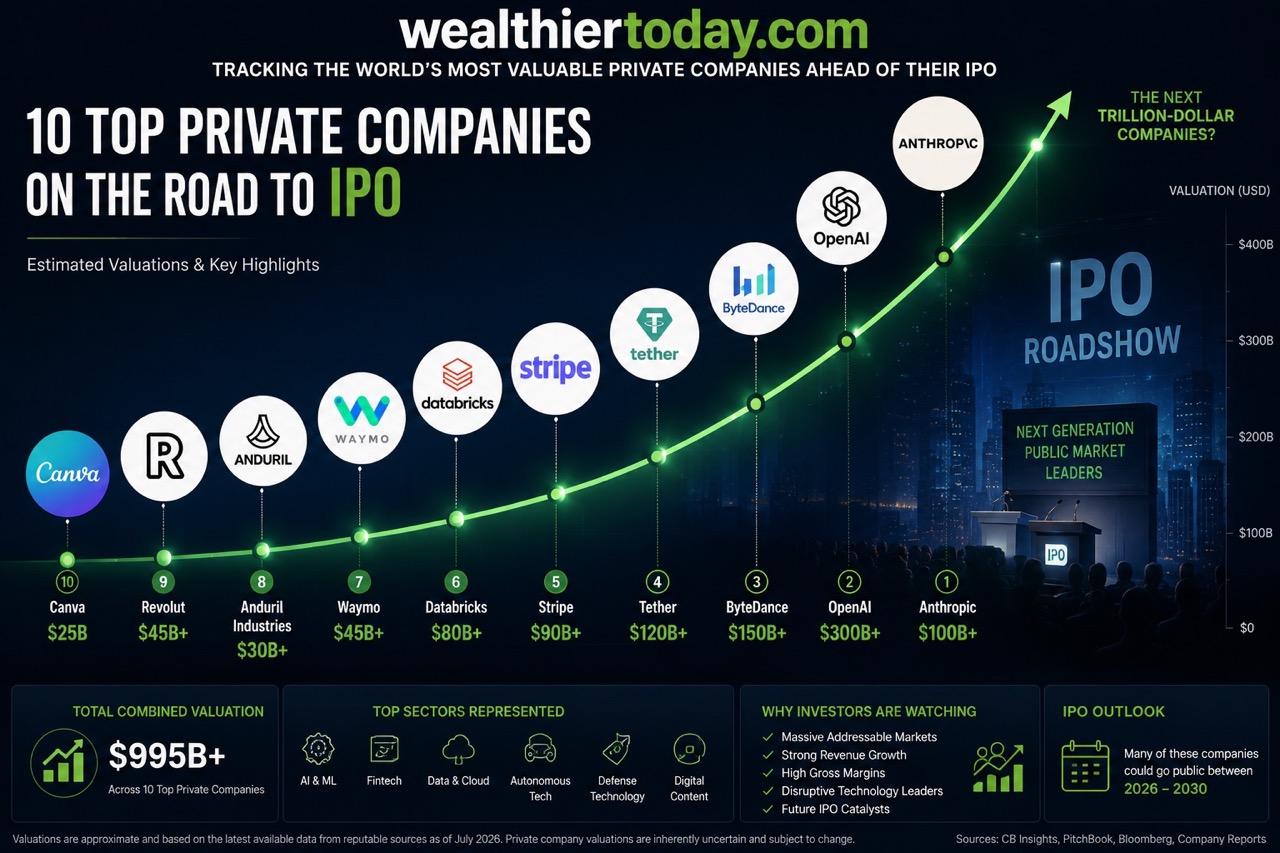
The world’s biggest private companies are still racing toward an IPO, and in 2026, the gap between valuation and transparency is wider than ever. Some are already posting billions of dollars in revenue, while others are still burning cash. In a few cases, the market has enough data to sketch the economics. In others, the numbers are estimates, not audited disclosures. But investors are looking at one thing, and that is the possibility of future growth.
Below is a fresh look at 10 of the most-watched private companies that have not yet been publicly listed (IPO). As expected, valuations move quickly in private markets, so the figures below should be read as the latest widely reported or company-disclosed figures available at the time of this report.
10 Private Companies Investors Are Watching For An IPO
Private company rankings are usually driven by valuation, not revenue, because a company can be worth more on paper than many public blue chips. This is even if its profit picture is thin or undisclosed. The most useful lens is a blended one, which is used in this report, including valuation, revenue, profitability, and the operating story behind both.
1) Anthropic
- Valuation: About $965 billion according to recent market coverage and secondary reporting
- Revenue: Reuters reported annualized revenue of about $31 billion in May 2026, based on first-half figures and company disclosures cited in the piece
- Profit: Anthropic expects $559 million in adjusted operating profit for one quarter, its first profitable quarter on that basis
- Why it matters: At nearly 30x annualized revenue in some estimates, Anthropic is being priced like a category-defining platform, not just a fast-growing startup
2) OpenAI
- Valuation: Roughly $852 billion in market and press estimates
- Revenue: Reuters reported OpenAI topped $25 billion in annualized revenue in March 2026, up from about $21.4 billion at the end of 2025
- Profit: Not publicly disclosed; multiple reports indicate the company remains heavily investment-led
- Why it matters: OpenAI is one of the clearest examples of a private company's story where revenue scale is real, but margin visibility is limited before an IPO filing
3) ByteDance
- Valuation: Roughly $480 billion in recent private-market reporting
- Revenue: Widely cited private-market estimates put annual revenue well above $100 billion. However, ByteDance does not publish full audited public results
- Profit: Not publicly disclosed in a way that is comparable to a listed peer
- Why it matters: ByteDance is one of the few consumer internet giants still outside public markets, and its mix of TikTok, Chinese regulatory risk, and geopolitics keeps the IPO question complicated
4) Tether (USDT)
- Valuation: roughly $500 billion in recent private-market coverage
- Revenue: Tether has said it earns from reserve income and related activities, but it does not publish a traditional operating revenue line like a public software company
- Profit: The company has claimed substantial profits in past statements, but standardized net income is hard to verify from public filings
- Why it matters: Tether is unlike most private companies on this list because its economics are tied to stablecoin reserves rather than enterprise software or hardware sales
5) Stripe
- Valuation: $159 billion in a 2025 tender offer announced by the company
- Revenue: Stripe said businesses running on its platform generated $1.9 trillion in total payment volume in 2025, up 34% from 2024
- Profit: Stripe said it remained “robustly profitable” in its 2025 annual letter
- Why it matters: Stripe is already operating at public-company scale, which makes the eventual IPO one of the market’s most anticipated fintech debuts
6) Databricks
- Valuation: About $134 billion in recent private-market rankings
- Revenue: Estimated at around $4.8 billion in the cited valuation and revenue tables
- Profit: Not publicly disclosed
- Why it matters: Databricks sits at the center of enterprise data infrastructure and AI tooling, a category where buyers still reward growth over near-term earnings
7) Waymo
- Valuation: About $126 billion in recent rankings
- Revenue: Not broadly disclosed; business lines are still scaling across robotaxi and autonomy services
- Profit: Not publicly disclosed
- Why it matters: Waymo’s challenge is not only technology, but unit economics. Autonomous driving can create massive revenue potential while remaining cash-intensive for years
IPO Watchlist: Anduril, Revolut, Canva, and Epic Games
Anduril, a defense technology company, announced a $5 billion Series H at a $61 billion valuation in May 2026.
- Revenue: Anduril said it generated $2.2 billion in 2025 revenue
- Profit: Not publicly disclosed, but coverage from Sacra says the company is projecting an operating loss of about $1.2 billion in 2026
- Contract backdrop: The U.S. Army said on 2026-03-13 it awarded Anduril an enterprise contract with a ceiling of up to $20 billion, though that figure is the maximum potential value, not an obligated amount
- Why it matters: Anduril is one of the few private companies where defense spending, manufacturing scale, and software lock-in all intersect. That makes it a high-upside IPO candidate, but also one with procurement and execution risk
9) Revolut
- Valuation: About $75 billion in recent private-market reporting
- Revenue: Not always disclosed in full, but recent private-market tables place annual revenue in the multi-billion-dollar range
- Profit: Not fully public; fintech profitability can swing sharply with credit, trading, and deposit income
- Why it matters: Revolut has become the most important European fintech IPO watch name, especially as investors compare growth against compliance costs and banking regulation
10) Canva
- Valuation: About $42 billion in recent private-market reporting
- Revenue: About $2 billion is commonly cited in private-market data tables
- Profit: Not publicly disclosed in a fully audited format
- Why it matters: Canva is a reminder that software businesses can scale to huge revenue while remaining private for years, especially if they want to avoid public-market scrutiny before margins stabilize
Bonus company: Epic Games
Epic Games often appears in the same IPO discussion even when it is not near a filing. Recent private-market tables have placed it around $47 billion with about $5.7 billion in revenue, reflecting the strength of gaming, engine tools, and the Fortnite ecosystem.
Editor Note: Private-company revenue and profit figures are often estimated or selectively disclosed. Where companies did not publish audited statements, this article uses company releases and reputable reporting from Reuters, TechCrunch, and official government or company sources. Valuations listed in this article may change after later rounds or secondary transactions carried out by the companies.
Tags
Continue reading
More resources
- Artificial IntelligenceHow To Use AI To Create Multiple Passive Income Streams For YourselfAI tools have collapsed the time and cost barriers to building digital assets and automated systems. Learn how to strategically stack multiple AI-powered income streams for diversification, realistic timelines, and durable wealth building, without the hype.Read next
- InvestingWhat is Investing?Saving helps you achieve your financial goals. Investing helps you grow your savings.Read next
- InvestingBest Investment Strategies for 2026This guide compares the best investment strategies for beginners and long-term investors, including index investing, asset allocation, dollar-cost averaging, rebalancing, value, growth, dividend, and active investing.Read next
- InvestingRisk vs. Reward: Meaning, Ratio and ExamplesLearn how risk vs. reward works, how to calculate a risk-reward ratio, and how to decide whether an investment's potential return is worth the risk.Read next