
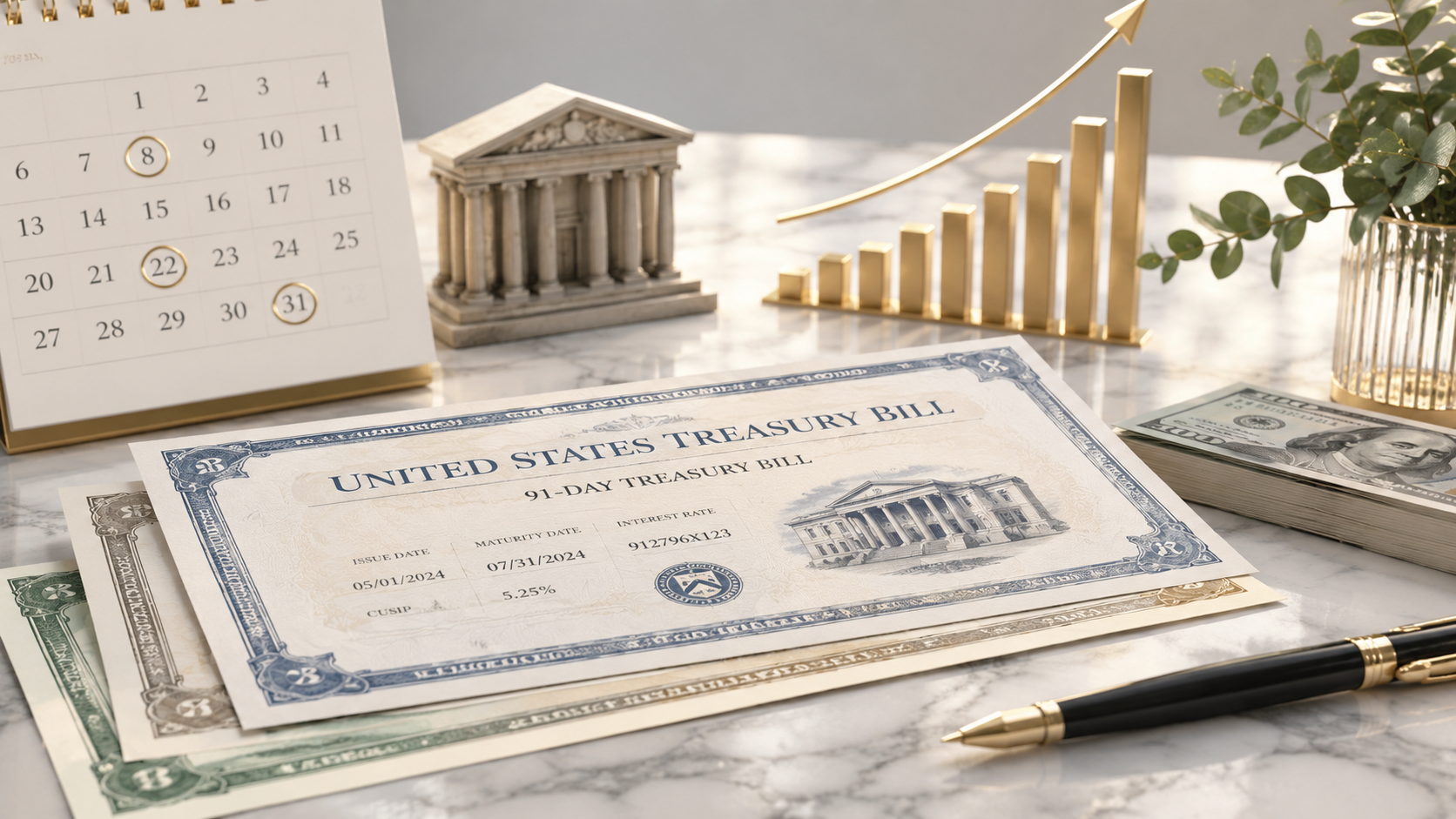
Treasury bills (T-bills) are short-term U.S. government debt securities that offer beginners one of the simplest and safest ways to earn a return on cash. Unlike stocks or even many bonds, T-bills have virtually no default risk when held to maturity because they are backed by the full faith and credit of the United States government.
They are sold at a discount to face value and mature at full face value—the difference is your return. Maturities typically range from 4 weeks to 52 weeks, making them ideal for short-term goals, emergency fund portions, or cash you want to keep productive while waiting for better long-term opportunities.
This guide covers everything a beginner needs: how T-bills work, where and how to buy them (step-by-step), comparisons to other safe options, tax treatment, risks to understand, and practical strategies like laddering. Whether you are parking cash for a house down payment in nine months or simply want a stable foundation alongside growth assets, T-bills deserve a place in most financial plans.
What Are Treasury Bills and How Do They Work?
Treasury bills are zero-coupon securities. You buy them below face value (the amount you will receive at maturity) and the government pays you the full face value when the bill matures. There are no periodic interest payments.
Key characteristics:
- Maturities: Common terms include 4-week, 8-week, 13-week, 17-week, 26-week, and 52-week bills. The Treasury also issues cash management bills on an as-needed basis.
- Pricing: Sold at auction on a discount basis. For example, a $1,000 face-value 26-week bill might be purchased for $980. At maturity you receive $1,000—the $20 difference is your return.
- Yield calculation: The return is determined by the discount and the time to maturity. The Treasury reports results using discount rate, investment rate, and price per $100.
- Minimum purchase: $100 face value, in $100 increments. Maximum per auction for non-competitive bids is typically $10 million.
- Liquidity: You can sell before maturity on the secondary market through a broker, though most beginners hold to maturity to avoid price volatility.
T-bills are issued electronically only—no paper certificates.
Why Beginners Should Consider Treasury Bills
T-bills solve a common problem: how to keep cash safe and earning something better than a traditional savings account while maintaining low risk.
Primary advantages for beginners:
- Extremely high safety when held to maturity.
- Predictable outcome—you know exactly how much you will receive on a specific date.
- State and local tax exemption on earnings (federal tax still applies).
- Low minimum investment and straightforward process.
- Excellent liquidity via secondary market if needed (though best held to term).
- No credit risk or company-specific risk.
They are especially useful in higher interest rate environments when short-term government yields are competitive with bank products but offer better tax treatment in many states.
T-Bills vs. High-Yield Savings Accounts vs. CDs vs. Money Market Funds
Choosing the right cash vehicle depends on your time horizon, tax situation, need for liquidity, and desire for predictability.
| Feature | Treasury Bills | High-Yield Savings Account | Certificates of Deposit (CDs) | Government Money Market Funds |
|---|---|---|---|---|
| Safety | U.S. government backed (highest) | FDIC insured up to $250k | FDIC insured up to $250k | Not FDIC; SIPC + underlying gov securities |
| Liquidity | High if held to maturity; secondary market available | Instant or same-day | Penalty for early withdrawal | Same-day or next-day |
| Yield Type | Fixed (discount to face value) | Variable (changes with Fed) | Fixed for term | Variable (7-day yield) |
| State & Local Tax | Exempt | Fully taxable | Fully taxable | Usually taxable |
| Minimum Investment | $100 | Often $0–$25 | Often $500–$1,000 | Often $1–$3,000 |
| Fees | None on TreasuryDirect | Usually none | Early withdrawal penalty | Low expense ratio |
| Best For | Short-term goals (1–12 months), tax-aware cash, laddering | Emergency funds, immediate access | Locking in rates when you won't need money | Brokerage cash sweep, very short-term parking |
| Main Risk | Selling early (price fluctuation) | Rate can fall | Early withdrawal penalty + opportunity cost | Not principal guaranteed (though very stable) |
Key insight: In high-tax states, a T-bill yielding slightly less than a HYSA on a pre-tax basis can deliver more after-tax income. In low- or no-tax states, the liquidity and simplicity of a top HYSA often wins for true emergency cash.
How to Buy Treasury Bills on TreasuryDirect.gov (Step-by-Step)
TreasuryDirect.gov is the official U.S. Treasury platform for buying new-issue securities directly with no fees. It is the most straightforward route for most beginners.
Before you start, gather:
- Social Security Number or Taxpayer ID
- U.S. residential address
- Email address
- Checking or savings account information (routing and account numbers)
Step 1: Create and verify your TreasuryDirect account Visit TreasuryDirect.gov and click to create a new account. The process includes identity verification (often through ID.me or similar secure service). This can take a few minutes to a few days depending on verification method.
Step 2: Link your bank account You must link a bank account in your name for funding purchases and receiving maturity proceeds. This is a one-time setup with small test deposits for verification.
Step 3: Navigate to BuyDirect Log in → Select “BuyDirect” from the menu → Choose “Bills – Short-term securities of 1 year or less” → Submit.
Step 4: Select the auction and term You will see upcoming auctions with term length, auction date, issue date, and maturity date. Choose the one that matches your timeline (e.g., a 26-week bill if you need the money in about six months).
Step 5: Enter your bid (non-competitive for beginners)
- Select non-competitive bid (you accept whatever yield the auction produces and are guaranteed to receive the full amount requested).
- Enter the face value amount you want to buy ($100 minimum, $100 increments).
- Choose your linked bank account as the source of funds.
- Review the estimated purchase price (actual price is set at auction).
Step 6: Review, confirm, and submit Double-check all details. Once submitted, you cannot change a non-competitive bid. Funds are typically debited on the issue date (usually a few days after auction).
Step 7: Manage your holdings After purchase, the bill appears in your TreasuryDirect account. At maturity, proceeds are automatically credited to your linked bank account (or you can reinvest/roll into new securities).
Pro tips for TreasuryDirect:
- Auctions have deadlines—submit early.
- Non-competitive bids are best for beginners (competitive bidding is for institutions and advanced users who specify a maximum discount rate).
- You can view upcoming auction schedules on the site.
- Account has purchase limits per auction and per security type.
Buying Treasury Bills Through a Brokerage or Bank
If you already have a brokerage account (Fidelity, Charles Schwab, Vanguard, etc.), buying Treasuries there is often more convenient.
Advantages of brokerage route:
- Can buy both new-issue (auction) and secondary market T-bills.
- Easier to sell before maturity if needed.
- Often integrated with other investments and automatic reinvestment tools.
- Some platforms now offer “Treasury accounts” or auto-laddering features that handle purchases and rollovers for you.
- May support buying inside IRAs or other tax-advantaged accounts easily.
Process overview:
- Log into your brokerage.
- Go to Fixed Income, Bonds, or Treasuries section.
- Search for T-bills or new issues.
- Choose competitive or non-competitive (most retail use non-competitive or simply buy at the auction price the broker provides).
- Enter quantity and confirm.
Many brokerages have eliminated or minimized commissions on U.S. Treasuries. Minimums are often $1,000 or higher for some secondary market lots, but new issues are generally accessible at lower amounts.
Secondary market note: Prices fluctuate daily based on interest rates. If you sell before maturity you may get more or less than you paid.
Easy Hands-Off Option: T-Bill ETFs
For maximum simplicity, consider short-term Treasury ETFs such as:
- SPDR Bloomberg 1-3 Month T-Bill ETF (BIL)
- iShares 0-3 Month Treasury Bond ETF (SGOV)
- iShares Short Treasury Bond ETF (SHV)
These trade like stocks in any brokerage account, have very low expense ratios, and provide instant liquidity. They hold portfolios of T-bills that roll continuously. They are not identical to holding individual bills to maturity (you get the ETF’s yield, not a locked discount), but they are excellent for beginners who want T-bill exposure without managing auctions or maturities.
Building a Treasury Bill Ladder (Simple Advanced Strategy)
A T-bill ladder staggers purchases across different maturities so you have regular liquidity events without sacrificing all yield to the shortest term.
Example 6-month ladder (adjust based on your timeline):
- Buy a 4-week bill
- Buy a 13-week bill
- Buy a 26-week bill
As each matures, reinvest into a new bill at the longest rung of your ladder. This smooths reinvestment risk and gives you cash available every few weeks or months.
Ladders are easy to implement on TreasuryDirect or (more conveniently) inside a brokerage that supports Treasury trading or has ladder tools.
Tax Treatment of Treasury Bills
Earnings on T-bills (the discount) are taxed as ordinary interest income at the federal level. They are exempt from state and local income taxes. This exemption can be worth 3–10%+ in effective yield depending on your state tax rate.
You will receive a Form 1099-INT from TreasuryDirect or your broker. Report the income on your federal tax return even if you reinvest the proceeds.
Tax tip: In tax-advantaged accounts (IRA, 401(k), etc.), the state tax exemption provides no additional benefit, so compare on a pre-tax basis and consider liquidity needs.
Risks of Treasury Bills (Beyond the “Risk-Free” Label)
While T-bills are among the safest assets, they are not riskless in every scenario:
- Interest rate risk — Selling before maturity when rates have risen can produce a capital loss.
- Reinvestment risk — When bills mature, new bills may offer lower yields.
- Inflation risk — If inflation exceeds your yield, your purchasing power declines.
- Opportunity cost — Cash in T-bills will underperform stocks and Bitcoin over long periods.
- Liquidity friction — While secondary markets exist, transaction costs and bid-ask spreads apply for small lots.
Most of these risks are minimized by buying appropriate terms and planning to hold to maturity.
How Treasury Bills Fit Into a Diversified Portfolio
T-bills excel as the stable, short-term portion of your cash allocation. They pair particularly well with higher-volatility growth assets:
- Keep 3–6 months of expenses in a high-yield savings account for true emergencies (instant access).
- Use T-bills or a ladder for money you know you won’t need for 1–12 months (down payment, planned purchase, etc.).
- Maintain a core position in growth assets (stocks, Bitcoin, etc.) for long-term wealth building.
In uncertain or high-rate environments, T-bills provide ballast and dry powder to deploy when better opportunities appear.
What Happens When Your T-Bill Matures?
On maturity date, the full face value is credited to your linked bank account (TreasuryDirect) or brokerage account. You can then:
- Transfer the cash
- Reinvest/roll into new T-bills or other Treasuries
- Move into longer-term investments
Many platforms offer automatic reinvestment or “rollover” instructions.
Getting Started: Your Action Plan
- Decide how much cash you want in short-term, safe instruments and your time horizon.
- Compare current after-tax yields of T-bills vs. top HYSAs in your state.
- Open or log into TreasuryDirect or your preferred brokerage.
- Start small—buy one bill to learn the process.
- Consider building a simple ladder for ongoing cash flow.
- Re-evaluate every 3–6 months as rates and your goals change.
Treasury bills are not exciting, but they are reliable, government-backed, and beginner-friendly. Used thoughtfully, they help protect and grow the cash portion of your wealth so you can take intelligent risks elsewhere.
Whether you are new to investing or simply looking for a better home for your emergency or short-term reserves, T-bills are worth understanding and using.
Frequently asked questions
Are Treasury bills completely risk-free?
Treasury bills are backed by the full faith and credit of the U.S. government, making default risk extremely low if held to maturity. However, if you sell before maturity on the secondary market, the price can fluctuate with interest rates, so you could realize a loss. They are among the safest investments available for preserving principal when held to term.
What is the minimum amount needed to buy Treasury bills?
You can buy Treasury bills for as little as $100, with additional purchases in $100 increments. This low minimum makes them accessible for beginners building emergency funds or short-term savings goals.
How do Treasury bills compare to high-yield savings accounts?
T-bills offer a fixed yield (bought at a discount) and are exempt from state and local taxes, which can make them more attractive in high-tax states. High-yield savings accounts provide instant liquidity and variable rates that can rise with the Fed but are fully taxable at federal, state, and local levels. T-bills require holding to maturity for full safety and predictability.
Can I lose money on Treasury bills?
If you hold a T-bill to maturity, you receive the full face value with no loss of principal. Losses are possible only if you sell before maturity when interest rates have risen (causing the market price to fall). This is why most beginners plan to hold until the bill matures.
Should I buy Treasury bills directly on TreasuryDirect or through my brokerage?
TreasuryDirect offers fee-free direct purchases from the government with non-competitive bids (ideal for beginners). A brokerage is often more convenient if you already have an account there—it may support secondary market trading, easier reinvestment, and tools, though some charge small fees or have higher minimums. Many beginners start with whichever platform they already use.
How are Treasury bill earnings taxed?
The discount (your earnings) is subject to federal income tax but is exempt from state and local income taxes. This state-tax exemption is a key advantage in high-tax states like California or New York. You will receive a 1099-INT form reporting the income.
What is a Treasury bill ladder and why use one?
A T-bill ladder involves buying bills with staggered maturity dates (e.g., 4-week, 13-week, 26-week) so a portion matures regularly. This provides ongoing liquidity, reduces reinvestment risk, and lets you capture yields across different terms. It is a simple, low-maintenance strategy popular with conservative investors.
Continue reading
More resources
- InvestingWhat is Investing?Saving helps you achieve your financial goals. Investing helps you grow your savings.Read next
- MoneyWhat Is Wealth Management? Services, Fees, and How It WorksWealth management is holistic financial planning for people with complex finances—covering investments, taxes, estates, retirement, and risk. Learn services, typical fees, asset minimums, and how to choose a fiduciary.Read next
- MoneyHow To Budget Your Money And Stop Living Paycheck To PaycheckThis is a practical evergreen guide to building a paycheck-based budget, breaking the cash-flow cycle, trimming leaks, handling debt, and creating breathing room.Read next
- InvestingInvesting for Dummies: Best Investments for BeginnersThis is a simplified guide to the best investments for beginners, including index funds, target-date funds, retirement accounts, savings, bonds, and simple starter portfolios.Read next