
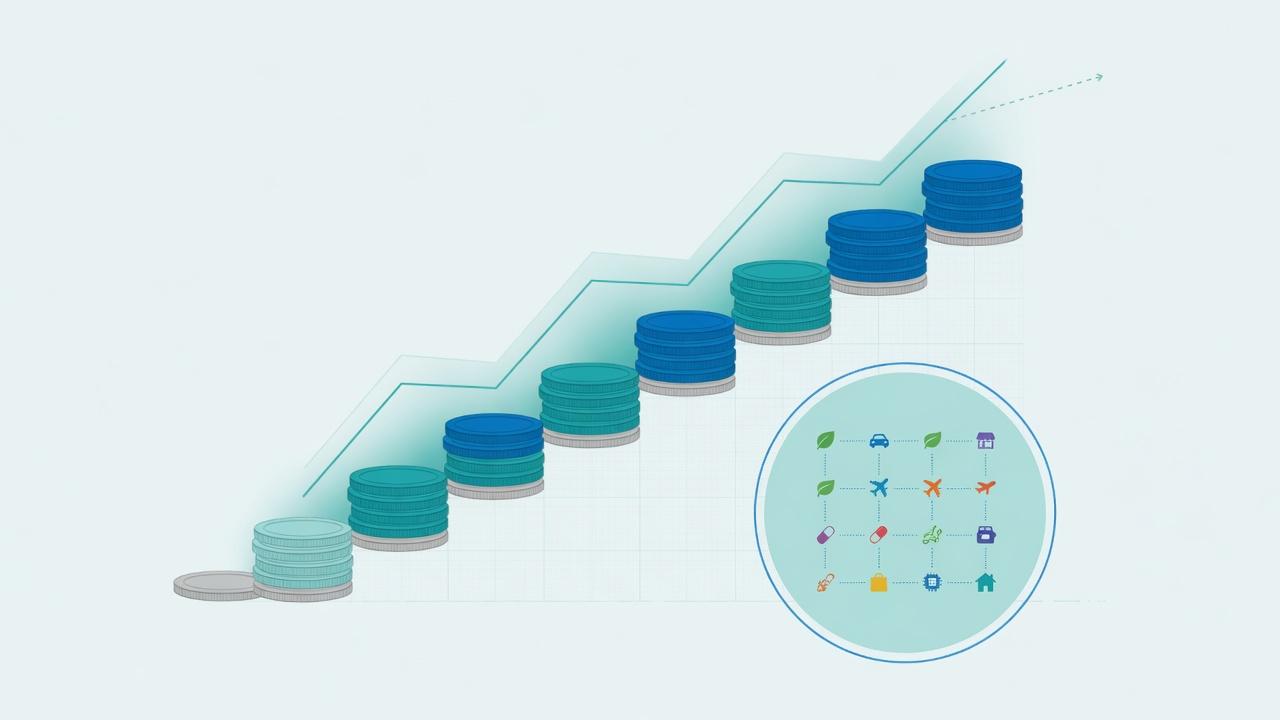
Building wealth from scratch with index funds is less about finding a secret fund and more about installing a system: create a surplus, protect it, buy broad ownership on a schedule, and leave compounding alone long enough to matter.
That system is available to people who are not starting with a large inheritance, a six-figure windfall, or a finance degree. Index funds let you own hundreds or thousands of companies in one purchase, pay low fees, and automate the process. The trade-off is patience. Index funds do not promise excitement. They promise a process that works if you keep funding it.
This guide is designed for beginners and late starters who want a practical path from zero, or near zero, to a durable investment base. It covers the foundation work most "best index fund" articles skip, the account order that can improve after-tax results, simple portfolios you can actually maintain, and the behavioral rules that decide whether the plan survives the next market crash.
If you want the broader wealth framework first, start with our guide on how to build wealth from scratch. If you want a general beginner map of accounts and starter investments, see investing for beginners. This article goes deeper on the index-fund engine itself.
Why Index Funds Are a Strong Wealth Engine From Zero
An index fund is a mutual fund or ETF designed to track a market index rather than beat it. Common examples include the S&P 500, the total U.S. stock market, international stock markets, and broad bond markets. You cannot buy an index directly. You buy a fund that owns the securities in that index, or a representative sample of them.
That structure is powerful for first-generation wealth builders for five reasons:
- Instant diversification. One fund can spread your money across many companies, sectors, and sometimes countries.
- Low cost. Passive funds usually charge much less than actively managed funds, and lower fees leave more return for you.
- Low skill barrier. You do not need to analyze balance sheets or time earnings calls to own the market.
- Easy automation. You can invest on payday and remove decision fatigue.
- Behavioral durability. A simple portfolio is easier to hold through fear, boredom, and FOMO.
Investor.gov explains asset allocation as dividing investments among stocks, bonds, and cash based on time horizon and risk tolerance. Index funds make that allocation easier because each fund can represent an entire asset class.
The key idea is ownership. Every month you invest in a broad stock index fund, you are converting earned income into a claim on the productive capacity of many businesses. Over decades, that ownership has historically been one of the strongest ways ordinary households build wealth.
The From-Scratch Sequence Most People Skip
Index funds work best after a short foundation sequence. Skipping the foundation is how people invest during a good month, then liquidate during a car repair, job gap, or credit card crisis.
Use this order:
| Priority | Action | Why it comes first |
|---|---|---|
| 1 | Build positive monthly cash flow | No surplus means no durable investing system |
| 2 | Create a starter emergency buffer | Prevents forced selling and new high-interest debt |
| 3 | Attack expensive consumer debt | High APRs can outrun market returns |
| 4 | Capture free employer match | Often the highest risk-adjusted "return" available |
| 5 | Automate index fund contributions | Turns investing into a default, not a mood |
| 6 | Raise the savings rate over time | Contribution size dominates early compounding |
| 7 | Rebalance and protect the plan | Keeps risk and taxes from drifting off course |
If your income barely covers expenses, the first wealth move is not fund selection. It is cash flow. Read our guides on how to budget and paying off debt fast before you force long-term money into the market.
A simple starter rule:
- If credit card or payday debt is growing, stabilize that first.
- If you have no cash buffer, save a small emergency fund while capturing any employer match.
- If the foundation is stable, automate index fund investing immediately rather than waiting for perfect confidence.
How Much Can Index Funds Grow? The Math That Matters
The early years of wealth building are dominated by how much you contribute. Later years are increasingly dominated by compounding. That is why people who wait for a "better market" or a "bigger paycheck" often stay stuck.
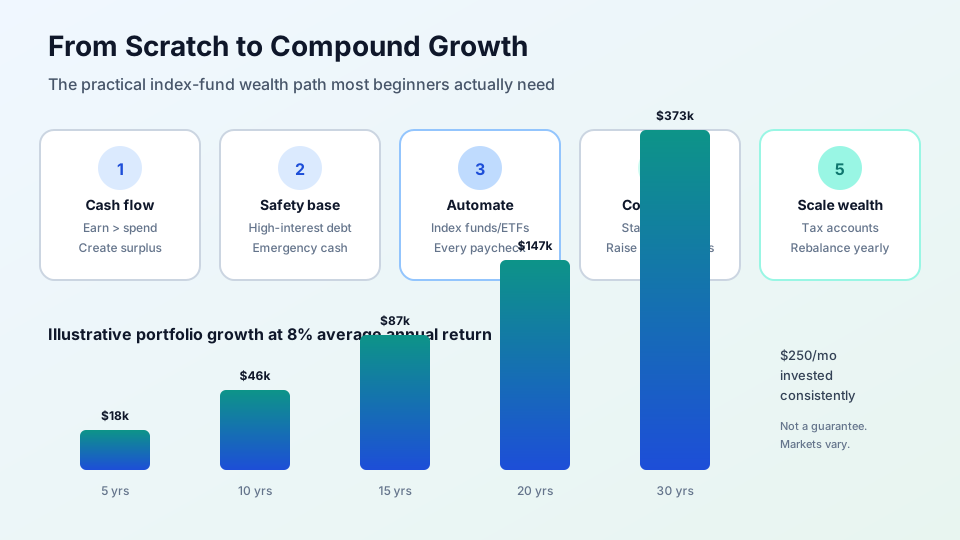
These examples assume monthly contributions and an 8% average annual return. They are illustrations, not forecasts. Real markets bounce, fees and taxes reduce returns, and future results can be higher or lower.
| Monthly investment | After 10 years | After 20 years | After 30 years |
|---|---|---|---|
| $50 | About $9,100 | About $29,500 | About $74,500 |
| $100 | About $18,300 | About $59,000 | About $149,000 |
| $250 | About $45,700 | About $147,000 | About $373,000 |
| $500 | About $91,500 | About $295,000 | About $745,000 |
| $1,000 | About $183,000 | About $589,000 | About $1.49 million |
What the table teaches:
- Small starts are valid. $50 or $100 a month builds the habit and the account structure.
- Raises matter more than fund tinkering. Moving from $100 to $250 a month changes the outcome far more than swapping one excellent S&P 500 fund for another.
- Time is a force multiplier. The biggest jump often happens in the later decades because returns begin compounding on a larger base.
Use our compound interest calculator with your real contribution number. Then use the FIRE calculator if your goal is financial independence rather than a generic "someday."
What Kind of Index Fund Should You Own?
Not all index funds serve the same job. The right choice depends on your goal, time horizon, and how much complexity you want.
Core growth funds
These are the main wealth engines for long time horizons:
| Fund type | What it owns | Best for | Trade-off |
|---|---|---|---|
| S&P 500 index fund/ETF | About 500 large U.S. companies | Simple U.S. large-cap growth | Misses smaller U.S. and international companies |
| Total U.S. stock market fund/ETF | Large, mid, and small U.S. companies | Broad domestic ownership in one fund | Still U.S.-only unless you add more |
| Total world or global stock fund/ETF | U.S. plus international stocks | One-fund global equity exposure | Can lag a pure U.S. fund for long stretches |
| International stock fund/ETF | Companies outside the U.S. | Diversification beyond one country | Currency and regional cycles can frustrate investors |
Stability funds
These reduce volatility when your time horizon shortens or your risk tolerance is lower:
- Total U.S. bond market index funds
- Intermediate Treasury funds
- Short-term bond funds for money needed sooner
- Balanced or target-date funds that already include bonds
One-fund simplicity options
- Target-date funds: Automatically shift from stocks toward bonds as the target year approaches.
- Balanced index funds: Maintain a stock/bond mix, such as 60/40, in one holding.
For a deeper comparison of long-horizon options, see best long-term investments. For risk framing, see our risk and reward guide.
Simple Portfolios You Can Build From Scratch
You do not need ten funds. You need a portfolio you will still hold after a 20% to 40% drawdown.
Portfolio A: One-fund beginner plan
- 100% target-date fund near your expected retirement year
Best if you want maximum simplicity and automatic rebalancing.
Portfolio B: One equity fund plan
- 100% total U.S. stock market fund or S&P 500 fund
Best if your time horizon is long, your emergency fund is solid, and you can tolerate large swings. Many wealth builders use this while young, then add bonds later.
Portfolio C: Two-fund global plan
- 70% to 90% total U.S. stock market
- 10% to 30% total international stock market
Best if you want global diversification without managing bonds yet.
Portfolio D: Classic three-fund plan
- 60% to 80% total U.S. stock market
- 10% to 30% international stocks
- 10% to 30% total bond market
Best if you want a durable, Bogleheads-style core that you can maintain for decades.
Portfolio E: Hands-off balanced plan
- 100% balanced index fund or a conservative target-date fund
Best if large stock drawdowns would cause you to sell.
A useful rule: the best portfolio is the one you can keep funding during boring years and hold during bad years. Complexity is only useful if it improves diversification, risk control, taxes, or behavior.
The Account Waterfall: Where Index Funds Belong First
Buying the right fund in the wrong account can waste tax advantages. Buying the right fund with money you need next year can force a sale at the worst time. Account choice is part of the strategy.
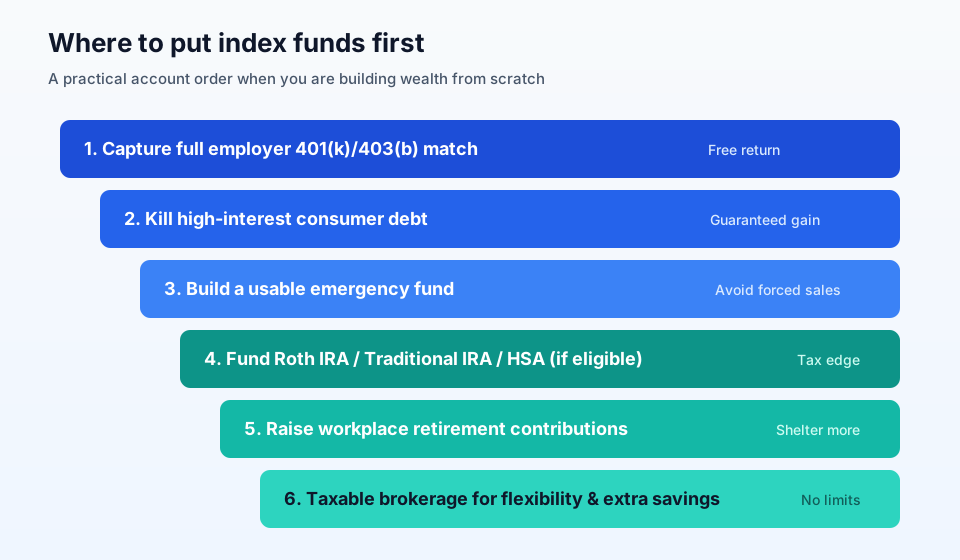
Practical order for most people building from scratch
- Contribute enough to get the full employer match in a 401(k), 403(b), or similar plan.
- Pay down high-interest consumer debt that compounds against you.
- Build an emergency fund in cash or a high-yield savings account, not in stock index funds.
- Fund a Roth IRA or traditional IRA if eligible, often with a low-cost index fund or target-date fund.
- Use an HSA for long-term investing if you have a qualifying high-deductible plan and can pay medical costs out of pocket.
- Increase workplace retirement contributions after IRA/HSA space is used or unavailable.
- Open a taxable brokerage account for goals that need flexibility, early retirement support, or savings above annual limits.
For 2026, the IRS set the employee elective deferral limit for 401(k), 403(b), governmental 457 plans, and the federal Thrift Savings Plan at $24,500. The IRA contribution limit is $7,500, with catch-up rules for older savers. Limits change, so verify current numbers before planning large contributions.
Account type cheat sheet
| Account | Main advantage | Main constraint | Good index-fund use |
|---|---|---|---|
| 401(k)/403(b) | Payroll automation, possible match, tax advantages | Limited fund menu, withdrawal rules | Target-date or broad index options |
| Roth IRA | Tax-free qualified withdrawals | Income and contribution limits | Total market, S&P 500, or three-fund mix |
| Traditional IRA | Potential deduction, tax-deferred growth | Income rules for deductibility, RMDs later | Same core index funds |
| HSA | Triple tax advantage when used for medical costs | Needs eligible health plan | Long-term stock index funds if you can leave the money invested |
| Taxable brokerage | Flexible access, no contribution cap | Dividends and capital gains can be taxable | Low-turnover broad ETFs and index funds |
For retirement-specific planning, see investing for retirement. For independence timelines, pair this with the FIRE calculator and our FIRE guide.
Index Mutual Fund vs Index ETF
Both can build wealth. The better wrapper depends on how you invest.
| Feature | Index mutual fund | Index ETF |
|---|---|---|
| Pricing | Once per day after market close | Trades during market hours |
| Automation | Often excellent for automatic investments | Excellent at many brokers, especially with dollar-based buys |
| Minimums | Some funds still have minimums | Often the price of one share, or less with fractional shares |
| Tax efficiency | Can be good | Often very tax efficient in taxable accounts |
| Beginner fit | Great for set-and-forget retirement plans | Great for brokerage accounts and flexible portfolios |
Decision shortcut:
- If your 401(k) only offers mutual funds, use the lowest-cost broad index or target-date fund available.
- If you are opening a brokerage IRA or taxable account, a low-cost index ETF or mutual fund can both work.
- Compare expense ratio, diversification, tracking quality, minimums, and whether your platform supports automatic purchases.
How to Choose a Specific Fund Without Overthinking It
When two funds track the same index, the checklist is short:
- Expense ratio. Investor.gov defines the expense ratio as the percentage of fund assets used each year for operating expenses. Lower is usually better.
- What it actually tracks. S&P 500, total market, international, bonds, and target-date funds are not interchangeable.
- Tracking quality. The fund should closely follow its index after fees.
- Minimum investment and fractional shares. Can you start with the amount you actually have?
- Bid-ask spread for ETFs. Broad, heavily traded ETFs are usually fine.
- Fund availability. The best fund on paper is useless if your 401(k) does not offer it.
Why fees are a wealth issue, not a trivia issue
A 1.00% annual fee may look small next to a 0.03% fee. Over decades, the difference is large because fees compound against you.
Rough illustration on a long-term portfolio:
| Annual fee | Drag on a growing portfolio | Practical meaning |
|---|---|---|
| 0.03% to 0.10% | Low | Typical for strong broad index funds |
| 0.20% to 0.50% | Moderate | Acceptable in some plans, still worth comparing |
| 1.00%+ | High | Can quietly erase a large share of lifetime growth |
If your workplace plan only has mediocre options, capture the match anyway, then use an IRA for cleaner low-cost index funds when possible.
Step-by-Step: How to Start Building Wealth With Index Funds This Month
Step 1: Define the job of the money
Write one sentence:
- "This money is for retirement in 25+ years."
- "This money is for financial independence."
- "This money is general long-term wealth."
If the money is for a home down payment in two years, it does not belong in a stock-heavy index fund. Stock index funds are for long horizons.
Step 2: Set a contribution you can survive
Start with a number that does not break your budget:
- $25 to $50 per paycheck if cash is tight
- 1% to 5% of income if you are stabilizing
- 10% to 20%+ if your foundation is solid
Then schedule automatic increases. A 1% raise in contribution after every salary increase is one of the highest-leverage wealth habits available.
Step 3: Open or use the right account
- Log into your workplace retirement plan and find index or target-date options.
- Open a Roth or traditional IRA at a low-cost broker if eligible.
- Use a taxable brokerage account only after you understand the tax trade-offs, or when you need flexibility.
Step 4: Buy one simple portfolio
Pick Portfolio A, B, C, or D above. Do not wait until you have researched fifty tickers. Broad and low-cost beats delayed and perfect.
Step 5: Automate purchases
Set contributions to happen on payday. This is dollar-cost averaging in real life: you buy more shares when prices are lower and fewer when prices are higher, without needing to predict either.
Step 6: Create a crash rule before the crash
Write this down:
- I will not sell my long-term index funds because of headlines.
- I will check my portfolio no more than quarterly or annually.
- I will keep buying on schedule unless my emergency fund or job situation changes.
Step 7: Review once a year
Annual review checklist:
- Did I capture the full employer match?
- Can I raise contributions?
- Has my time horizon or risk capacity changed?
- Do any funds have high fees I can replace?
- Do I need to rebalance?
That is enough. Wealth from index funds is mostly boring execution.
The First $10,000, $100,000, and Beyond
Milestones help because they change the psychology and the math.
First $1,000 to $10,000
This stage is almost entirely about systems:
- Open the accounts.
- Automate small contributions.
- Learn not to tinker.
- Keep expensive debt from undoing progress.
The portfolio value will feel small. That is normal. You are building infrastructure.
First $100,000
This is the milestone where compounding starts to feel real. A major market move now changes your net worth by thousands, not dozens. The danger is lifestyle inflation and panic selling just as the machine is warming up.
To reach $100,000 faster with index funds:
- Raise your savings rate aggressively after raises.
- Use tax-advantaged accounts.
- Avoid high fees.
- Stay fully invested according to your plan.
- Do not interrupt compounding for speculative side quests.
$100,000 to $1,000,000
At this stage, contribution rate still matters, but time and asset allocation matter more. Many households get here with nothing fancier than:
- Broad stock index funds while young
- Gradual addition of bonds as the goal approaches
- Consistent tax-advantaged contributions
- No major behavioral disasters
If you want a broader asset mix later, keep index funds as the core and use a satellite approach for real estate, individual stocks, or other alternatives. That structure is covered in our investing strategies guide.
Tax Basics That Affect Index-Fund Wealth
Taxes are not the first problem when you are starting from scratch, but they become important as balances grow.
- Tax-advantaged accounts can shelter dividends and capital gains while money stays invested.
- Roth accounts can be powerful if you expect higher taxes later or want tax-free qualified withdrawals.
- Traditional pre-tax accounts can help if you want a deduction now and expect a lower tax rate later.
- Taxable accounts may generate dividends every year and capital gains when you sell.
- Asset location matters later: holding tax-efficient broad equity ETFs in taxable accounts and keeping less tax-efficient assets in sheltered accounts can improve after-tax results.
Do not let tax optimization delay the start. First own low-cost diversified funds. Then improve placement as your system matures. For broader tax context, see what tax is.
Behavioral Edges That Beat Fancy Portfolios
Most underperformance is not caused by choosing VTI instead of VOO. It is caused by behavior.
The five wealth-killing behaviors
- Waiting for the perfect entry. Time in a diversified portfolio usually beats waiting for comfort.
- Checking balances daily. More checking often means more bad decisions.
- Panic selling. Locking in losses converts a temporary decline into a permanent setback.
- Performance chasing. Switching into last year's winner often means buying after the easy gains.
- Lifestyle inflation. Every raise that becomes a new car payment never becomes compound growth.
The five wealth-building behaviors
- Automate contributions on payday.
- Increase investing percentage after every raise.
- Keep an emergency fund so markets do not fund emergencies.
- Rebalance on a schedule, not on fear.
- Measure success by savings rate and process, not one-month returns.
Diversification helps here too. A broad index fund reduces the chance that one company failure ruins your plan, which makes it psychologically easier to stay invested.
When Index Funds Are the Wrong Tool
Index funds are excellent for long-term wealth building. They are the wrong tool when:
- You need the money in the next one to three years.
- You do not have any emergency cash and may be forced to sell.
- High-interest debt is compounding faster than a realistic after-tax market return.
- A stock-heavy fund would cause you to panic-sell in a downturn.
- You are using leverage or speculative options around index products you do not understand.
In those cases, cash, high-yield savings, Treasury bills, CDs, debt payoff, or a more conservative allocation may be the better move. Index funds are a wealth engine, not a parking place for rent money.
Common Mistakes When Building Wealth With Index Funds
Avoid these high-frequency errors:
- Buying five overlapping U.S. stock funds and calling it diversification
- Ignoring expense ratios inside a 401(k)
- Holding long-term index funds while carrying 20%+ APR credit card debt
- Stopping contributions every time the market falls
- Treating meme stocks or crypto as a substitute for a diversified core
- Confusing an account with an investment ("I have a Roth IRA" is not a portfolio)
- Over-rebalancing and creating unnecessary taxes in taxable accounts
- Waiting until you feel expert before making the first automated purchase
A clean beginner default beats a sophisticated plan you abandon.
A 30-Day Action Plan
| Day range | Action | Done looks like |
|---|---|---|
| Days 1 to 3 | Calculate monthly surplus and net worth | You know what you can invest without bouncing bills |
| Days 4 to 7 | Build or top up a starter emergency buffer | At least a small cash cushion exists |
| Days 8 to 10 | List high-interest debts | You know whether debt payoff must come before extra investing |
| Days 11 to 14 | Capture employer match | Payroll contribution is high enough for the full match |
| Days 15 to 18 | Open IRA or brokerage account if needed | Account is approved and linked to your bank |
| Days 19 to 22 | Choose one simple portfolio | Target-date, total market, or three-fund plan is selected |
| Days 23 to 26 | Automate contributions | Money moves on payday without manual decisions |
| Days 27 to 30 | Write your crash rules and annual review date | You know what you will do when markets fall |
After day 30, the job is not more research. The job is consistency.
How This Fits Into a Larger Wealth Plan
Index funds can be the core of a lifelong plan, but they are still one layer in a complete system:
- Cash flow and budgeting
- Emergency reserves
- High-interest debt control
- Automated low-cost index investing
- Tax-advantaged account maximization
- Optional satellites later: real estate, individual stocks, business equity, or small alternative allocations
- Insurance and estate basics once assets become meaningful
That is how you build wealth from scratch without needing perfect market timing or a complicated strategy. Own a broad slice of the market, keep costs low, keep contributions rising, and give the process decades.
Final Takeaway
If you want to build wealth from scratch with index funds, stop searching for the perfect ticker and install the boring machine:
- Create a surplus.
- Protect against emergencies and high-interest debt.
- Capture tax breaks and employer matches.
- Buy broad, low-cost index funds.
- Automate contributions.
- Stay invested long enough for compounding to matter.
You can start with an imperfect amount this month. You can improve the savings rate later. You can refine the allocation as your life changes. What you cannot recover easily is the time spent waiting to begin.
Frequently asked questions
Can you really build wealth from scratch with index funds?
Yes. Index funds are one of the most reliable ways to turn a monthly surplus into long-term ownership because they are diversified, low cost, and easy to automate. The hard part is not picking the perfect fund. It is creating cash flow, staying invested through downturns, and raising contributions as income grows.
How much money do I need to start investing in index funds?
Many brokers and retirement plans let you start with very small amounts, sometimes as little as a few dollars through fractional shares or automatic payroll contributions. Consistency matters more than the first deposit size.
What is the best index fund for beginners building wealth?
For many beginners, the best starting options are a target-date fund matched to retirement, a total U.S. stock market fund or ETF, or an S&P 500 fund. A simple two- or three-fund mix with U.S. stocks, international stocks, and bonds is also strong if you want more control.
How long does it take to build wealth with index funds?
It depends on your savings rate, investment returns, fees, taxes, and time horizon. Someone investing $100 a month will reach milestones slower than someone investing $500 a month. The main controllable levers are contribution size, expense ratios, account type, and the discipline to stay invested.
Are index funds safer than individual stocks?
Broad index funds are usually less risky than owning one or two stocks because losses in some companies can be offset by gains in others. They are not risk-free. Stock index funds can fall sharply in bear markets, so money needed soon should not sit in aggressive equity funds.
Should I use a Roth IRA, 401(k), or taxable brokerage for index funds?
Use the account that matches your goal and tax situation. Capture any employer match first, then consider IRAs, HSAs if eligible, additional workplace retirement contributions, and taxable brokerage accounts for flexibility once tax-advantaged space is filled or unavailable.
Is dollar-cost averaging better than investing a lump sum?
If money arrives over time through paychecks, dollar-cost averaging is natural and effective. If you already have a lump sum you can leave invested for many years, investing according to your target allocation often increases market exposure sooner, while spreading purchases can reduce timing regret.
Can index funds make you a millionaire?
Over long periods, consistent contributions into low-cost broad index funds can grow into very large balances because of compounding. There is no guarantee of any specific future value, and results depend on contribution size, returns, fees, taxes, and how long you stay invested.
Continue reading
More resources
- InvestingWhat is Investing?Saving helps you achieve your financial goals. Investing helps you grow your savings.Read next
- InvestingBest Investment Strategies for 2026This guide compares the best investment strategies for beginners and long-term investors, including index investing, asset allocation, dollar-cost averaging, rebalancing, value, growth, dividend, and active investing.Read next
- InvestingRisk vs. Reward: Meaning, Ratio and ExamplesLearn how risk vs. reward works, how to calculate a risk-reward ratio, and how to decide whether an investment's potential return is worth the risk.Read next
- MoneyWhat Is Wealth Management? Services, Fees, and How It WorksWealth management is holistic financial planning for people with complex finances—covering investments, taxes, estates, retirement, and risk. Learn services, typical fees, asset minimums, and how to choose a fiduciary.Read next