

If you want to know how to build wealth, start with a less glamorous question: how much of your income can you keep and turn into assets every month? That is the part most wealth advice skips.
It is easy to say "buy real estate," "invest in stocks," or "start buying Bitcoin." However, it is harder to build the cash flow, habits, risk controls, and ownership structure that let those assets compound for decades. Wealth is not one trade, one salary jump, or one hot market; It is a system that repeatedly turns earned income into net worth.
This guide is written for first-generation wealth builders, late starters, and anyone trying to push their net worth above that $100,000 mark for the very first time. The goal is not only to become richer on paper, but to build an asset base that makes your life more stable, creates options for your family, and eventually becomes generational wealth.
How to Build Wealth: What Nobody Tells You
For the majority of people who fall within the average income range, the simplest wealth-building formula is this: Earn more than you spend, protect the gap, and use the gap to buy assets.
In practice, that simply means that you need to:
- Track your net worth so you know the score.
- Build a starter emergency fund before taking a major investment risk.
- Pay off high-interest debt because it compounds against you over time.
- Capture any employer retirement match. Max out whatever your employer is offering
- Automate investing a portion of your income into diversified index funds or ETFs.
- Increase your income without letting lifestyle creep absorb every raise.
- Add real estate, individual stocks, Bitcoin, crypto, or business assets only after the foundation is working.
- Protect what you build with insurance, beneficiaries, estate documents, and financial education for the next generation.
As expected, there are lots of 'how to build wealth' advice out there, but these generic wealth advice often separates these ideas into disconnected checklists. The better approach is to connect them into a sequence because a beginner does not need ten strategies at once. What a beginner needs is the right move that leads them to the next great move.
Why the First $100,000 Matters
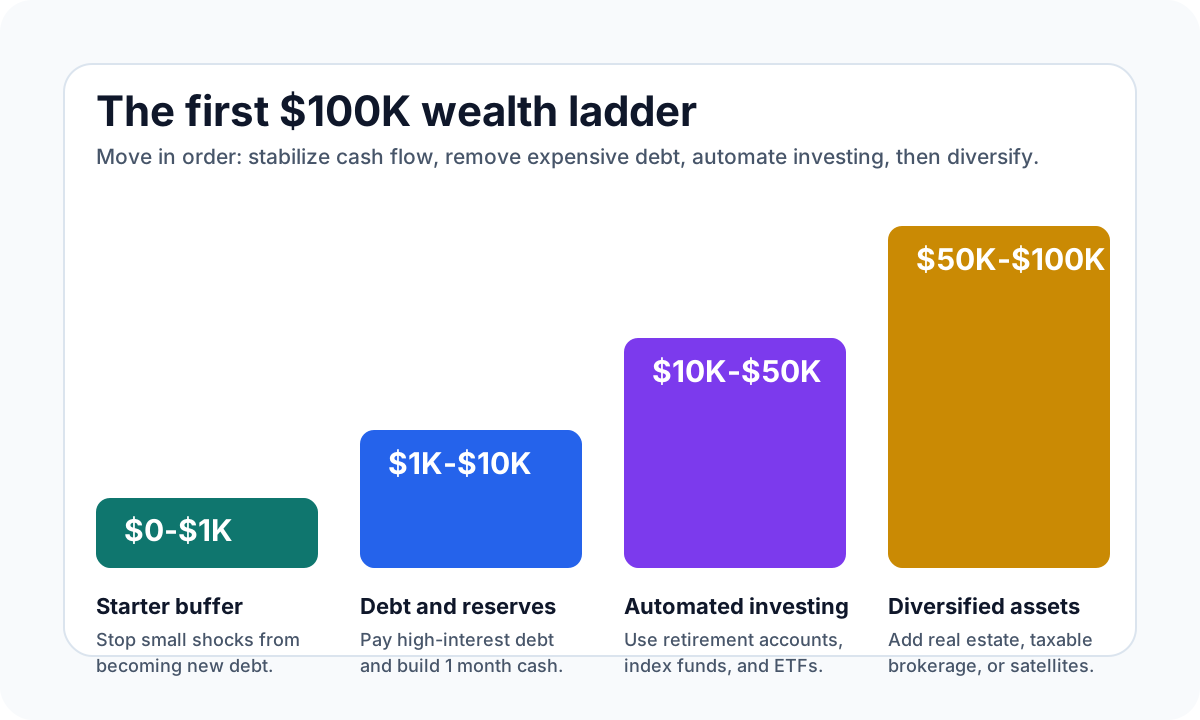
The first $100,000 is a useful milestone because it forces you to build the habits that every later milestone depends on. First, you must learn to spend below your income, avoid expensive debt, keep investing during boring markets, and resist the urge to cash out every time life gets uncomfortable.
It also changes the math because a 7% return on $5,000 is $350 before fees and taxes. However, a 7% return on $100,000 is $7,000. This simply means that the larger your asset base becomes, the more compounding starts to share the workload with your paycheck.
That does not make $100,000 magic, as it is still vulnerable to market losses, inflation, job loss, medical bills, divorce, bad leverage, and speculation. But it is a strong first checkpoint because it means you have now moved from survival mode toward asset ownership.
Calculate Your Starting Net Worth
Before choosing the best investments for you, you need to calculate your current net worth to know what your starting point is. Below is an easy formula to help you calculate your net worth:
Assets - liabilities = net worth
Assets include cash, retirement accounts, brokerage accounts, home equity, vehicles, business equity, valuable collectibles, and crypto you actually control.
Liabilities include credit cards, student loans, auto loans, personal loans, mortgages, tax debt, medical debt, and margin loans.
Do not make this complicated. A simple spreadsheet updated monthly is enough, and the purpose is to make progress visible, drawing a clear line between the starting point and where you are in your journey. Now, if your net worth is negative, you should not feel embarrassed. It means the first goal is to move the number in the right direction before you start investing in anything.
To get you started on how to move your net worth from negative to positive, you need to track four numbers:
| Number | Why it matters |
|---|---|
| Monthly income | Shows how much fuel enters the system. |
| Monthly fixed costs | Shows how much cash is already committed. |
| Monthly surplus | Shows how much can go to debt payoff, cash reserves, or investments. |
| Net worth | Shows whether your decisions are actually building wealth. |
How To Build Wealth If You Earn Less Than $100,000
You can learn how to build wealth on less than $100,000 a year, but the margin for error is smaller. So, you need a plan that protects cash flow before it disappears.
Start with these priorities:
- Keep housing and transportation reasonable. These are usually the two expenses that decide whether you can invest. A slightly cheaper apartment, house hack, roommate, used car, or shorter commute can matter more than cutting out Starbucks or Avocado toast.
- Use windfalls deliberately. Tax refunds, bonuses, overtime, gifts, and abt side income should have an assignment before they even hit your checking account. This way, you're not spending money before you get it.
- Automate your investment number. Even $50 or $100 per paycheck builds the habit, and then you increase it when debt drops, income rises, or expenses fall.
- Capture free money first. If your employer offers a retirement match, use it to the fullest, as that usually beats almost any other beginner move.
- Build skills that will help increase your income. Certifications, sales ability, technical skills, management experience, and job changes can create more room than budgeting alone.
The trap is waiting to learn how to build wealth until you "make enough" to start. A higher income helps, but income without a savings system often turns into a better apartment, a newer car, and a larger credit card balance.
Create a Cash Flow System
How to build wealth starts with your money having a job before the month begins. To learn how to do this, a workable cash flow system should answer three questions:
- What must be paid to keep your current lifestyle stable?
- What must be saved or invested before you start spending on other things?
- What can be spent freely without creating debt?
One simple structure that can help you is to apportion your income into buckets or categories, and then map out what purpose they will serve before the money comes. Here, we will use four buckets: Bills, Safety, Life, and Wealth
| Bucket | Purpose | Example target |
|---|---|---|
| Bills | Rent or mortgage, utilities, insurance, minimum debt payments | Paid from a checking account |
| Safety | Emergency fund and near-term sinking funds | Should contain enough to cover 1-6 months of expenses in case something happens |
| Wealth | Retirement accounts, brokerage, debt payoff, and a real estate fund | Automatic transfer of a set percentage or amount of income on payday |
| Life | Food, fun, gifts, travel, hobbies | Spend after the first three buckets are completed |
The goal is not perfection, but to make investing happen before the money is absorbed by convenience spending. This is how to build wealth for those not born into wealth who need to manage their income.
Pay Down Debt That Blocks Wealth
Debt is not automatically bad, as most people think, and one thing that separates wealthy people from ordinary people is that they know how to leverage debt for their benefit. For example, a fixed-rate mortgage on a reasonably priced home can help build equity, while a student loan tied to a higher income may be productive. Likewise, a business loan can be useful if the business's cash flow supports it.
However, high-interest consumer debt is different. These include credit card balances, payday loans, some personal loans, and expensive auto loans, which can grow faster than a normal investment portfolio. Thus, paying them down is often a high-return move because every dollar of interest avoided is a dollar that can later become an asset.
To pay down bad debt, use a simple rule:
- If the interest rate is very high, attack it aggressively. Pay more than the minimum requirement to pay it down faster.
- If the interest rate is moderate, balance paying it off with investing.
- If the interest rate is low and fixed, make the minimum required payments and invest the surplus if your foundation is stable.
For more details on how to pay down your bad debt quickly, read our guide to understanding debt.
Build an Emergency Fund Without Overdoing Cash
Emergency funds are boring until they prevent you from selling investments during a market crash or putting a car repair on a credit card. This puts you in a stronger position to weather storms without being tempted to panic-sell a good investment during a temporary drawdown.
A practical sequence to building an emergency fund in your journey to build wealth includes:
- Saving a starter buffer of $500 to $1,000 per paycheck. This can be lower or higher depending on your income and living expenses.
- Paying down the worst high-interest debt aggressively to get rid of it.
- Building one month of essential expenses first, and then moving up to two months.
- Working toward 3-6months if your job, health, family, or housing situation is less stable.
As you build your emergency fund, remember that cash is protection, not your main wealth engine. Once the emergency fund is strong enough, additional long-term dollars should usually move toward productive assets that will help your wealth-building journey.
Invest Before You Feel Ready
When it comes to the question of how to build wealth, many people delay investing because they want to understand every term first. Yes, you should understand risk, but you do not need to become a market expert before buying diversified funds.
Check out our Compound Interest Calculator that shows you how a small amount could grow considerably over time. The lesson here is usually the same: time and consistency matter more than perfect timing.
How To Build Generational Wealth With Index Funds
Index funds are one of the cleanest tools for building wealth because they let you own a broad market at low cost. Instead of trying to guess which company will win, an index fund tracks a market benchmark such as the S&P 500, the total U.S. stock market, or a global stock market index.
Index funds work well for generational wealth because they are:
- Diversified. One fund can hold hundreds or thousands of companies.
- Low cost. Lower fees leave more of the return for you.
- Easy to automate. You can invest on a schedule.
- Easy to explain. Heirs are more likely to maintain a simple portfolio than a complicated collection of speculative positions.
A strong first portfolio might use a total U.S. stock market fund, a total international stock fund, and a bond fund. Younger investors may hold more stocks due to higher risk-taking tendencies. But investors close to retirement or dependent on portfolio income may hold more bonds and cash.
For a deeper investing foundation, read our guides on Best Long-Term Investments and Dollar-Cost Averaging.
How To Build Generational Wealth With ETFs
Exchange-traded funds, or ETFs, are funds that trade on an exchange like stocks. Many ETFs track indexes, which makes them similar to index mutual funds. The main difference is how they trade and how investors buy them.
ETFs can be useful if you want:
- Broad diversification with low minimums.
- Intraday trading flexibility, though long-term investors rarely need it.
- Tax-efficient holdings in a taxable brokerage account.
- Easy access to stocks, bonds, REITs, commodities, or international markets.
The danger is using ETFs to overcomplicate your portfolio. A beginner does not need a dozen narrow thematic funds. A few broad, low-cost ETFs can actually do more for the long-term wealth of an investor than a collection of expensive trend funds.
If you are choosing between an index mutual fund and an ETF, focus on expense ratio, diversification, account type, minimum investment, bid-ask spread, and how easy it is to automate contributions.
How To Build Generational Wealth With Stocks
Stocks represent ownership in businesses, and over long periods, owning profitable businesses has been one of the most powerful ways to build wealth. The only downside of stocks is that individual stocks are much harder to evaluate than broad funds.
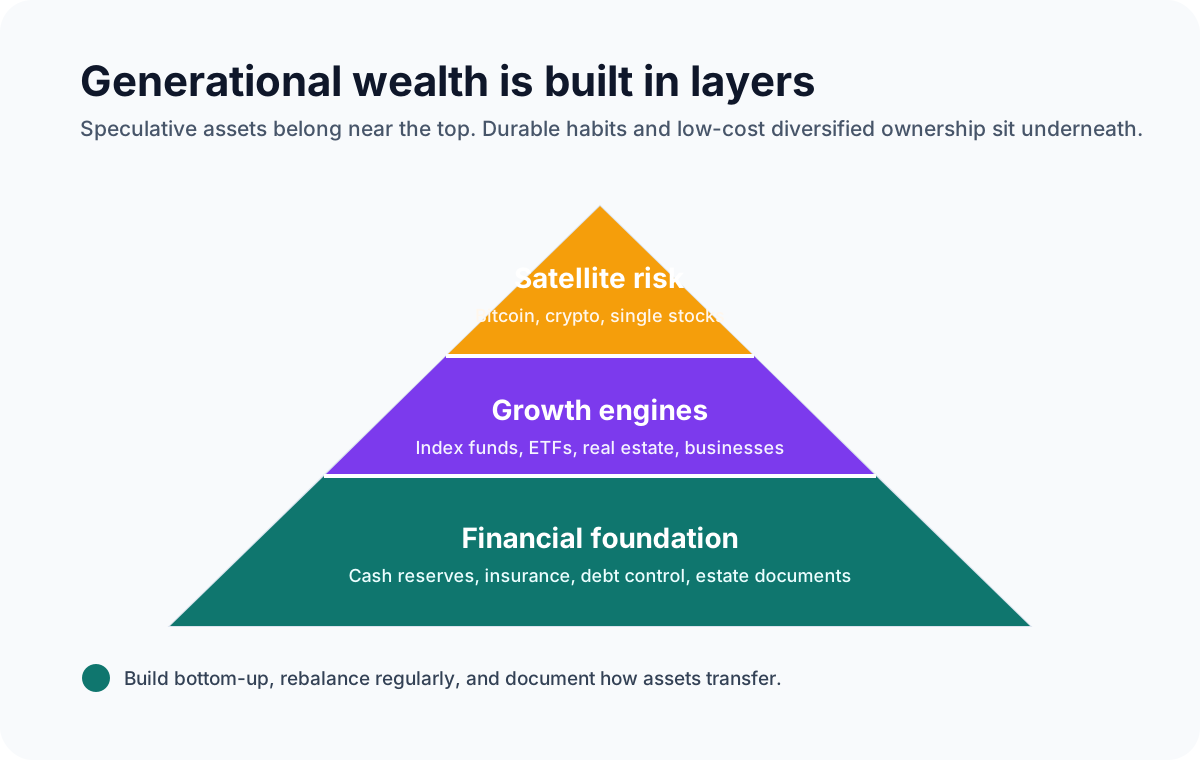
Use this hierarchy:
- Core: broad index funds or ETFs.
- Optional tilt: dividend funds, small-cap funds, value funds, or sector funds if you understand why you own them.
- Satellite: individual stocks you can research and hold through volatility.
Individual stocks can build wealth if you choose excellent companies and hold them long enough. They can also destroy wealth if you chase hype, concentrate too heavily, or confuse a familiar brand with a good valuation.
If you buy individual stocks, write down:
- Why did you invest in the company?
- What price or situation would make you sell?
- How large can the position become before you rebalance?
- Whether the money is something you can leave in for the long-term or if you will need it soon.
See our full guide to investing in stocks before making stock picking a major part of your plan.
How To Build Generational Wealth With Real Estate
Real estate can build generational wealth because it combines shelter, leverage, rental income, tax considerations, and potential appreciation. It can also create concentrated risk because one property can involve a large mortgage, repairs, vacancies, local market risk, insurance costs, and legal obligations.
There are several ways to use real estate, and we outline the best strategies below:
| Strategy | Best for | Main risk |
|---|---|---|
| Primary home | Stability and equity building | Overbuying, maintenance, and local price declines |
| House hacking | Lower housing costs and rental experience | Tenant issues, privacy trade-offs |
| Long-term rental | Cash flow and appreciation | Vacancies, repairs, leverage |
| Short-term rental | Higher potential income | Regulation, seasonality, operations |
| REITs | Real estate exposure without direct ownership | Market volatility, interest-rate sensitivity |
The best real estate investment is not always the property with the highest projected return. It is the one you can survive owning when something goes wrong.
Before buying, stress-test the deal:
- What happens if rent falls 10%?
- What happens if the property is vacant for two months?
- What happens if insurance, taxes, or repairs rise?
- Can you cover the mortgage without panic?
- Is the property still attractive after realistic maintenance and management costs?
If you want direct ownership, start with our guide to investing in real estate. If you want income without owning property, compare REITs with other passive income strategies.
How To Build Generational Wealth With Bitcoin
Bitcoin is a scarce digital asset with a fixed issuance schedule and a global market. Some investors hold it as a long-term store-of-value bet, a hedge against monetary debasement, or a high-conviction technology investment.
Bitcoin may fit a wealth plan if you can answer these questions:
- Do you understand volatility and the possibility of large drawdowns?
- Will your plan survive if Bitcoin falls 50% or more?
- Do you understand self-custody, private keys, hardware wallets, and exchange risk?
- Do you have a tax recordkeeping system?
- Is the position small enough that it will not ruin your financial foundation?
For many investors, Bitcoin belongs in the satellite layer of a portfolio, not the foundation. That might mean 1% to 5% of investable assets for a risk-tolerant investor, or 0% for someone who does not understand it or cannot handle volatility.
Read Investing in Bitcoin, What Is Bitcoin?, and Bitcoin Wallets before making it part of a long-term family wealth plan.
How To Build Generational Wealth With Crypto
Crypto is broader than Bitcoin. It includes smart contract platforms, stablecoins, tokens, decentralized finance, NFTs, governance tokens, and exchange-traded products tied to digital assets. The opportunity is broader, but the risk is also broader. However, they carry much higher risk than traditional assets due to the wild fluctuation in their prices.
Use stricter rules for crypto than for diversified funds:
- Avoid leverage.
- Avoid projects you cannot explain.
- Avoid yields that depend on unclear counterparty risk.
- Keep records for taxes.
- Separate long-term holdings from experimental positions.
- Use reputable custody and understand the trade-offs between exchanges and self-custody.
Crypto can create wealth, but it can also erase years of savings quickly. If your goal is generational wealth, speculation should never be allowed to endanger the base layer: cash reserves, insurance, retirement investing, debt control, and diversified ownership.
For more background, read our guides to cryptocurrency, Ethereum, DeFi, and hardware wallets.
Use Tax-Advantaged Accounts First
Taxes can quietly decide how much wealth your family keeps. In the U.S., retirement accounts are often the first place to build long-term investments because they can offer tax deductions, tax-deferred growth, tax-free growth, or employer contributions.
For 2026, the IRS says the employee contribution limit for 401(k), 403(b), governmental 457 plans, and the federal Thrift Savings Plan is $24,500. It also says the IRA contribution limit is $7,500, with additional catch-up rules for eligible older savers.
A common order of operations:
- Contribute enough to get the full employer match.
- Pay down high-interest debt.
- Fund a Roth IRA, traditional IRA, HSA, or additional workplace retirement contributions if eligible.
- Use a taxable brokerage account for flexibility, early retirement goals, or money beyond annual account limits.
Tax rules change. Before making major moves, check current IRS limits and consider a qualified tax professional.
Turn the First $100,000 Into Generational Wealth
Reaching $100,000 is not the end. It is simply the point where protection and transfer planning matter more.
Generational wealth requires three things:
- Assets: Investments, real estate, cash, insurance, business equity, intellectual property, or education funding.
- Instructions: Beneficiary designations, wills, trusts where appropriate, account access plans, and documented wishes.
- Capability: The next generation needs enough financial literacy to preserve and grow what they inherit.
Start with the basics:
- Name beneficiaries on retirement accounts and life insurance.
- Keep an updated will.
- Consider a trust if your situation is complex, you own property in multiple states, or you want more control over distributions.
- Maintain adequate insurance.
- Teach children and heirs how budgeting, credit, investing, and taxes work.
- Keep a secure inventory of accounts, policies, documents, and key contacts.
Money without instructions can create stress. Money without education can disappear. Generational wealth is not just what you leave behind. It is the system you leave behind.
Common Mistakes That Slow Wealth Building
Avoiding big mistakes can matter as much as finding great investments. The most common wealth blockers are:
- Waiting for the perfect time to invest.
- Keeping too much money in cash for long-term goals.
- Carrying credit card debt while speculating.
- Buying too much house or a car too early.
- Ignoring insurance until a crisis.
- Chasing individual stocks or crypto before building a diversified core.
- Selling long-term investments because of short-term headlines.
- Letting every raise become a lifestyle upgrade.
- Failing to update beneficiaries and estate documents.
Here Is A Practical 12-Month Plan That Will Guide You On How To Build Wealth By Hitting The First $100,000 Milestone.
If you are starting now, use the next year to install the system.
| Month | Focus | Action |
|---|---|---|
| 1 | Net worth | List assets, a, income, and fixed costs. |
| 2 | Cash flow | Create automatic transfers for savings and investing. |
| 3 | Debt | Choose avalanche or snowball payoff for high-interest balances. |
| 4 | Emergency fund | Save a starter buffer or one month of expenses. |
| 5 | Retirement | Capture employer match and review account fees. |
| 6 | Investing | Pick a simple index fund or ETF allocation. |
| 7 | Income | Ask for a raise, apply elsewhere, or build a monetizable skill. |
| 8 | Insurance | Review health, auto, renters, homeowners, disability, and life coverage. |
| 9 | Real estate | Decide whether buying, house hacking, REITs, or waiting makes sense. |
| 10 | Satellite assets | Set rules for any Bitcoin, crypto, or individual stock exposure. |
| 11 | Estate basics | Update beneficiaries and create or review a will. |
| 12 | Review | Recalculate net worth and raise contributions if possible. |
Repeat the cycle every year. Wealth building is not a one-time project. It is a reviewable operating system.
Final Thoughts On Wealth-Building
The best way to build wealth from scratch is to turn your monthly surplus into ownership before lifestyle inflation, debt, or speculation can absorb it. Start with cash flow and high-interest debt. Build an emergency fund. Automate diversified investments through index funds or ETFs. Add real estate, stocks, Bitcoin, or crypto only when they fit your risk capacity and do not threaten the foundation.
Your first $100,000 proves the system works. But generational wealth begins when you keep that system running, protect the assets, and teach the next generation how to own rather than only consume.
Disclaimer: This article is for informational purposes only and should not be considered financial, investment, legal, or tax advice. Always conduct your own research and consult a qualified professional before making financial decisions.
Frequently asked questions
What is the best way to build wealth from scratch?
The best starting point is to create positive monthly cash flow, keep a starter emergency fund, pay down high-interest debt, and automate investments into diversified assets such as low-cost index funds or ETFs. After the foundation is stable, you can add real estate, individual stocks, business assets, or small Bitcoin and crypto positions if they fit your risk tolerance.
How long does it take to save and invest your first $100,000?
It depends on your savings rate and investment returns. Someone investing $500 per month reaches $100,000 much faster than someone investing $100 per month, and market returns are never guaranteed. The main levers are income, spending discipline, debt costs, employer retirement matches, and consistency.
Can you build generational wealth without real estate?
Yes. Real estate can help, but generational wealth can also be built through retirement accounts, taxable brokerage accounts, index funds, ETFs, businesses, life insurance, education funding, and good estate planning. The key is owning durable assets and making sure they can transfer efficiently.
Is Bitcoin good for building generational wealth?
Bitcoin may be part of a long-term wealth plan for investors who understand volatility, custody, taxes, and position sizing. It should not replace emergency savings, retirement contributions, diversified stock exposure, or debt payoff. Many investors treat Bitcoin as a small satellite holding rather than the core of a portfolio.
How do you build wealth if you earn less than $100,000?
Focus on the gap between income and expenses, not the headline salary. Capture employer matches, reduce high-interest debt, automate a realistic investing amount, increase income through raises or skill-building, and avoid lifestyle inflation when your pay improves.
Continue reading
More resources
- InvestingBest Long-Term Investments for 2026Compare the best long-term investments, including index funds, ETFs, bonds, real estate, dividend stocks, retirement accounts, and Bitcoin.Read next
- InvestingFinancial Independence, Retire Early (FIRE)Learn how Financial Independence, Retire Early (FIRE) works, how to calculate your FIRE number, and how Lean, Fat, Coast, and Barista FIRE differ.Read next
- InvestingDollar Cost AveragingDollar cost averaging is an investment strategy which seeks to minimize risk when investing in volatile markets.Read next
- InvestingHow To Tell A Ponzi Scheme From A Real Investment OpportunityPonzi schemes promise high returns with little risk but rely on new investor money rather than real profits. Learn the clear red flags, how legitimate investments differ, and a practical due diligence process to protect yourself in 2026 and beyond.Read next