

A smart retirement plan with target-date funds is not just "buy the 2055 fund and forget it." It is a system: define when money needs to come out, fund the plan aggressively enough, place contributions in the right accounts, choose a glide path that matches your risk, keep fees low, and avoid the portfolio mistakes that quietly cancel the automation.
Target-date funds (TDFs), also called target retirement or lifecycle funds, became the default investment for millions of workers because they solve a real problem. Most people will not rebalance a three-fund portfolio every year, will not dial risk down on schedule, and will not stay calm through every market cycle. A good TDF does the allocation work in the background, so your main job is contribution rate and consistency.
That convenience is also why weak advice spreads. Many guides stop at "pick the year closest to retirement." That is only the first filter. Two funds with the same year can hold very different stock allocations, charge very different fees, reach their most conservative mix at different times, and behave differently in a crash right before you stop working.
This guide is built for 2026 retirement planning: what target-date funds actually do, how to choose one intelligently, how to fund them with current contribution limits, which structural mistakes to avoid, and when a custom portfolio is worth the extra work. For broader retirement savings context, see investing for retirement. For the index-fund engine behind many TDFs, see how to build wealth with index funds.
Quick Answer: How To Plan Retirement With Target-Date Funds
If you want the short version:
- Estimate your retirement year based on when withdrawals start, not when you wish markets will peak.
- Set a savings target high enough to matter. Capture any employer match first, then raise contributions over time.
- Use tax-advantaged accounts first: workplace plan, IRA, and HSA when eligible.
- Pick a low-cost target-date fund near that year, then read the glide path, equity level at retirement, and expense ratio.
- Make the TDF the core, not one random holding mixed with five overlapping stock funds.
- Automate contributions on payday so market timing is not part of the plan.
- Review once a year: contribution rate, target year, fees, and major life changes.
- Customize only with a reason, such as a pension, early retirement, concentrated stock, or multi-account complexity.
What A Target-Date Fund Is (And What It Is Not)
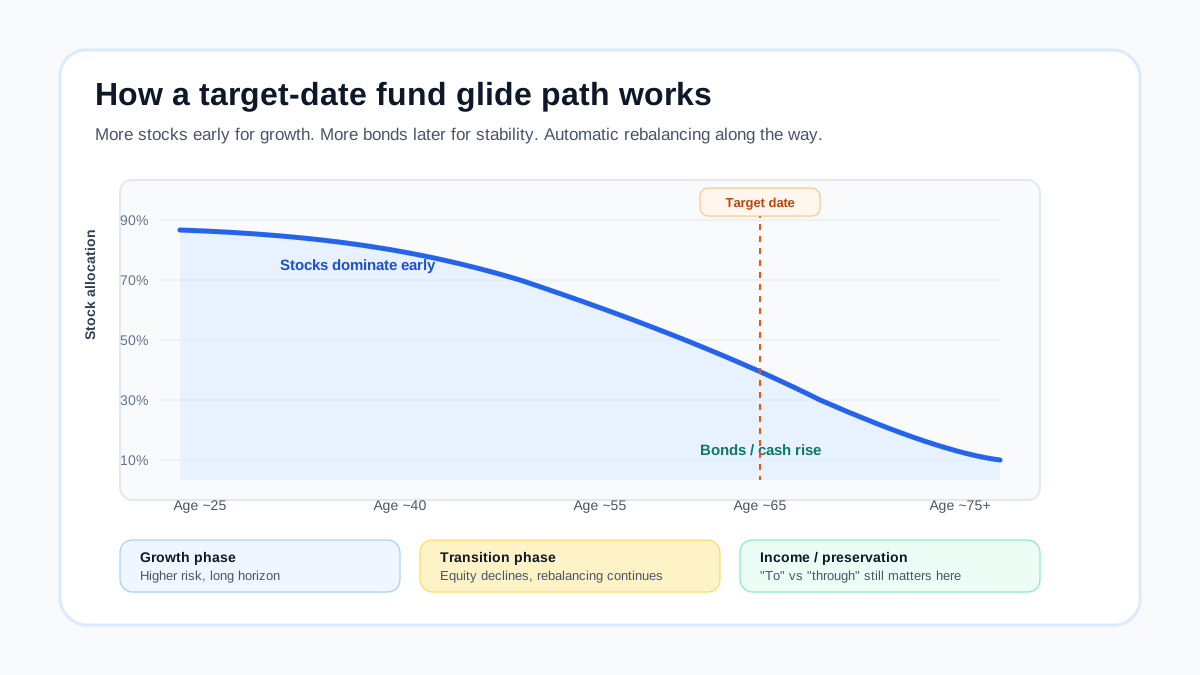
A target-date fund is a diversified portfolio packaged as one fund and named for an approximate retirement year, such as 2035, 2045, or 2060. Inside the package, the manager owns a mix of stocks, bonds, and sometimes cash-like holdings or alternative sleeves. Over time, the mix shifts from growth-oriented assets toward more conservative assets. That shifting mix is called the glide path.
What a TDF usually does well:
- Diversifies across asset classes in one purchase
- Rebalances automatically
- Reduces stock exposure as the target date approaches
- Lowers the decision burden for busy investors
- Serves as a strong default in 401(k), 403(b), 457, and IRA menus
What a TDF does not do:
- Guarantee you will have enough money to retire
- Protect you from market losses, especially before the fund turns conservative
- Replace a high enough savings rate
- Customize for every personal factor, such as a pension, home equity, or early retirement
- Automatically fix a high-fee fund menu or poor contribution habits
Investor.gov explains asset allocation as dividing investments among stocks, bonds, and cash based on goals, time horizon, and risk tolerance. Target-date funds are one way to implement that allocation with less manual maintenance.
Why Target-Date Funds Rank High For Real-World Retirement Plans
The academic case for stocks, bonds, and low costs is well known. The practical case for TDFs is behavioral.
Most households under-save, over-concentrate, fail to rebalance, and sell after declines. A low-cost TDF attacks several of those failure points at once:
| Retirement problem | How a good TDF helps |
|---|---|
| Too many decisions | One-fund portfolio instead of constant tinkering |
| No rebalancing | Managers maintain the current target mix |
| Risk too high near retirement | Glide path gradually reduces equity exposure |
| Risk too low early | Distant target years usually start stock-heavy |
| Fund-picking paralysis | Year-based naming gives a clear starting point |
| Inconsistent investing | Easy to automate with payroll contributions |
TDFs are especially useful when:
- You want a complete portfolio in one holding
- Your 401(k) fund menu is limited
- You are unlikely to maintain a DIY allocation
- You value simplicity more than customization
- You are building a "set and maintain" core while focusing on career and savings rate
They are less ideal when:
- Fees are high and better low-cost options exist in the same plan
- You already run a disciplined multi-fund portfolio
- You have large non-portfolio income or assets that change the right risk level
- You need money soon and should not be in stocks at all
- You treat the fund year as magic and ignore contribution size
The Smart Retirement System Around The Fund
A target-date fund is the vehicle. The plan is the engine.
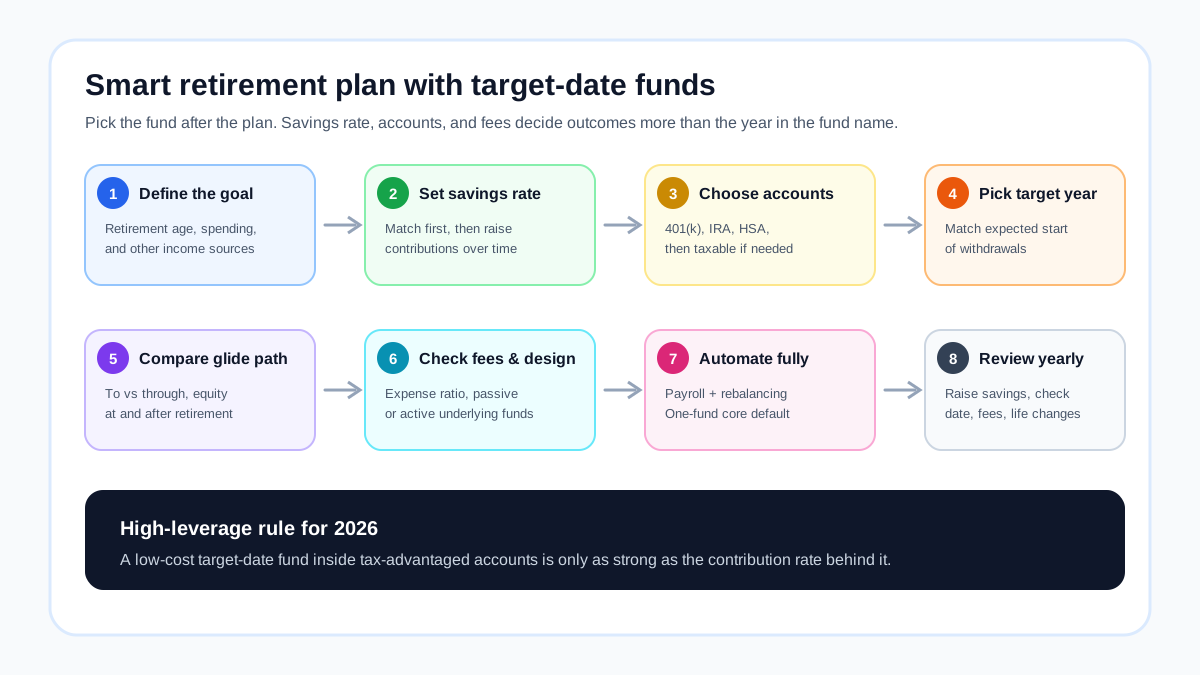
1. Define the job of the money
Write a one-line goal:
- "Replace most of my paycheck by age 65."
- "Semi-retire at 55 and cover the gap until Social Security."
- "Coast into traditional retirement after maximizing workplace savings."
If the money is for a home purchase in three years, it does not belong in a stock-heavy target-date fund. TDFs are retirement and long-horizon tools.
2. Translate lifestyle into a portfolio target
You do not need a perfect model to start, but you do need a direction. A simple framework:
- Estimate annual spending in retirement.
- Subtract expected reliable income such as Social Security, a pension, or rental income.
- The remainder is the gap your portfolio must cover.
- Multiply that gap by a planning factor, often in the 22x to 30x range depending on withdrawal strategy, taxes, and risk tolerance.
Use the FIRE calculator if you want an independence-style estimate, and the compound interest calculator to test contribution paths. Early independence goals are covered in more detail in our FIRE guide.
3. Make contribution rate the main lever
Portfolio design matters. Contribution rate usually matters more, especially in the first 10 to 15 years.
A practical hierarchy for 2026:
- Contribute enough for the full employer match.
- Attack high-interest consumer debt that can outrun market returns.
- Build an emergency fund outside the TDF.
- Raise retirement contributions toward 15% of income, including match when possible.
- Use catch-up contributions if eligible.
The IRS set the 2026 employee elective deferral limit for 401(k), 403(b), governmental 457 plans, and the Thrift Savings Plan at $24,500. The IRA contribution limit is $7,500, with an additional catch-up amount for savers age 50 and older. Catch-up rules for workplace plans are higher, including a larger amount for ages 60 to 63 when the plan allows it. Confirm current figures before making large plan decisions.
4. Then choose the target-date vehicle
Only after the savings system is clear should you obsess over the fund series. A brilliant glide path with a 3% contribution rate loses to an average glide path funded at 15%.
How To Choose The Right Target Year
Most people should start with the year closest to their expected retirement or withdrawal start date. Funds usually come in five-year increments.
| Situation | Better starting choice | Why |
|---|---|---|
| Plan to retire near 65 to 67 | Fund year near that calendar year | Matches the standard design assumption |
| Want to retire earlier | Earlier target year | Moves you to a more conservative mix sooner |
| Expect to work longer or delay withdrawals | Later target year | Keeps more growth assets for longer |
| High risk capacity, strong emergency fund, long retirement | Slightly later year | More equity if you can tolerate drawdowns |
| Low risk tolerance or large lump-sum need at retirement | Slightly earlier year | Lower equity sooner, less sequence-of-returns stress |
Important nuance: choosing a later date is not free return. It is more stock risk. Choosing an earlier date is not "safer forever." It can reduce long-term growth and purchasing-power protection.
Decision shortcut:
- If a 30% to 40% stock decline near retirement would force you to delay retirement or slash spending, lean earlier or more conservative.
- If your real danger is running out of growth over a 30-year retirement, lean later or accept a through-style glide path with more equity after the target year.
Glide Paths: The Ranking Factor Most Articles Under-Explain
The year in the fund name is marketing shorthand. The glide path is the strategy.
To vs through retirement
The U.S. Department of Labor notes that investors should understand whether a TDF uses a "to" or "through" approach and when the fund reaches its most conservative allocation. In plain terms:
| Glide path type | What it usually means | Better fit when |
|---|---|---|
| To | Most conservative mix around the target date | You expect to take large withdrawals soon after retiring, or you want lower market risk at the retirement handoff |
| Through | Equity keeps adjusting after the target date and may remain higher at retirement | You expect decades of withdrawals and can accept more market risk for long-term growth |
Neither design is automatically better. They optimize for different risks:
- To designs emphasize the danger of a crash right when you leave work.
- Through designs emphasize longevity risk and the need for growth during a long retirement.
Questions to answer before you buy
- What is the stock allocation today?
- What is the stock allocation at the target date?
- What is the stock allocation 10 years after the target date?
- How much international stock does the fund own?
- Does it use broad index funds, active funds, or a blend?
- How quickly does the fund de-risk between ages 50 and 65?
Two 2045 funds can be different products. One might hold far more equity five years from retirement than the other. That gap can matter more than a tiny difference in trailing three-year returns.
Fees, Design Quality, And What To Compare In 2026
Low fees are not the only factor, but they are one of the few advantages you can lock in.
Expense ratio reality check
Expense ratio is the annual percentage of assets taken for fund operating costs. Investor.gov defines the expense ratio as a core cost measure for fund investors. On a long retirement timeline, cost drag compounds.
| Annual fee level | Rough meaning in a TDF lineup |
|---|---|
| About 0.05% to 0.15% | Strong low-cost index-oriented territory for many retail options |
| About 0.15% to 0.40% | Common middle range; still compare design carefully |
| About 0.50% to 1.00%+ | Expensive for a default retirement fund unless the plan has no better option |
If your workplace plan only offers a higher-cost TDF, capturing the employer match can still be correct. Then use an IRA for cleaner low-cost funds when eligibility and cash flow allow.
Active, passive, and blend
Even "passive" target-date funds involve active design choices: glide path shape, landing point, underlying benchmarks, and rebalancing rules. What usually differs is whether the underlying sleeves track indexes, use active managers, or mix both.
Compare:
- Total cost, not marketing labels
- Diversification quality across U.S. stocks, international stocks, and bonds
- Risk at the retirement date, not just recent returns
- Manager consistency and whether the strategy recently changed
- Share class available in your plan, because institutional and retail fees can differ
Collective investment trusts vs mutual funds
Many 401(k) plans offer target-date strategies as collective investment trusts (CITs) rather than mutual funds. Functionally, the idea is similar: a managed glide path for a retirement year. Documentation, availability, and fees can differ. Read the plan materials rather than assuming the CIT is identical to a retail mutual fund with a similar name.
Where Target-Date Funds Belong In Your Accounts
Buying the right fund in the wrong account sequence wastes tax advantages.
Practical account order for most workers
- Workplace plan contributions up to the full match
- High-interest debt cleanup and emergency cash outside investments
- IRA contributions if eligible and useful for your tax situation
- HSA investing if you have a qualifying high-deductible plan and can leave the money invested
- Additional workplace contributions toward annual limits
- Taxable brokerage for surplus savings or earlier flexibility
| Account | Why it works with a TDF | Watch-outs |
|---|---|---|
| 401(k) / 403(b) / 457 | Payroll automation, match, tax advantages | Limited menu, plan fees, withdrawal rules |
| Traditional IRA | Tax-deferred growth, broad fund choice at many brokers | Deductibility rules, later required distributions |
| Roth IRA | Tax-free qualified withdrawals | Income and contribution limits |
| HSA | Strong tax treatment for medical costs | Needs eligible health plan and long-term discipline |
| Taxable brokerage | Flexible access | Dividends and capital gains can create annual tax drag |
For beginners still choosing a first portfolio, our investing for beginners guide and long-term investments comparison can help place TDFs next to index funds, bonds, and other cores.
One Fund Or Core-Satellite? Avoid The Hidden Risk Stack
The cleanest TDF strategy is often the boring one:
- 100% of retirement contributions into one target-date fund matched to your plan
That works because the fund already owns stocks and bonds. Problems start when people stack risk without measuring it.
Common portfolio accidents
| Mistake | What goes wrong | Better approach |
|---|---|---|
| TDF + S&P 500 fund "for growth" | Total equity exposure becomes higher than the glide path intends | Either stay 100% TDF or build a deliberate multi-fund portfolio |
| Different TDF years in 401(k) and IRA | Conflicting risk levels across accounts | Align years, or treat one account as the risk sleeve on purpose |
| TDF plus company stock | Concentration risk on top of market risk | Cap company stock and keep the diversified core intact |
| Old TDF from a prior employer plus new TDF | Fragmented fees and allocations | Consolidate when rollover math and features make sense |
| Checking daily and switching years after every headline | Turns automation into market timing | Change the year only after a real plan change |
When a satellite makes sense
A small satellite can be reasonable if:
- The TDF remains the clear majority of long-term retirement money
- The satellite has a defined purpose, such as a taxable brokerage growth sleeve or a modest alternative allocation
- You still know your total stock/bond mix after adding it
If you cannot state your total equity percentage, you do not have a plan. You have a collection of tickers.
Target-Date Funds Vs Three-Fund Portfolios Vs Robo-Advisors
| Approach | Best for | Main advantage | Main trade-off |
|---|---|---|---|
| Target-date fund | Hands-off investors, workplace plans | One fund, automatic glide path | Less customization, design varies by issuer |
| Three-fund portfolio | DIY investors who rebalance | Control over equity, international, and bond mix | Requires maintenance and discipline |
| Robo-advisor | Investors who want automation outside a single TDF | Automatic rebalancing, often with tax features in taxable accounts | Advisory fee on top of fund costs |
| Balanced fund (static mix) | People who want simplicity without a declining equity path | Stable allocation, easy to understand | Does not automatically de-risk with age |
A useful rule:
- Choose a TDF if implementation risk is your biggest enemy.
- Choose a three-fund portfolio if you enjoy the process and will maintain it.
- Choose a robo-advisor if you want automation plus features a single fund does not provide, and the fee is worth it.
- Do not combine all three without a reason. Complexity is not sophistication.
Near-Retirement Strategy: Sequence Risk Is The Real Boss
The most dangerous window for many retirees is the last few working years and the first few withdrawal years. A large market drop then can permanently reduce the portfolio that has to last decades.
Target-date funds try to manage that risk by lowering equity over time, but they do not eliminate it. A 2030 fund can still hold a meaningful stock allocation.
Smart moves in the final 5 to 10 years
- Know your actual equity percentage, not just the fund year.
- Build cash reserves for near-term spending outside the most volatile sleeve if retirement is close.
- Stress-test the plan for a bad market in year one of retirement.
- Coordinate Social Security timing with portfolio withdrawals rather than treating them as unrelated decisions.
- Avoid large lifestyle upgrades funded by peak portfolio statements.
- Review whether a to or through design still matches your drawdown plan.
If you will need a large sum at retirement for debt payoff, a home move, or delayed pension start, a fund that still holds high equity at the target date may be the wrong default for that lump-sum need.
In Retirement: Stay, Shift, Or Customize?
You do not have to abandon a target-date fund the day you retire. Many people keep the same low-cost series and let the glide path continue.
Stay in the TDF if:
- Fees remain competitive
- The post-retirement allocation matches your spending plan
- You want maximum simplicity
- You do not want to manage rebalancing or bond ladders
Customize if:
- You have a pension that already replaces a large share of spending
- You hold a large taxable account and care about tax location
- You want a dedicated cash bucket for two to three years of withdrawals
- You prefer a higher or lower equity share than the fund provides
- You are coordinating multiple accounts and Social Security with a formal written plan
A hybrid that works for some retirees:
- Keep the TDF as the long-term core
- Hold one to three years of planned withdrawals in cash or short-term Treasuries
- Replenish the cash bucket during strong market years
That structure reduces the chance you sell depressed stock holdings to buy groceries after a crash.
2026 Contribution Playbook With Target-Date Funds
Use this as a practical funding map:
| Priority | Action | TDF role |
|---|---|---|
| 1 | Get the full employer match | Direct matched contributions into the plan TDF or best low-cost equivalent |
| 2 | Stabilize cash and high-interest debt | Keep this money out of the TDF |
| 3 | Fund IRA if it improves your plan | Use a low-cost brokerage TDF or simple index portfolio |
| 4 | Increase workplace deferrals | Automate raises after every salary increase |
| 5 | Use catch-up contributions if eligible | Same TDF core, higher savings rate |
| 6 | Add taxable investing only after tax-advantaged space is used or unavailable | Consider whether a TDF or a more tax-efficient index mix is better |
Automation beats motivation. The best retirement portfolio is the one that receives money every payday for decades.
High-Leverage Sections Competitors Often Skip
These are the topical vectors that improve usefulness and ranking depth because basic "what is a target-date fund" pages usually stop early.
1. Multiple account coordination
If you have a 401(k), old 403(b), Roth IRA, and taxable account, the question is not "which TDF is best" in isolation. The question is what your household stock/bond mix is after every account is combined. Pick one policy allocation, then implement it with the lowest-friction tools in each account.
2. Employer stock and concentrated wealth
A TDF cannot neutralize a huge company-stock position. If a large share of net worth sits in one employer, the diversified TDF is still useful, but your true risk is higher than the fund fact sheet implies.
3. Early retirement and Coast FIRE
Standard TDF years assume a traditional retirement age. If you want financial independence earlier, you may need:
- A higher savings rate
- A later-dated fund for longer growth, or
- A custom equity-heavy portfolio until your independence date, then a deliberate de-risking plan
See our FIRE guide and FIRE calculator if the goal is optional work rather than age-65 retirement.
4. Inflation and longevity
Bonds reduce volatility. They do not automatically solve multi-decade inflation. That is one reason through-style designs keep some stocks after the target year. A retirement plan that becomes too conservative too early can feel safe in year one and fragile in year twenty.
5. Spouse and household planning
Couples often need one household plan, not two independent fund years chosen in isolation. If one spouse has a pension and the other does not, the right equity level for the joint portfolio can differ from either fund's default assumption.
Common Mistakes That Weaken Target-Date Retirement Plans
- Under-saving into a perfect fund. Allocation cannot fix a contribution gap.
- Ignoring expense ratios because the fund is the plan default.
- Choosing a year based on age only, without thinking about when withdrawals actually start.
- Stacking stock funds on top of a TDF and accidentally increasing risk.
- Panic-selling during the first big decline after automation did its job.
- Leaving old high-fee accounts scattered across former employers.
- Treating recent returns as proof of a superior glide path. Different equity levels produce different short-term results by design.
- Using a TDF for short-term money.
- Never re-reading the fund after a strategy or fee change.
- Skipping the annual contribution raise. Lifestyle inflation is a silent retirement tax.
A 30-Day Setup Plan For 2026
| Day range | Action | Done looks like |
|---|---|---|
| Days 1 to 3 | Write retirement age, rough spending, and other income sources | You know what the portfolio is for |
| Days 4 to 7 | List every retirement account and current fund | No hidden old 401(k)s |
| Days 8 to 10 | Check employer match and current deferral rate | Match is fully captured or scheduled |
| Days 11 to 14 | Compare TDF options: year, glide path, equity at retirement, fee | One primary fund is selected |
| Days 15 to 18 | Align IRA or other accounts with the same policy risk level | Household allocation is intentional |
| Days 19 to 22 | Automate contributions and future increases | Payday funding requires no willpower |
| Days 23 to 26 | Write crash rules | You know what you will not do in a bear market |
| Days 27 to 30 | Set an annual review date | Contribution rate, target year, and fees get a yearly checkup |
After day 30, stop researching tickers every weekend. Fund the plan.
Annual Review Checklist
Once a year, ask:
- Can I raise my contribution rate by 1% or more?
- Is my target year still realistic?
- Has the fund's glide path, fee, or strategy changed?
- Do I still understand my total household equity exposure?
- Did I leave concentrated stock, cash needs, or pension income out of the plan?
- Am I closer to the point where a cash bucket or custom withdrawal strategy is needed?
- Are old accounts worth consolidating?
That is enough maintenance for most TDF investors.
Who Should Not Use A Target-Date Fund As The Whole Plan
A TDF can still be part of the toolkit, but it should not be the whole plan if:
- You need professional coordination for equity compensation, a business sale, or complex taxes
- You already manage a disciplined portfolio and prefer exact control
- Your only available TDF is expensive and a low-cost three-fund option exists in the same account
- Your retirement is funded mostly by a pension, and you want a different residual risk profile
- You are withdrawing irregular large amounts that need a dedicated cash or bond structure
Even then, a TDF can remain a reasonable default for a spouse account, a small workplace plan, or money you do not want to micromanage.
Final Takeaway
Planning a smart retirement with target-date funds in 2026 is less about finding a secret series and more about installing a durable system:
- Define when the money must start working as income.
- Save enough, consistently, inside tax-advantaged accounts.
- Choose a low-cost fund whose glide path matches that timeline.
- Keep the portfolio simple enough that you will not sabotage it.
- Review once a year, especially contributions, fees, and life changes.
The target year gets you into the right aisle. The savings rate, fee level, glide path, and behavior decide whether the plan works.
If you want the next layer after this default, build from index funds, diversification, and investing strategies. If debt or cash flow is still unstable, fix that first with how to budget and pay off debt fast before you ask a target-date fund to do impossible work.
Frequently asked questions
What is a target-date fund and how does it help with retirement?
A target-date fund is a diversified mutual fund or collective investment trust built around an expected retirement year. It holds a mix of stocks, bonds, and sometimes other assets, then automatically becomes more conservative as the target year approaches. For many people, it is a one-fund retirement portfolio with built-in diversification and rebalancing.
How do I choose the right target-date fund year?
Start with the year closest to when you expect to begin withdrawing money, often around age 65 to 67 for traditional retirees. If you plan to retire earlier, pick an earlier date. If you have high risk capacity and a long withdrawal horizon, a slightly later date can keep more equity. The year is a planning tool, not a legal deadline.
What is the difference between a to and through target-date fund?
A to glide path usually reaches its most conservative stock and bond mix at the target retirement year. A through glide path keeps reducing risk after the target year and may hold more stocks at retirement because it assumes withdrawals continue for decades. The difference can change how much market risk you face in the first years of retirement.
Are target-date funds good for beginners?
Yes, for many beginners they are one of the best defaults because they package allocation, diversification, and rebalancing into one holding. They work especially well as a core holding inside a 401(k), 403(b), IRA, or similar retirement account when the expense ratio is low and the glide path matches your plan.
What expense ratio should I look for in a target-date fund?
Prefer the lowest-cost fund that still offers a sensible glide path and broad diversification. Many strong index-based target-date options charge well under 0.20%. Higher fees are not automatically wrong if the design is better, but small fee differences compound for decades and deserve a hard look.
Can I hold a target-date fund and other investments at the same time?
Yes, but you need to count the combined risk. Adding stock funds on top of a target-date fund can push your total equity exposure higher than you intended. If the target-date fund is your core, extra holdings should be intentional satellites, not accidental doubles of the same market.
Should I leave my target-date fund before retirement?
Not automatically. Many investors can stay in a low-cost target-date fund through retirement. Consider customizing if you have a pension, large taxable account, unusual risk needs, multiple large accounts with overlapping funds, or a clear plan for a three-fund or bond-ladder strategy you will maintain.
Are target-date funds the same as index funds?
No. Some target-date funds invest mainly in index funds, while others use active managers or a blend. The target-date wrapper is about automatic asset allocation over time. Whether the underlying holdings are passive, active, or blended is a separate design choice you should check in the fund materials.
Continue reading
More resources
- InvestingWhat is Investing?Saving helps you achieve your financial goals. Investing helps you grow your savings.Read next
- InvestingBest Investment Strategies for 2026This guide compares the best investment strategies for beginners and long-term investors, including index investing, asset allocation, dollar-cost averaging, rebalancing, value, growth, dividend, and active investing.Read next
- InvestingRisk vs. Reward: Meaning, Ratio and ExamplesLearn how risk vs. reward works, how to calculate a risk-reward ratio, and how to decide whether an investment's potential return is worth the risk.Read next
- MoneyWhat Is Wealth Management? Services, Fees, and How It WorksWealth management is holistic financial planning for people with complex finances—covering investments, taxes, estates, retirement, and risk. Learn services, typical fees, asset minimums, and how to choose a fiduciary.Read next