

Before starting a business, you need evidence that customers will pay, a price that covers the real cost of delivery, enough cash to survive payment delays, and a plan that protects your household. You also need to check the registrations, taxes, licenses, and insurance required where you operate.
A logo and a registration certificate do not answer the hardest question: can this business support itself and eventually pay you? The checklist below turns that question into decisions you can test before committing to a lease, large inventory order, loan, or resignation.
The commercial principles apply broadly. The legal and tax section covers United States basics; readers elsewhere should use their local government and tax authority for requirements.
1. Define the customer, problem, and offer
Write one sentence: “I help [specific customer] solve [specific problem] with [specific offer] at [price].” If you cannot name the buyer or the problem, narrow the idea before building more of it.
“A bookkeeping service for independent tradespeople who fall behind on invoicing” is easier to test than “financial services for everyone.” A narrow starting market lets you learn where customers gather, what they already pay for, and what would justify switching.
Investigate direct competitors and substitutes. A customer might choose another provider, a spreadsheet, an employee, a do-it-yourself solution, or simply tolerate the problem. Your offer must compete with the choice they actually make.
The SBA's business planning guide recommends examining demand, market size, saturation, and pricing. Use those questions to organize research, then test your own offer rather than assuming a large market guarantees customers.
Create a simple comparison with three alternatives: their customer, promise, price, buying process, and recurring complaints. Look for a specific opening such as a neglected customer type, faster turnaround, transparent scope, or a service that removes an inconvenient step. Being cheaper is only useful if the resulting economics work.
2. Validate demand before making expensive commitments
Customer interviews reveal problems; purchases reveal willingness to pay. Both matter, but they answer different questions.
Ask potential buyers about the last time they faced the problem. What did they do? What did it cost? Who approved the purchase? What made the alternative frustrating? Questions about past behavior are more informative than asking whether someone likes your idea.
Then design the smallest credible test. A service business might offer a tightly scoped paid pilot. A product business might demonstrate a prototype and seek an order with clear delivery and refund terms. A regulated business may need approvals before it can accept money or deliver anything.
| Signal | What it tells you | What remains unproven |
|---|---|---|
| Compliments or social likes | The concept attracts attention | Willingness to pay |
| An email signup | Someone wants updates | Purchase intent at your price |
| A serious quote request | A buyer may have an active need | Conversion and delivery economics |
| A paid pilot | Someone will exchange money for the offer | Repeat demand and scalable delivery |
| A repeat purchase or referral | The delivered result has value | Whether acquisition and capacity can grow |
Set your test budget, deadline, and decision rule before launching. For example, you might require several unrelated customers to buy at the intended price and accept the standard scope. That is an illustrative gate, not a universal sample size or statistical proof.
Record rejected offers too. “Too expensive” could mean the wrong customer, weak value, poor timing, or a genuinely unworkable price. Repeated requests for a different outcome may point to a better offer. If only friends buy or every sale requires a deep discount, keep testing before scaling.
3. Calculate unit economics and the cost of your time
Unit economics describe what remains from one sale after the costs caused by delivering it. Your unit might be a product, appointment, subscription month, or completed project.
Start with the selling price, then subtract materials, fulfillment, payment fees, delivery labor, and a realistic allowance for returns or rework. Track customer acquisition cost separately so you can see whether buying the sale leaves enough contribution to cover overhead.
A hypothetical service-business example
Suppose a service sells for $300 per job. Materials, travel, fees, and an expected rework allowance total $60. Delivery takes four hours, valued at $35 per hour. Winning each new job costs $30 in marketing.
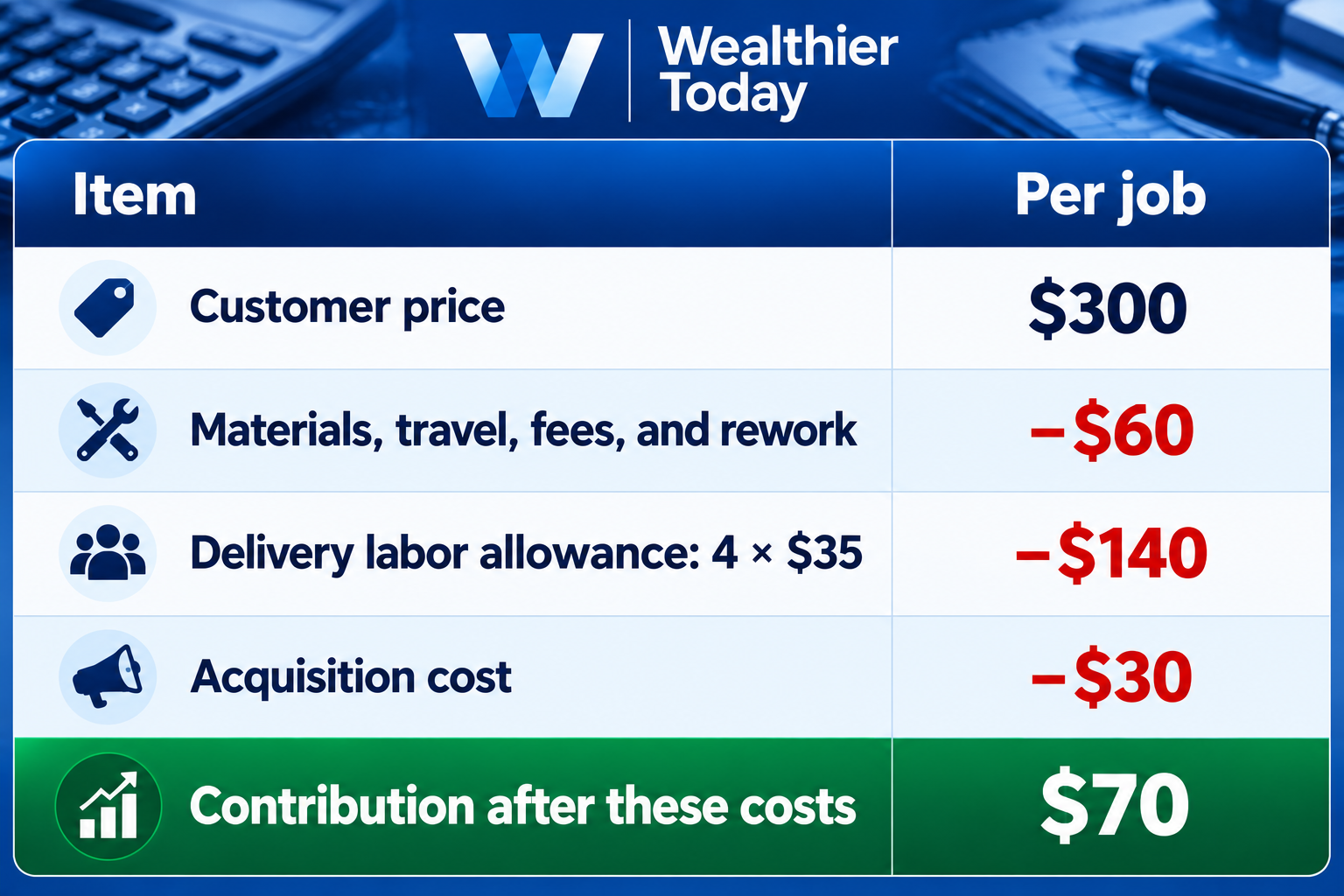
With $1,400 in monthly fixed operating costs, this simplified model needs 20 jobs to cover those costs: $1,400 ÷ $70. At 25 jobs, $1,750 in contribution leaves $350 after fixed costs, before tax and any costs omitted from the model. It also requires 100 delivery hours, plus selling and administration.
The labor allowance helps evaluate whether the work pays adequately. For a sole proprietor doing the work personally, it is an economic planning allowance, not necessarily a deductible wage expense. Do not subtract it again as an additional owner withdrawal when measuring the same earnings.
This is a practical extension of the SBA's break-even formula: fixed costs divided by price minus variable cost. Real businesses may have multiple products, discounts, and capacity limits, so calculate by offer before blending the results.
Test a downside case. If acquisition cost rises from $30 to $60, contribution falls to $40 and break-even rises to 35 jobs. That means 140 delivery hours before administration. A business that appears viable at one advertising cost may become impossible to operate at another.
4. Separate startup costs, profit, and working capital
You need three views of money:
- Startup spending: what you must pay before opening, including equipment, deposits, initial stock, and professional help.
- Profitability: whether revenue exceeds recognized expenses over a period.
- Cash availability: whether money arrives before bills fall due.
Working capital generally means current assets minus current liabilities. For launch planning, focus especially on the cash tied up between paying for work and collecting from customers. Inventory and unpaid invoices can make a business look asset-rich while its bank balance is empty.
The SBA's startup-cost guidance distinguishes initial expenses, assets, and cash needed to cover early operating deficits. Treat your launch budget as more than the cost of opening day.
Consider a hypothetical project completed this month with $10,000 invoiced and $6,000 in related costs paid immediately. If the customer pays next month, the simplified accrual profit is $4,000, but this month's project cash flow is negative $6,000. You need cash to bridge the gap. This illustration excludes taxes and other overhead.
Build a weekly cash forecast for the first 13 weeks. Enter opening cash, expected collection dates, supplier payments, payroll, rent, debt payments, tax reserves, and owner withdrawals. Forecast collections rather than assuming every invoice becomes cash on the issue date.
Run scenarios for slower sales, a late-paying large customer, returns, and an essential repair. Identify the lowest projected cash balance. That low point, plus a contingency suited to your risks, is more useful than a generic instruction to save a certain number of months.
You may reduce the gap with deposits, milestone billing, smaller inventory batches, or negotiated supplier terms. Each involves a tradeoff: deposits can deter buyers, frequent ordering can raise unit costs, and supplier credit creates a payment obligation.
5. Protect household runway before leaving your job
Business reserves and household reserves serve different purposes. Do not count the same savings toward both.
Begin with your essential living costs, minimum debt payments, insurance, childcare, and irregular expenses. Subtract dependable income that continues after launch. Our guide to budgeting with irregular income can help you build that baseline.
Household runway = cash allocated to household support ÷ monthly household shortfall.
For a hypothetical household spending $4,000 a month with $1,500 in dependable outside income, the monthly shortfall is $2,500. A dedicated $20,000 reserve provides eight months at that pace. If $5,000 must instead fund the business, only $15,000 remains for the household, reducing runway to six months.
This simple division assumes stable spending and income. Allow separately for emergencies and the time it might take to find employment if the business stops. Do not assume uncertain business withdrawals will arrive on schedule.
Account for benefits you would lose when leaving employment. In the US, eligible self-employed people can explore individual coverage through the Health Insurance Marketplace. Price the actual premium and likely out-of-pocket costs; coverage choices affect your launch budget. Our health insurance guide explains the basic terms.
Starting part time can preserve wages while you learn. The tradeoff is less delivery capacity and a slower test. Check your employment agreement, confidentiality duties, intellectual-property terms, and potential conflicts before using evenings for a related business.
6. Match funding to the risk you are taking
Choose funding after estimating cash needs and testing the offer. Borrowing more does not fix a sale that loses money.
| Funding approach | Practical advantage | Cost or constraint |
|---|---|---|
| Savings and gradual reinvestment | Preserves ownership and flexibility | Exposes personal savings; growth may be slower |
| Customer deposits or paid pilots | Can finance specific delivery work | Creates delivery and refund obligations |
| Business borrowing | Can fund equipment or a defined cash gap | Requires repayment; guarantees and collateral may expose personal assets |
| Equity investment | Can support an uncertain growth period without scheduled loan repayment | Dilutes ownership and may change control |
| Friends or family | May offer flexible terms | Can damage relationships unless ownership, repayment, and risks are explicit |
For any loan, model fees, interest, principal payments, and the consequences of missing them. Read personal guarantees separately from the company paperwork. Our guide to evaluating debt provides a broader affordability framework.
Keep near-term operating cash accessible and appropriate for its purpose. Investing your rent or payroll reserve in volatile assets introduces another risk before the business has stabilized. Our savings account guide covers basic cash-account considerations; business account eligibility and protection details require separate checks.
7. Check legal, tax, and insurance requirements before trading
US scope: requirements depend on your state, locality, activity, ownership, and hiring plans. Check government sources and get professional help for decisions with substantial consequences.
The SBA's launch guide explains how business structure affects liability and taxes, and covers registrations, tax IDs, permits, banking, and insurance. A sole proprietorship does not separate business liabilities from the owner. An LLC can offer liability protection in many circumstances, but formation alone does not resolve every exposure.
Before launch, establish which registrations and permits apply, whether the location allows the activity, and which insurance your risks or contracts require. Home-based operations can still face zoning restrictions. Ask about customer contracts, cancellation terms, data handling, and ownership of work created with collaborators. Resolve these questions before taking an order you cannot legally fulfill.
For federal taxes, the IRS self-employed tax center explains that self-employed people generally owe income tax and self-employment tax, and may need estimated payments. Use current IRS guidance and your circumstances to calculate reserves; one universal percentage will not fit every owner. Separately check state and local sales, payroll, and other applicable taxes.
Set up separate business banking and a bookkeeping routine from the beginning. Save invoices, receipts, contracts, and payment records. The IRS recordkeeping guide explains that records support tax reporting and help monitor the business. Reconcile accounts regularly rather than reconstructing the year at filing time.
8. Set launch gates and an exit rule
A business plan is useful when it records assumptions you can check. Start with a short operating plan: customer, offer, sales channel, price, delivery capacity, startup budget, cash forecast, compliance requirements, and next review date.
Use the following gates before increasing your commitment:
| Gate | Evidence to collect | If it is missing |
|---|---|---|
| Demand | Unrelated buyers accept the offer at a workable price | Change the customer, offer, or sales process and retest |
| Delivery | You can deliver the promised result within the cost and time allowance | Reduce scope, improve the process, or raise the price |
| Cash | A downside forecast leaves enough cash to meet obligations | Reduce commitments or arrange suitable funding before expanding |
| Household | Living costs and benefit changes fit a separate reserve plan | Keep outside income or delay full-time launch |
| Compliance | Required permissions, records, contracts, and protection are ready | Resolve gaps before performing the affected activity |
Define an exit or redesign rule while you still have options. You might pause if cash reaches a protected floor, if repeated tests produce no paying demand, or if delivery remains unprofitable after specific changes. Include shutdown costs and outstanding customer obligations in that floor.
For the first operating months, review cash weekly and margins monthly. Watch collected revenue, contribution per sale, acquisition cost, repeat purchases, delivery hours, and overdue invoices. Revenue growth alone can hide deteriorating economics.
Your next step is a bounded test: one customer segment, one offer, a realistic price, a spending cap, and a review date. Expand when the evidence supports the next commitment. That gives you a practical path from an appealing idea to a business your finances can sustain.
Frequently asked questions
What should I do first before starting a business?
Identify one specific customer problem and test whether people will pay for a focused solution. Check regulatory requirements before offering a paid pilot, and limit spending until you have evidence of demand.
How much money should I save before starting a business?
Add one-time startup costs, the projected business cash shortfall, and a separate household reserve. The amount depends on payment timing, essential living costs, dependable outside income, and how long it could take to replace your earnings.
Should I quit my job to start a business?
Consider testing part time when your employment agreement and the business model allow it. Leaving becomes more defensible when you have paying customers, workable margins, a realistic sales pipeline, and reserves that survive a downside scenario.
Can a profitable business run out of cash?
Yes. Customers may pay after suppliers, wages, rent, and other bills are due. Inventory purchases, equipment, debt principal, and owner withdrawals can also consume cash without matching the current period's profit calculation.
Do I need an LLC before starting a business?
An LLC is not a universal requirement in the United States. Structure depends on liability, ownership, taxes, financing, and state rules. Verify the registrations and licenses needed for your activity before trading, even when operating as a sole proprietor.
Tags
Continue reading
More resources
- Personal FinanceSpending & BudgetingSpending is how you pay for things; budgeting is how you make it sustainable.Read next
- Lending & BorrowingCredit & Debt: Good Debt vs Bad Debt and How to Use It WiselyDebt can build wealth or drain it. Learn how to tell good debt from bad debt, understand the real cost of interest, and use borrowing strategically to invest in your future.Read next
- MoneyWhat Is Wealth Management? Services, Fees, and How It WorksWealth management is holistic financial planning for people with complex finances—covering investments, taxes, estates, retirement, and risk. Learn services, typical fees, asset minimums, and how to choose a fiduciary.Read next
- Personal FinanceInvesting For RetirementSaving and investing for retirement is crucial. The earlier you start, the better off you'll be.Read next