
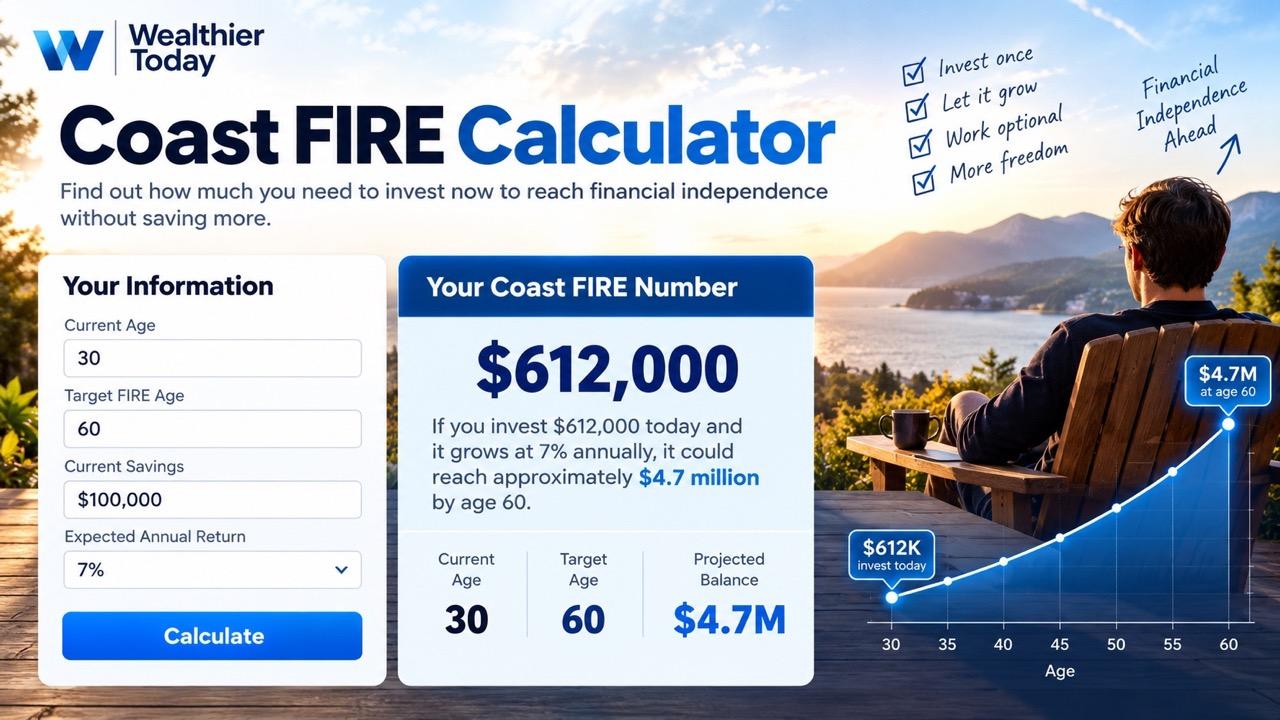
Your Coast FIRE number is the amount you need invested today that could grow into your retirement target without further contributions. It depends on retirement spending, years until retirement, investment returns after inflation, and your withdrawal-rate assumption.
In a hypothetical example, a 35-year-old planning to retire at 65 with $60,000 of annual portfolio-funded spending needs about $478,294 invested today, assuming 7% nominal annual returns, 3% inflation, and a 4% starting withdrawal rate. Those are modeling assumptions, not promised returns or a safe-to-retire verdict.
Open the free FIRE calculator and check your Coast FIRE status. Its Coast result uses age 65. The steps below explain the inputs, show how to calculate a different retirement age, and help turn a threshold into a practical contribution decision.
How to use the Coast FIRE calculator
The calculator combines a traditional FIRE projection with a separate Coast FIRE check. To use it:
- Enter Current age and Current investments. Include the portfolio committed to retirement, rather than your entire net worth.
- Enter Annual take-home income and Annual spending. The tool uses their positive difference as ongoing contributions for its main FIRE projection.
- Set Expected annual return as a nominal rate, before inflation. Account for investment costs in the rate you choose because there is no separate fee field.
- Set Inflation and Withdrawal rate. The calculator converts the return into an inflation-adjusted rate internally.
- Read Coast FIRE by age 65. Below the threshold, it displays the balance needed today. At or above it, it displays Reached.
The main FIRE date and growth chart continue contributions based on income minus spending. They do not show the outcome of stopping contributions at the Coast milestone. Income affects that main projection; it does not change how much existing capital is required to coast.
There is also only one spending input. It determines both the retirement target and current contributions. If current spending is $45,000 but planned retirement spending is $60,000, entering $60,000 can test the retirement target, but the displayed contribution rate and main FIRE date will no longer describe your current budget accurately. Use the formula below for the separate retirement budget and assess current cash flow independently.
There are no separate pension, Social Security, tax, or custom retirement-age inputs. Treat the output as a first screen, then model those details separately.
What Coast FIRE lets you stop doing
Coast FIRE separates saving for future retirement from paying for life today. If investments could reach your eventual target without additional deposits, you may have room to reduce retirement contributions, change jobs, or work fewer hours. Your current expenses still need funding without drawing down that portfolio.
| Approach | What pays today's bills? | What happens to the portfolio? |
|---|---|---|
| Coast FIRE | Work or other resources outside the retirement portfolio | Remains invested without planned withdrawals; new contributions may stop |
| Barista FIRE | Work plus portfolio withdrawals | Supports some spending now, requiring a withdrawal plan |
| Full financial independence | Portfolio and other retirement income | Must support the planned spending gap from now onward |
These are informal labels; individual plans differ. The distinction matters because taking money out during the coast years changes the calculation. A lower-paying job that covers all expenses can fit Coast FIRE. A job that requires selling investments to pay rent needs a different model.
Our FIRE guide explains the broader movement and withdrawal framework. This article focuses on the earlier decision about contributions.
The Coast FIRE formula, including a custom retirement age
Start with a retirement portfolio target:
Retirement target = annual portfolio-funded spending ÷ withdrawal rate.
Then discount that future target back to today:
Coast FIRE number = retirement target ÷ (1 + real annual return)^years until retirement.
Here, years until retirement equals your chosen retirement age minus your current age. Use 0.04 for a 4% withdrawal rate and 0.04 for a 4% real return. The two rates have different jobs: one sizes the retirement target; the other models growth before retirement.
This is ordinary compound-growth arithmetic, not a simulation of market volatility. With zero real growth, the Coast number equals the full retirement target. With negative real growth, you need more today than the eventual real-dollar target. At retirement, there is no remaining coast period.
Use the exact real return
Keep all figures in today's purchasing power by calculating:
Real annual return = (1 + nominal annual return) ÷ (1 + inflation rate) − 1.
At hypothetical 7% nominal growth and 3% inflation, that is `1.07 ÷ 1.03 − 1`, or 3.8835%, rather than exactly 4%. Subtraction gives an approximation; the difference compounds over decades.
Do not enter a real return into the calculator's nominal-return field and subtract inflation again. Likewise, do not inflate retirement spending into future dollars and then compare it with a today's-dollar portfolio projection.
Use a return appropriate to your allocation after relevant costs, and consider ongoing tax drag where applicable. The SEC explains how mutual fund costs reduce returns. Historical averages are not commitments about your next 30 years.
Worked example: age 35, retirement at 65
Assume a hypothetical household has a retirement budget of $60,000 annually in today's dollars, including its expected withdrawal-related taxes. Assume the portfolio supplies that whole amount, with no pension income included.
- Retirement target at a 4% starting withdrawal rate: `$60,000 ÷ 0.04 = $1,500,000`.
- Growth period: `65 − 35 = 30 years`.
- Real return: `1.07 ÷ 1.03 − 1 = 0.03883495`.
- Coast number: `$1,500,000 ÷ 1.03883495^30 ≈ $478,294`.
Using the same assumptions but retiring at 60 leaves 25 years to compound and raises the required balance today to about $578,665. A five-year change is a substantial funding decision.
A 4% withdrawal assumption is also not a claim that $1.5 million lasts forever. The classic guideline starts with 4% of the initial portfolio, then adjusts that dollar withdrawal for inflation. Retirement length, allocation, costs, and spending flexibility matter. Vanguard explains the limits of applying the 4% rule to early retirement.
Coast FIRE by age and return assumption
The following hypothetical table assumes retirement at 65, $60,000 annual portfolio-funded spending in today's dollars, a 4% starting withdrawal rate, and no further contributions or withdrawals. Each column uses a different real annual return. Amounts are rounded to the nearest dollar.
| Current age | Years until 65 | 3% real return | 4% real return | 5% real return |
|---|---|---|---|---|
| 25 | 40 | $459,835 | $312,434 | $213,069 |
| 30 | 35 | $533,075 | $380,123 | $271,935 |
| 35 | 30 | $617,980 | $462,478 | $347,066 |
| 40 | 25 | $716,408 | $562,675 | $442,954 |
| 45 | 20 | $830,514 | $684,580 | $565,334 |
| 50 | 15 | $962,793 | $832,897 | $721,526 |
| 55 | 10 | $1,116,141 | $1,013,346 | $920,870 |
| 60 | 5 | $1,293,913 | $1,232,891 | $1,175,289 |
The 4% real column differs from the worked example's 3.8835% real return. Neither is a forecast. At age 35, changing the assumption from 5% to 3% raises the required portfolio by approximately $271,000. A status that depends on the most optimistic column deserves further review.
Why waiting alone does not close a funding gap
The age table can create a misconception: your investments grow as you get older, so won't you eventually coast automatically?
Under unchanged assumptions, the Coast target grows at the same rate as your untouched portfolio because the remaining compounding period shrinks. A portfolio that is 90% of the target remains 90% funded in this constant-return model without additional deposits.
For example, $450,000 is about 94.1% of the 35-year-old's $478,294 target above. If both grow at the assumed real rate, that shortfall persists proportionally. New contributions, lower spending, a later retirement date, or better realized returns can change the outcome. Simply waiting does not fix it under the original assumptions.
Check what belongs in your portfolio and budget
Count invested assets intended to fund retirement, including vested workplace retirement savings and retirement-designated brokerage investments. Avoid counting the same money in two goals.
Keep emergency cash, a near-term house deposit, and money reserved for tuition outside the coast portfolio unless your plan explicitly reallocates them. Home equity needs a specific monetization plan: selling and buying a cheaper home may release capital, but the full property value is not automatically available for retirement spending.
The future budget should include housing, repairs, transport, health coverage, taxes, dependents, and irregular purchases. Use our budgeting guide to establish current spending, then make explicit retirement adjustments.
A pension or public benefit can reduce what investments must supply, but only for the years it actually pays. Do not subtract a benefit starting at 70 from every year of a retirement starting at 60. A fixed pension also loses purchasing power unless its terms provide increases. The linked calculator does not handle those cash flows separately.
Spending creep can erase your Coast status
Suppose the hypothetical 35-year-old reaches the $478,294 threshold, stops contributions, and raises recurring spending from $60,000 to $72,000 in today's dollars. If that lifestyle continues in retirement, the required portfolio rises 20%, and so does the Coast threshold: to approximately $573,952 under the same assumptions.
Spending freed-up contribution money on a one-time experience has a different retirement implication from adding permanent rent, car, or subscription costs. Before spending the entire former contribution, decide which costs end and which become the new retirement baseline.
Build a margin for error before reducing contributions
A spreadsheet threshold is conditional. Market returns vary, and a career change can affect insurance, income stability, and the ability to resume saving.
Test at least three adjustments to your base case:
- Lower real returns. Use the age table or recalculate at one or two percentage points less.
- A larger retirement budget. Include higher housing, health, or family costs, instead of assuming every expense follows general inflation.
- A lower withdrawal rate. In the worked example, moving from 4% to 3.5% raises the Coast number from about $478,294 to $546,621.
These are stress scenarios, not probabilities. Passing them does not establish a particular chance of success. A fixed extra 10% cushion cannot compensate for every combination of lower returns and higher spending.
Review whether the assumed return fits the portfolio you can actually hold through declines. Our index fund guide covers diversified, low-cost investing; a diversified portfolio can still lose value.
Protect the portfolio from current-life withdrawals
Keep accessible reserves appropriate to job stability and likely disruptions. The CFPB explains why emergency-fund size depends on personal circumstances. Someone moving to variable freelance income may need a different reserve from someone keeping a stable salary.
A hypothetical $20,000 withdrawal today from the worked example's portfolio represents about $62,723 of lost real-dollar retirement value after 30 years at the assumed rate, before withdrawal taxes or penalties. A sabbatical financed separately preserves the COAST calculation; one financed from the retirement portfolio changes it.
In the United States, many retirement-account distributions before age 59½ can face an additional 10% tax, subject to account-specific exceptions. Ordinary income tax may also apply. Check the IRS early-distribution exception rules rather than assuming the Coast milestone changes account-access rules.
Should you keep investing after reaching Coast FIRE?
Often, some contributions still serve a purpose: preserving an employer match, retiring sooner, funding a more expensive future, or increasing resilience. You can be mathematically eligible to coast and still prefer continued saving.
For a hypothetical U.S. employee earning $80,000, a dollar-for-dollar match on the first 4% of eligible pay adds $3,200 annually when the employee contributes $3,200. Cutting contributions to zero gives up that match under these assumed terms. Confirm your actual eligibility, matching schedule, and vesting before making a change.
Your own workplace-plan contributions are fully vested; employer contributions may follow a schedule. The IRS explains vesting and checking your plan documents. A job change can also forfeit unvested money that appears in the account balance.
An intermediate option is reducing unmatched contributions while keeping an affordable contribution that earns the match. Continue saving separately for emergencies and near-term goals. Coast FIRE concerns retirement funding, not permission to stop every form of saving.
Make the decision reversible
Use the result to design a manageable experiment:
- Write down your retirement age, spending, return assumptions, and minimum acceptable funding level.
- Verify the proposed job or hours change covers current bills, taxes, health insurance, and reserves without portfolio withdrawals.
- Try a temporary reduction in contributions before adding large recurring commitments or leaving work permanently.
- Schedule a review after six months and at least annually thereafter. Recalculate after a major spending change, market decline, or benefits change.
- Set a response in advance: restore contributions, reduce optional spending, or reconsider retirement timing if the plan falls below your chosen threshold.
Resuming contributions may be harder after a career change, so consider your earning options alongside the financial projection. The useful outcome is knowing how much flexibility your current savings could support, and what you would change if the assumptions fail.
Frequently asked questions
How do I calculate my Coast FIRE number?
Divide annual retirement spending by your assumed withdrawal rate, then divide that target by one plus your real annual return raised to the years until retirement. Use decimals for percentages and keep spending and returns on the same inflation basis.
Does Coast FIRE mean I can stop working?
No. Coast FIRE assumes your existing investments remain untouched until retirement. You still need income or separate resources to cover current expenses, taxes, insurance, and other goals.
Can I reach Coast FIRE just by waiting?
Under an unchanged constant-return model, a portfolio below its Coast target remains the same percentage funded without new contributions. Closing the gap requires additional money, better realized returns, lower planned spending, or a later retirement date.
Should I stop contributing to my 401(k) after reaching Coast FIRE?
Reaching a modeled threshold does not make stopping the best choice. Evaluate the employer match, vesting, taxes, cash reserves, and downside scenarios first. Reducing unmatched contributions while keeping an affordable matched contribution can preserve flexibility.
Does my home count toward Coast FIRE?
Include only assets actually assigned to the retirement funding plan. Home equity is not an investable portfolio balance unless you explicitly model selling, downsizing, or another way of accessing it, including replacement housing costs.
Can I use a retirement age other than 65?
The linked Wealthier Today calculator uses age 65 for its Coast FIRE result. For another retirement age, use the formula in this article with your chosen number of years until retirement. Its main FIRE date is a separate projection that continues contributions.
Continue reading
More resources
- MoneyWhat Is Wealth Management? Services, Fees, and How It WorksWealth management is holistic financial planning for people with complex finances—covering investments, taxes, estates, retirement, and risk. Learn services, typical fees, asset minimums, and how to choose a fiduciary.Read next
- Personal FinanceHow To Budget Your Money And Stop Living Paycheck To PaycheckThis is a practical evergreen guide to building a paycheck-based budget, breaking the cash-flow cycle, trimming leaks, handling debt, and creating breathing room.Read next
- Personal FinanceSpending & BudgetingSpending is how you pay for things; budgeting is how you make it sustainable.Read next
- InvestingWhat is Investing?Saving helps you achieve your financial goals. Investing helps you grow your savings.Read next