
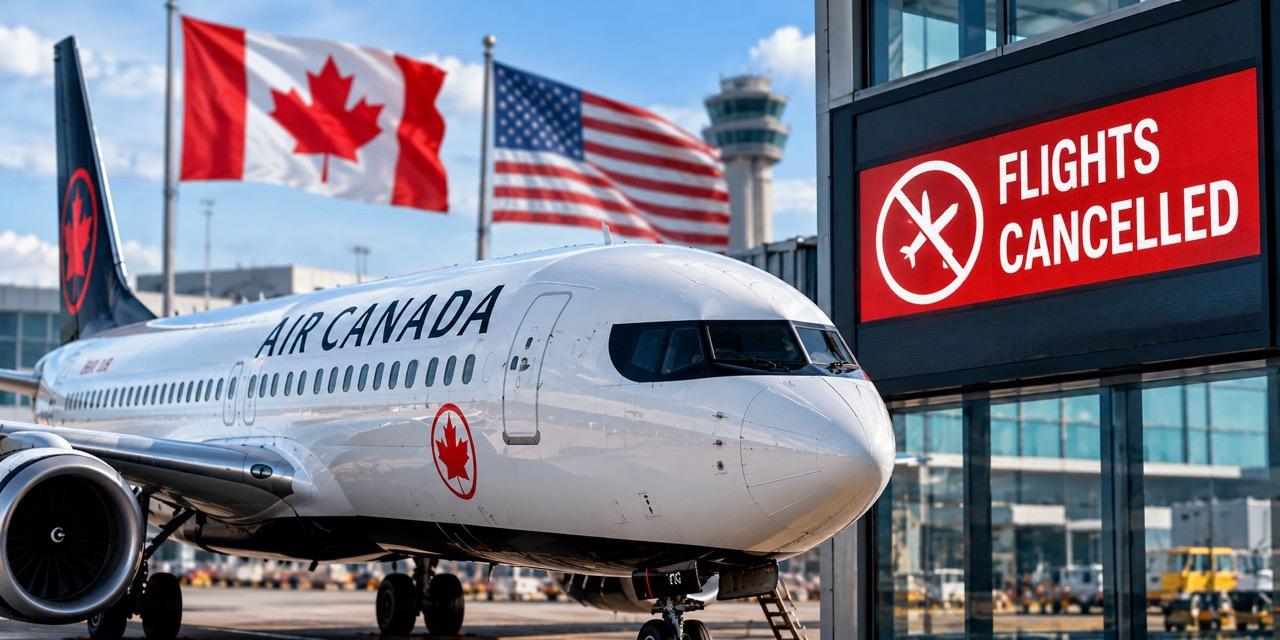
Air Canada (TSX: AC) is removing five routes between Canada and the United States from its 2027 schedule, including its Toronto–Charleston service. The cuts do not mean the airline is cancelling all flights to the US. Air Canada is also adding three routes for next summer as it adjusts its network to customer demand and commercial priorities.
The changes became visible in schedule data analyzed by aviation publications this week. The most notable withdrawal is the planned discontinuation of the seasonal route between Toronto Pearson International Airport and Charleston International Airport in South Carolina. Air Canada will no longer offer direct service to Charleston, which had been served by the carrier through its Toronto connection.
An Air Canada spokesperson confirmed the decision to discontinue the route for commercial reasons in comments reported by TheStreet. The company said it regularly reviews its schedules to match capacity with customer demand and travel patterns.
The cuts come after a prolonged decline in Canadian travel to the United States. Statistics Canada data cited in the report showed that Canadian trips to the US in September 2026 were down 29% compared with September 2024. Return trips by car were down 31% over the same period, while trips by air fell 19%. The figures point to continued weakness in cross-border travel relative to two years earlier, even as some routes remain in demand.
Which Air Canada Routes Are Being Cancelled?
The five routes removed from Air Canada’s planned 2027 network are:
- Montréal–Seattle: The route is being removed from the summer 2027 schedule. Air Canada will continue to serve Seattle from other Canadian cities.
- Toronto Billy Bishop–Boston: Flights are scheduled to stop from December 2026 onward. The change affects the service from Toronto’s downtown airport rather than all Air Canada flights to Boston.
- Vancouver–Nashville: The planned seasonal service will not return for summer 2027.
- Vancouver–Raleigh/Durham: The route has also been removed from the next summer schedule.
- Toronto Pearson–Charleston: Air Canada will discontinue its seasonal service to Charleston, leaving the city without a direct Air Canada route.
The removals affect specific city pairs, not the airline’s entire US operation. Air Canada will continue flying to major US markets through Toronto, Montréal, Vancouver and other Canadian hubs.
The Toronto–Charleston change is particularly significant for travellers who relied on a nonstop flight. Passengers planning trips to South Carolina may need to connect through another US or Canadian airport or book with a different airline. Travellers should check the airline’s official flight status and schedule tools before making plans, since schedules can change.
Why Air Canada Is Cutting Routes While Adding New US Flights
Air Canada’s network adjustments reflect a combination of weaker cross-border demand and the need to allocate aircraft to routes with stronger commercial prospects. The company has said the Charleston cancellation is for commercial reasons. It has not publicly attributed every route removal to a single cause.
The broader travel pullback has coincided with trade tensions between Canada and the US, including tariffs and political disputes that have affected travel sentiment. Higher fuel prices have also pressured airline economics this year. The impact of crude oil’s rise above $100 a barrel illustrates the cost pressures facing carriers, although Air Canada has not identified fuel as the specific reason for every route in the latest round of cuts.
At the same time, Air Canada is not retreating from the US market as a whole. The airline announced three new routes for summer 2027: Toronto to Louisville, Montréal to Indianapolis and Edmonton to Newark. The Toronto–Louisville service is scheduled to begin on April 28, 2027, while the Montréal–Indianapolis and Edmonton–Newark routes are planned for June.
The new services form part of a broader expansion with United Airlines. The two carriers are also planning to increase capacity on certain existing routes and deepen their transborder partnership, subject to regulatory approval. Their strategy is to connect more passengers through major hubs while continuing to serve business and leisure markets where demand supports the service.
These additions show why it would be misleading to describe the announcement as Air Canada cancelling all US flights. The airline is removing routes that no longer fit its plans while investing in other city pairs. For travellers, the result is a narrower choice of direct flights on some routes but more options on others.
For now, the most important change for affected passengers is the loss of specific nonstop services, especially the Toronto–Charleston connection. Travellers booked on affected flights should monitor airline notifications and review their options if their itinerary changes. The airline’s wider US network remains in operation, and its summer 2027 schedule includes both withdrawals and new routes.