
Anthropic's Claude Duet and Meta's Muse AI are competing to make artificial intelligence more useful by moving beyond answering questions to completing tasks on users' behalf. However, the two assistants take different approaches to personal productivity, business workflows and everyday tasks.
Anthropic introduced Claude Duet on October 21, 2026, as a research preview aimed at professionals and small-business owners. The assistant can monitor connected applications, prepare daily briefings and work on complex assignments in the background. Meta introduced Muse on September 8, 2026, positioning it as a personal AI agent designed to help a broader audience manage tasks and pursue goals.
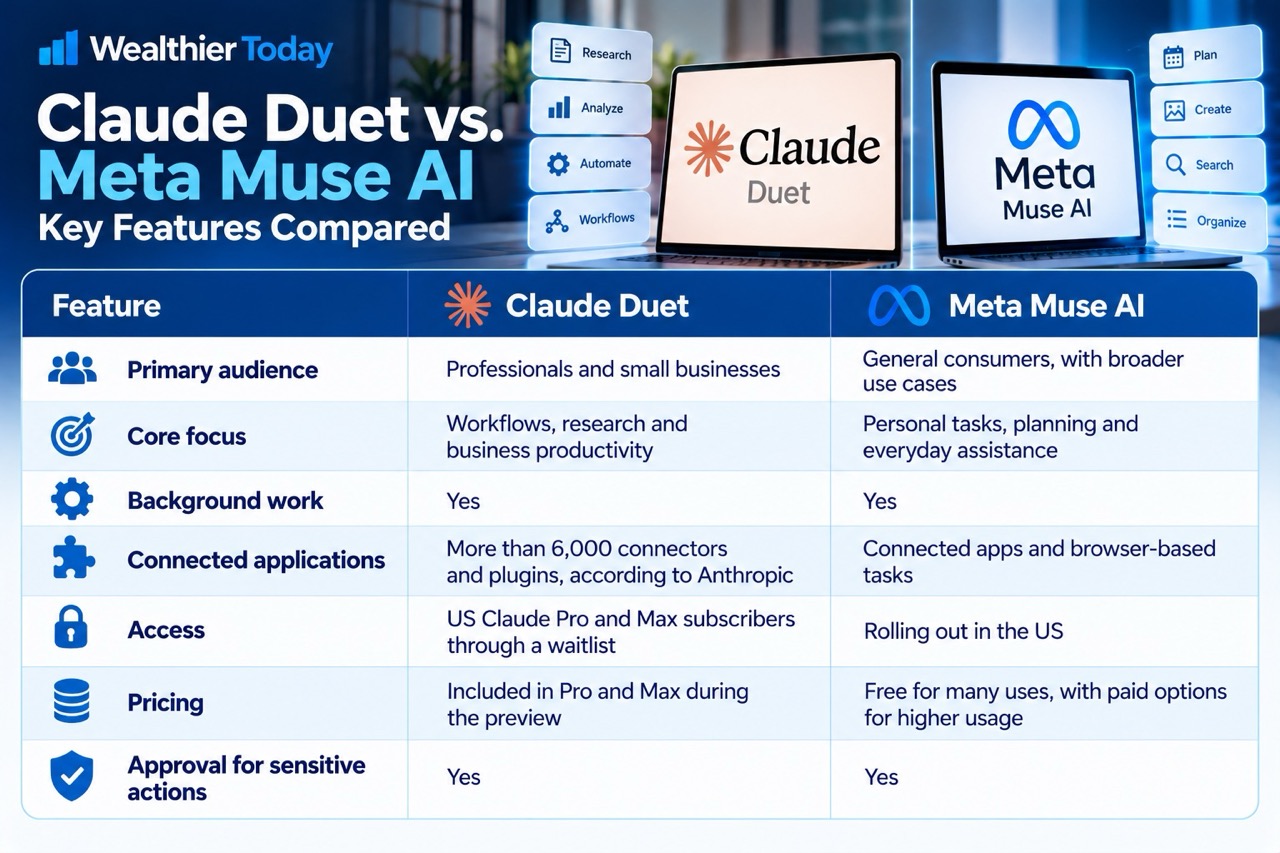
Both products can work across connected apps and continue tasks when users are away. The main distinction is their intended audience: Claude Duet emphasizes professional productivity, while Muse focuses on personal assistance and everyday activities.
Claude Duet vs. Meta Muse AI: Key Features and Differences
Claude Duet is built around Anthropic's Claude Opus 5.5 model and is designed to identify work that needs attention without requiring users to initiate every interaction. According to Anthropic's product announcement, it can review connected information, prepare a morning briefing, draft responses and handle larger assignments, including financial forecasts, dashboards and web applications.
The assistant also supports more than 6,000 connectors and plugins, according to Anthropic. Users can assign work through its standalone mobile app or web interface, then review the resulting documents and other deliverables. Anthropic says Duet requests approval before sensitive actions, including sending messages or making payments.
Meta Muse takes a broader consumer approach. Powered by Meta's Muse Spark model at launch, the assistant can help users send emails, arrange travel, complete online forms and organize longer-term projects. Meta says users can interact with Muse through its dedicated app and WhatsApp, with the agent continuing work in the background when necessary.
The company has also developed Muse Secure VM, a dedicated virtual machine intended to isolate the agent's activities and connected data. Meta says Muse requests permission for sensitive actions and lets users control which applications it can access.
Availability and features may change as both products develop. The details above reflect the companies' published announcements and product information available as of October 23, 2026.
Which AI Assistant Is Better for Work, Privacy and Everyday Tasks?
For professionals who regularly handle research, reporting, spreadsheets and complex projects, Claude Duet appears better aligned with those needs. Its morning briefings, extensive connector support and ability to produce financial models, presentations and dashboards make it a potential option for users looking to delegate time-consuming work.
However, Claude Duet is still in its research-preview stage. Anthropic acknowledges that the assistant can misjudge urgency, and its background checks may miss information that arrives between scheduled reviews. Access is also restricted to eligible US-based Pro and Max subscribers invited through its waitlist, limiting its immediate reach.
Meta Muse has a broader appeal for people who want an assistant to manage personal tasks, organize plans and interact with everyday services. Its integration with WhatsApp offers a familiar way to communicate with the agent, while its free usage allowance makes it easier to try without immediately committing to a separate subscription.
Meta has also extended Muse into business workflows. As detailed in Wealthier Today's report on Muse AI's expansion into small businesses, the company has introduced integrations with services including Shopify, QuickBooks and Stripe. That expansion means Muse is not limited to personal errands, although the available features depend on the version and connected services.
Privacy is another consideration. Both companies say their assistants require approval for sensitive actions and incorporate protections for connected accounts. Users should nevertheless review permissions carefully before granting either agent access to email, calendars, financial information or other personal data.
Neither product has established a definitive performance advantage across all tasks, and their capabilities are still evolving. A fair comparison will require independent testing of accuracy, reliability, completion rates and the amount of human supervision each assistant needs.
Verdict: Meta Muse is the more accessible choice for everyday assistance, particularly for users who already rely on Meta's ecosystem. Claude Duet is the more targeted option for professionals who want to delegate complex, multi-step work across connected applications. For now, the better assistant depends on the user's priorities rather than a proven overall performance winner.