
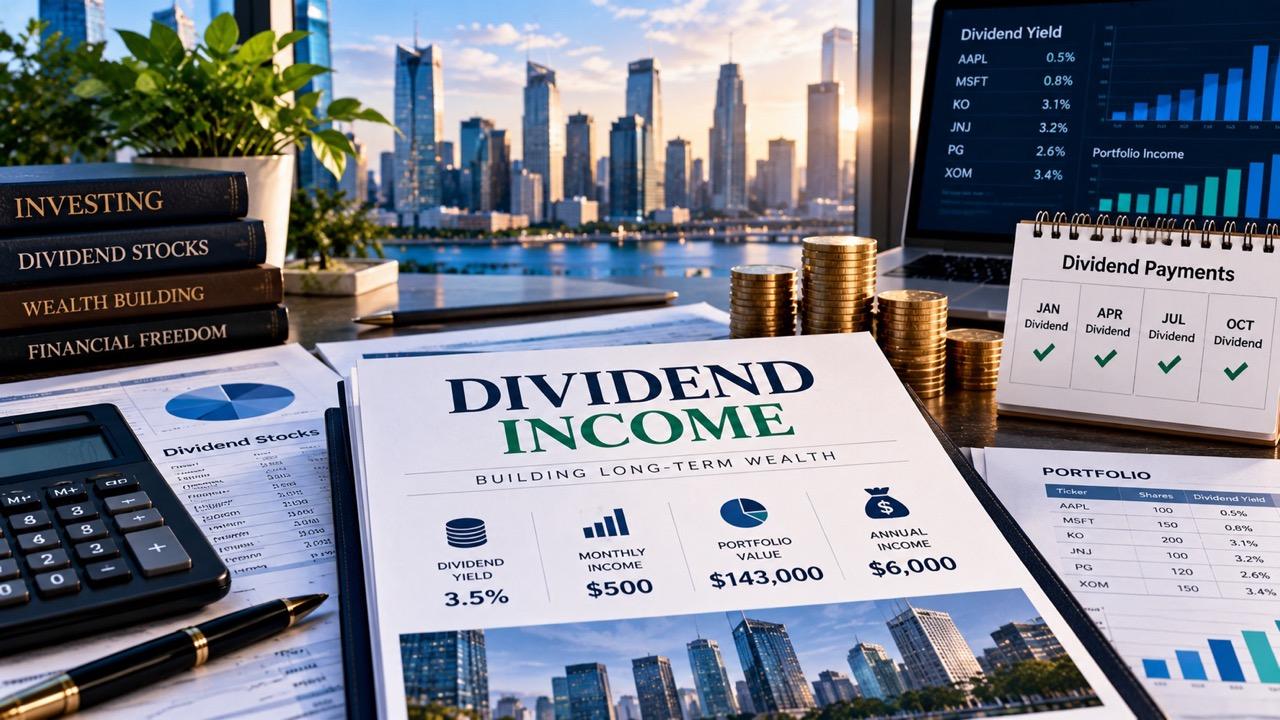
Investors targeting $500 a month in dividend income need to build a portfolio capable of generating $6,000 annually. Depending on the yield, that can require between $100,000 and $300,000 invested, before taxes. Aiming for a sustainable payout rather than the highest advertised yield can help protect the capital needed to generate that income.
How Much You Need to Invest at Different Dividend Yields
The calculation starts with a simple formula: divide your annual income goal by the portfolio’s dividend yield. Dividend yield measures annual dividends relative to the current value of an investment.
For a $500 monthly target, the annual income goal is $6,000. Here is the amount you would need invested at different assumed portfolio yields.
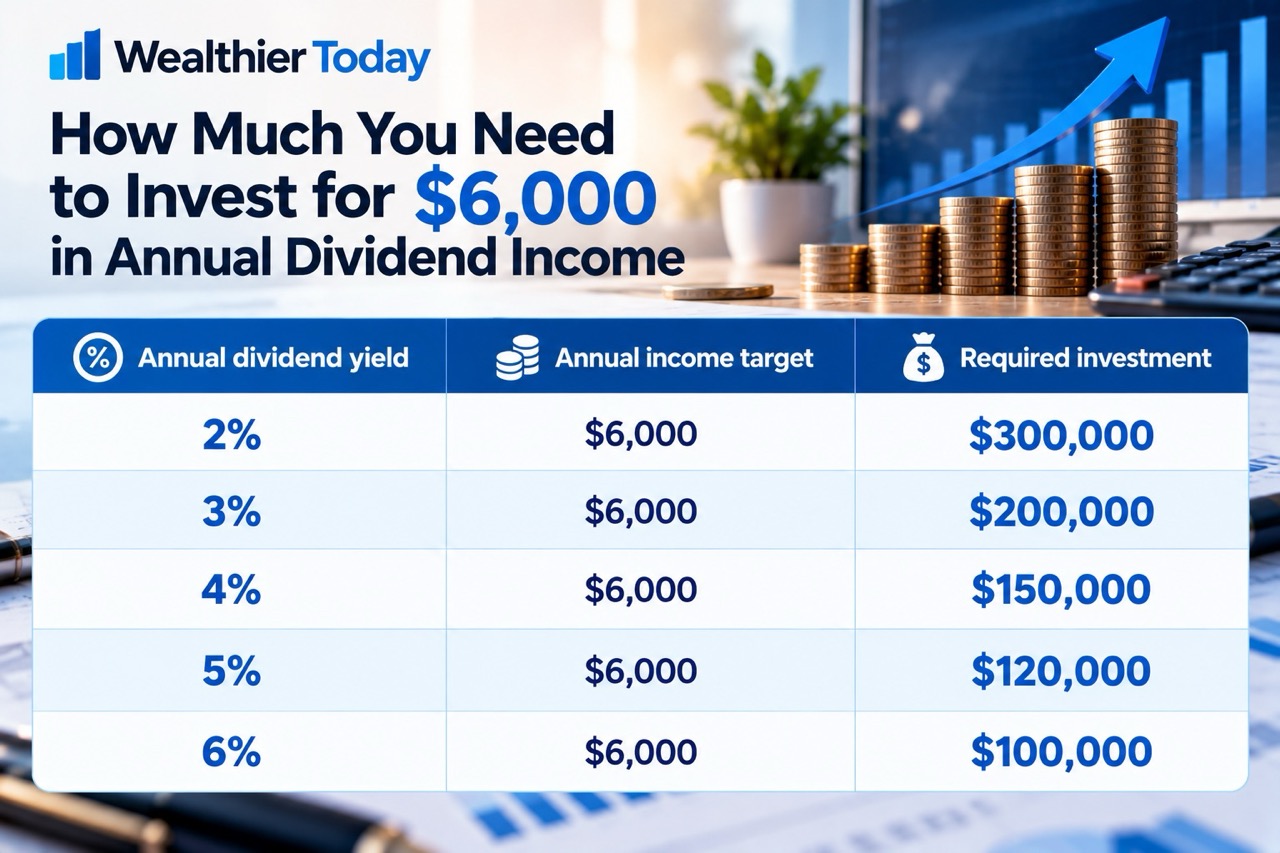
These are mathematical estimates, not guaranteed returns. They assume your portfolio continues generating the stated yield and that the $6,000 target is measured before taxes.
A 3% yield requires twice as much capital as a 6% yield because the portfolio must be larger to generate the same income. However, choosing investments purely because they offer a high yield can expose you to greater risk. A company may offer a high yield because its share price has fallen sharply, potentially reflecting concerns about earnings or the sustainability of its dividend.
For a real-world reference, the Schwab U.S. Dividend Equity ETF (SCHD) reported a trailing-12-month distribution yield of 3.00% as of August 31, 2026. At that historical rate, an investment of approximately $200,000 would correspond to $6,000 in annual distributions. Future payouts can change, so the figure should not be treated as a forecast.
The difference between a portfolio’s yield and its total return is also important. Dividends provide cash income, but share prices can fall. A portfolio that distributes $6,000 while losing more than that amount in market value may still leave its owner worse off overall.
This is why dividend investors should examine the underlying businesses as well as their payouts. Revenue, profit margins, debt and available cash flow can all affect a company’s ability to maintain or increase its dividend. PepsiCo (NASDAQ: PEP), for example, has to balance shareholder distributions with operating expenses and its earnings outlook, as reflected in its 2026 profit and dividend outlook.
How to Build a Dividend Portfolio That Can Sustain $500 a Month
Reaching a $500 monthly income goal does not require finding one stock with an unusually high yield. Investors can spread their money across dividend-paying companies in different sectors or use dividend-focused exchange-traded funds to gain exposure to multiple businesses through a single investment.
Diversification matters because companies do not all respond to economic conditions in the same way. Banks depend partly on lending conditions, consumer companies are exposed to household spending, and energy businesses can be affected by commodity prices. A portfolio concentrated in one industry may suffer if several holdings face the same pressure at once. Reviewing how family offices distribute investments across their portfolios can provide context for thinking about exposure across businesses and sectors, although their strategies may differ from those of individual investors.
Investors should also decide whether they need the income immediately. Someone still building a portfolio may benefit from reinvesting dividends to buy additional shares, allowing future payouts to be generated from a larger number of holdings. Someone already using dividends to cover living costs may instead direct distributions to a cash account.
Payment timing creates another practical issue. Many US companies distribute dividends quarterly rather than monthly. A portfolio generating $6,000 over a year may therefore provide uneven payments throughout the year, even though its average income works out to $500 a month. Investors who need consistent monthly spending money can keep a cash reserve and transfer a set amount into their spending account each month.
Taxes can raise the amount of investment capital needed to meet a spending target. The tax treatment depends on the investor’s circumstances, the account holding the investments and whether distributions qualify for preferential treatment. The IRS guidance on investment income explains the distinction between ordinary dividends and qualified dividends. Investors targeting $500 in after-tax income should calculate the gross payout required after accounting for their applicable taxes.
It is also important to review dividend sustainability regularly. Companies can reduce or suspend distributions when earnings weaken or cash needs increase. The SEC’s investor bulletin on fund distributions notes that fund distributions are not guaranteed and that investors can lose money even when a fund pays them.
For anyone starting from a smaller balance, building toward $100,000 or more may take years of regular contributions and reinvestment. The time required depends on how much is invested, the returns earned and whether the portfolio’s dividends grow. A broader long-term investing plan can help balance income goals with growth, liquidity and the risk of losing capital.
The bottom line: A $500 monthly dividend target equates to $6,000 a year. At a 4% yield, the required portfolio is about $150,000 before taxes; at a 3% yield, it is about $200,000. The most useful target is not simply the smallest amount of capital required, but a portfolio whose income is reasonably sustainable without taking excessive risks to reach it.