
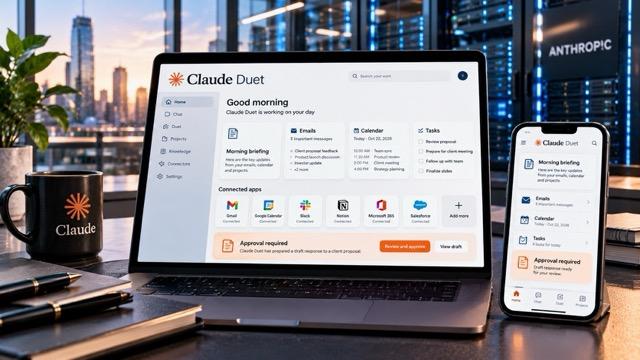
Anthropic has launched Claude Duet, a proactive AI assistant designed to monitor connected work apps, flag important updates and complete tasks while users are away. The research preview became available on October 21 through a waitlist for US subscribers on Claude Pro and Max plans, adding another competitor to the growing market for AI agents that do more than answer prompts.
The new app is designed for professionals and small-business owners who juggle email, calendars, customer communications and administrative work across multiple services. Rather than waiting for users to open a chat and issue a request, Claude Duet can prepare a morning briefing, track connected apps throughout the day and contact users when something needs attention.
In its official announcement, Anthropic said the assistant is built around Claude Opus 5.5 and can handle tasks ranging from scheduling meetings to creating dashboards, financial forecasts and web applications. The company is positioning the product as a work partner that can make progress independently while asking for permission before taking consequential actions.
The launch comes as Anthropic expands Claude beyond conventional chatbot interactions. The company’s reported $16.8 billion in third-quarter revenue highlights the commercial momentum behind its AI business, while Duet gives it another way to turn Claude’s capabilities into a tool businesses can use throughout the workday.
What Claude Duet Does and How It Works
Claude Duet connects to a user’s existing Claude account, bringing across its memory, skills and connected applications. It is available as a standalone app for iOS and Android and through the web at Claude.ai. Users can communicate with it by text or voice in an ongoing thread.
Its main feature is proactive assistance. Each morning, Duet prepares a summary of important items across connected apps, including email and calendar activity. It then checks those accounts every few hours and sends notifications when it identifies something that may require attention. Anthropic says the checks are deliberately spaced out because continuous monitoring would consume more of a user’s plan allowance.
Users can also assign work directly. For example, Duet can find unanswered messages, draft email replies, identify unpaid invoices and prepare payment reminders. It can help prepare payroll information, organize sales data, create presentations and build dashboards. The user can then review the work rather than assembling every step manually.
Anthropic says Duet supports more than 6,000 connectors and plugins through the Claude Marketplace. Integrations include Gmail, Slack, QuickBooks, Stripe, Gusto, HubSpot, DocuSign and Shopify, depending on the task and service permissions granted. The company says Duet can also make purchases using Stripe’s Link digital wallet or Shopify’s Shop Pay, with approval required through the relevant payment process.
The product differs from a conventional Claude conversation because it operates through a virtual machine with its own browser in the cloud. That allows it to continue working after a user closes the app or steps away from their computer. Users receive a notification when a task is completed or when a decision is needed.
The same capabilities distinguish Duet from competing products. Meta’s Muse AI assistant is expanding into business software and commerce, while OpenAI’s Dots agents are designed to pursue goals across connected apps. The products signal a shift from chatbots that mainly respond to questions toward assistants that can carry out multi-step work.
There are limits. Claude Duet remains an early research preview and may misjudge urgency, misunderstand a conversation or overlook information between checks. Anthropic says the current version is better suited to professional work than personal errands, such as booking tickets, and its browser activity is not yet directly visible to users in the same way as a conventional browser session.
Safety, Privacy and Access: What Users Should Know
Anthropic says Duet requires user approval before it sends messages, makes payments, signs documents or deletes information. It also says the assistant does not directly see account passwords or sign-in tokens, and a dedicated classifier and safety system are designed to prevent sensitive information from being shared without explicit instructions.
Some actions remain prohibited even with user approval. According to Anthropic, Claude Duet cannot trade securities or move money between accounts. Users can also disconnect apps they no longer want the assistant to access.
These safeguards are important because an AI agent that can read email, inspect calendars and prepare transactions has a different risk profile from a chatbot that only generates text. An incorrect message or a misinterpreted instruction could affect a real customer relationship or business process. Anthropic says it has conducted adversarial testing and external penetration testing, and that the product is covered by its public bug bounty program.
Access is currently limited. The research preview is available to users in the US who subscribe to Claude Pro or Max and join the waitlist. It is not yet available on Team or Enterprise plans. The assistant does not carry a separate subscription price during the preview, but it shares the user’s existing Claude usage limits, including the work performed in the background. Larger tasks can therefore consume more of a plan’s allowance than a typical chat.
The rollout also matters for businesses considering adoption. Duet can work across connected systems, but users still need to verify its outputs and decide which data and permissions to provide. Businesses handling payroll, customer records or financial information may need to review internal security requirements before giving an AI agent access to those services.
Anthropic’s launch places it in a more direct contest with companies developing autonomous assistants. As the company broadens Claude’s commercial reach, Duet could make AI useful for recurring office work rather than just drafting and research. Whether it delivers lasting productivity gains will depend on how reliably it handles connected tools, how well it judges when to interrupt users and how much work people can delegate without losing control.
For now, Claude Duet is a limited-access preview rather than a fully mature replacement for existing workplace software. Its central promise is that Claude can monitor routine work, make progress in the background and return when human judgment or approval is needed. The next stage will depend on feedback from early users and Anthropic’s ability to improve reliability, security and task completion.