
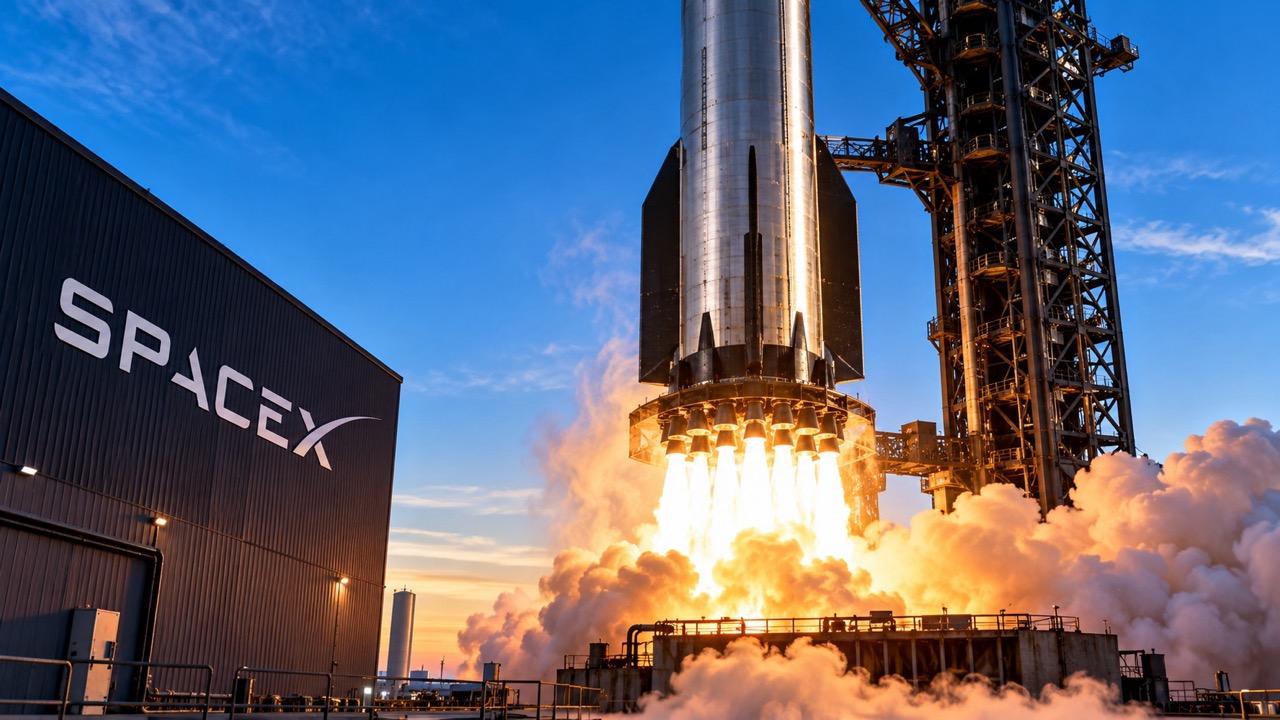
SpaceX (NASDAQ: SPCX) has completed a full-duration engine test of its Super Heavy booster as preparations intensify for the next Starship launch, a mission that could attempt the first catch of the spacecraft’s upper stage by the launch tower.
The booster, designated Booster 22, fired all 33 of its Raptor 3 engines for approximately 15 seconds during a static-fire test at the company’s Starbase facility in South Texas on October 25. Space.com reported the test on October 26, citing SpaceX’s confirmation that the booster had completed the planned firing.
The test marks a key step toward Starship Flight 15, although the rocket still has additional preparations to complete before launch. SpaceX must conduct further checks on the booster and upper stage before the two vehicles are combined for the mission.
Super Heavy Booster Completes 33-Engine Static Fire
The October 25 test involved igniting all 33 engines on the Super Heavy first stage for around 15 seconds. A static fire allows engineers to evaluate propulsion systems while the rocket remains secured on the ground, rather than testing them during flight.
Booster 22 is expected to fly with Starship upper stage Ship 42 on Flight 15. Before the launch can proceed, Ship 42 must undergo its own testing, including a static engine firing and final systems checks.
The preparations follow Starship Flight 14’s first successful trip to orbit, which took place on September 28. During that mission, Starship deployed 26 next-generation Starlink V3 satellites, giving the program its first successful orbital payload deployment.
Flight 14 did encounter a problem during ascent when a Raptor engine on the upper stage shut down prematurely. SpaceX ended the planned mission early, and the vehicle completed a controlled reentry and splashdown in the Pacific Ocean after roughly three hours rather than following the original 10-hour flight plan.
Flight 15 could carry another batch of Starlink V3 satellites, but SpaceX has not officially confirmed the payload. The next-generation satellites are central to the company’s plans to expand Starlink’s network capacity, and Starship is designed to carry larger payloads than SpaceX’s operational Falcon 9 rocket.
Starship Flight 15 Could Attempt First Tower Catch
SpaceX is also targeting a major recovery milestone for Flight 15. Elon Musk has said the company will attempt to catch the Starship upper stage with the launch tower’s mechanical arms, potentially extending the recovery approach already used for Super Heavy boosters.
A successful catch would be an important step toward SpaceX’s goal of making both stages of Starship rapidly reusable. The company has demonstrated booster catches in previous tests, but recovering the upper stage would introduce a new challenge involving the spacecraft’s return, positioning and interaction with the launch infrastructure.
Starship’s development also has implications for NASA’s Artemis lunar program. SpaceX is building a modified version of the vehicle to serve as a lunar lander, and NASA has outlined additional demonstrations the company must complete before the system can carry astronauts. The agency’s upcoming Artemis plans include tests in Earth orbit, while an uncrewed lunar landing demonstration is expected before a crewed landing attempt.
SpaceX has additional ambitions for Starship beyond Flight 15, including a first launch from Florida and a possible re-flight of an upgraded Super Heavy booster before the end of 2026. Those milestones remain dependent on testing progress and mission readiness.
The company has not announced a confirmed launch date for Flight 15. Based on the timing of recent test campaigns, Space.com reported that a launch could take place in mid-to-late November, though the schedule may change as the remaining checks proceed.
For now, the successful 33-engine firing provides a concrete step toward the next test. The more significant milestone will be whether SpaceX can complete the remaining preparations and demonstrate another Starship flight while advancing its plans for full vehicle recovery.