
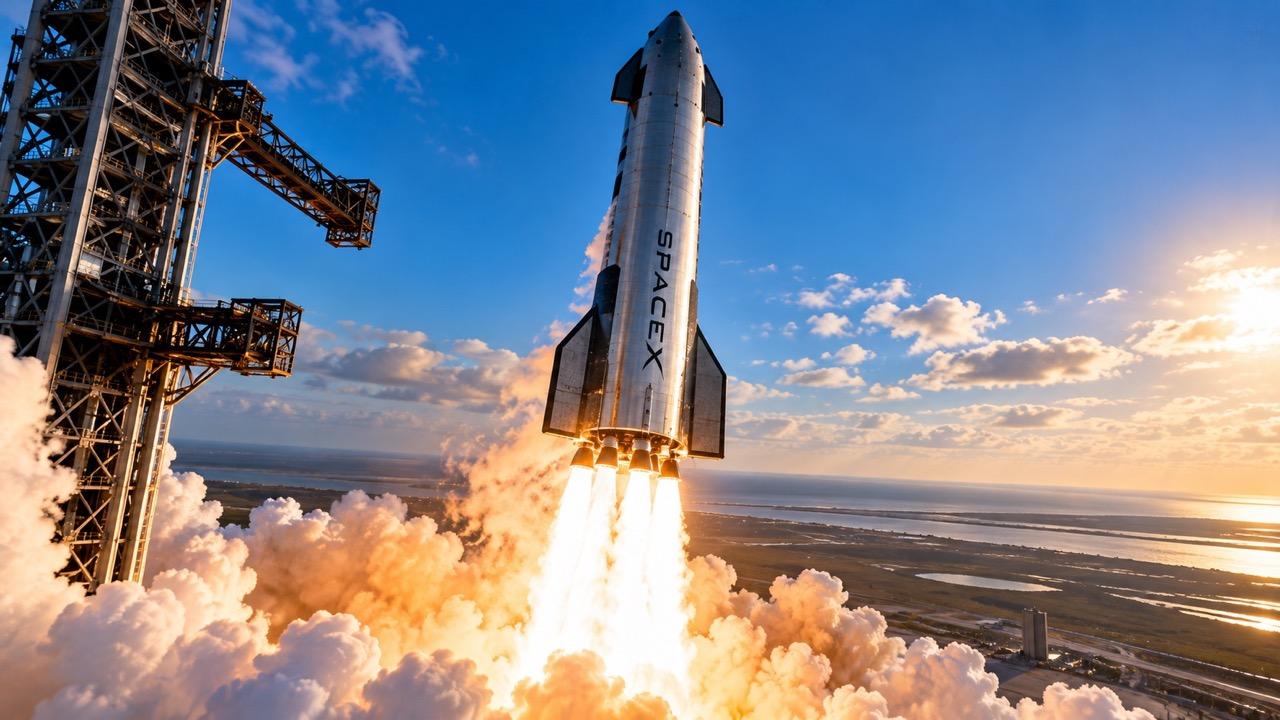
- SpaceX's Starship reached Earth orbit for the first time on Sept. 28 during Flight 14, clearing a major test milestone after an engine issue during ascent briefly put the mission's orbital attempt in doubt.
SpaceX's Starship reached orbit for the first time Monday during its 14th integrated flight test, achieving a key objective for the vehicle after years of development and 13 previous suborbital test flights.
The vehicle lifted off from SpaceX's Starbase facility in South Texas at 8:48 a.m. EDT (12:48 p.m. GMT), according to Space.com's report on the Flight 14 launch.
The mission did not proceed entirely as planned during its early stages. One of the six engines on the Starship upper stage shut down during ascent, raising uncertainty over whether the vehicle would continue with its planned orbital insertion. Mission controllers initially announced that the orbital attempt had been called off before reversing that decision and proceeding with the flight.
About 25 minutes after liftoff, Ship 41 fired a Raptor engine to perform the orbital-insertion burn. Mission control subsequently confirmed that Starship had reached orbit. The achievement marks a new phase in the development of SpaceX (NASDAQ: SPCX)'s Starship system.
Starship Reaches Orbit and Deploys 26 Starlink V3 Satellites
The Flight 14 mission has objectives beyond reaching orbit. Starship is carrying 26 next-generation Starlink V3 satellites, which are scheduled for deployment during the mission. Space.com reported that the satellites were planned to begin deploying roughly 34 minutes after liftoff over a period of about 30 minutes.
The payload is significant because Starlink V3 is designed as a higher-capacity generation of satellites. The flight therefore serves as both an orbital test of Starship and a demonstration of its ability to deploy operational payloads.
SpaceX's official Starship Flight 14 information identifies orbital insertion and Starlink deployment among the mission's objectives. The first stage also completed a controlled return. The Super Heavy booster splashed down in the Gulf of Mexico approximately seven minutes after launch, according to Space.com.
Neither the booster nor Ship 41 is being recovered on this mission. The Flight 14 mission profile instead calls for the Starship upper stage to continue the flight before a planned controlled splashdown. The remaining portion of Flight 14 is expected to last several more hours. S
pace.com reported that the mission is designed to continue for roughly 9 hours and 50 minutes, with Ship 41 expected to complete additional orbits before carrying out a deorbit maneuver and targeting a splashdown in the Pacific Ocean off the coast of Chile. The vehicle stands roughly 407 feet, or 124 meters, tall, and SpaceX says the system is designed to eventually be fully and rapidly reusable.
The result builds directly on the earlier Flight 14 preparation campaign, which included stacking the booster and upper stage and conducting a wet dress rehearsal. Wealthier Today's earlier Starship Flight 14 coverage detailed the planned orbital insertion and 26-satellite deployment.
Why the First Orbital Flight Matters
Reaching orbit changes what SpaceX can test with Starship. The previous integrated Starship flights followed suborbital trajectories. Flight 14 is the first mission in the program designed to place the upper stage into orbit before conducting an orbital mission and controlled return.
The test is also relevant to NASA's lunar exploration plans. NASA is working with SpaceX to develop a Starship Human Landing System for the Artemis program. The agency says SpaceX's lander is being developed to transport astronauts from lunar orbit to the Moon's surface and back.
NASA's current Artemis planning includes an uncrewed lander demonstration before crewed lunar surface missions. The agency says the Artemis III demonstration mission in 2027 is intended to test rendezvous and docking operations between Orion and commercial human-landing-system test vehicles developed by SpaceX and Blue Origin.
Flight 14 still has additional objectives to complete. The upper stage must continue its orbital mission, perform its planned deorbit maneuver, and attempt a controlled splashdown. Those stages are necessary to evaluate the vehicle beyond the initial orbital-insertion milestone.
For now, the clearest result is that Starship has reached orbit for the first time. The mission also demonstrated a successful Super Heavy splashdown and began the planned deployment of next-generation Starlink satellites.
The remaining hours of Flight 14 will provide additional data on Starship's orbital performance, payload deployment, and controlled return.