
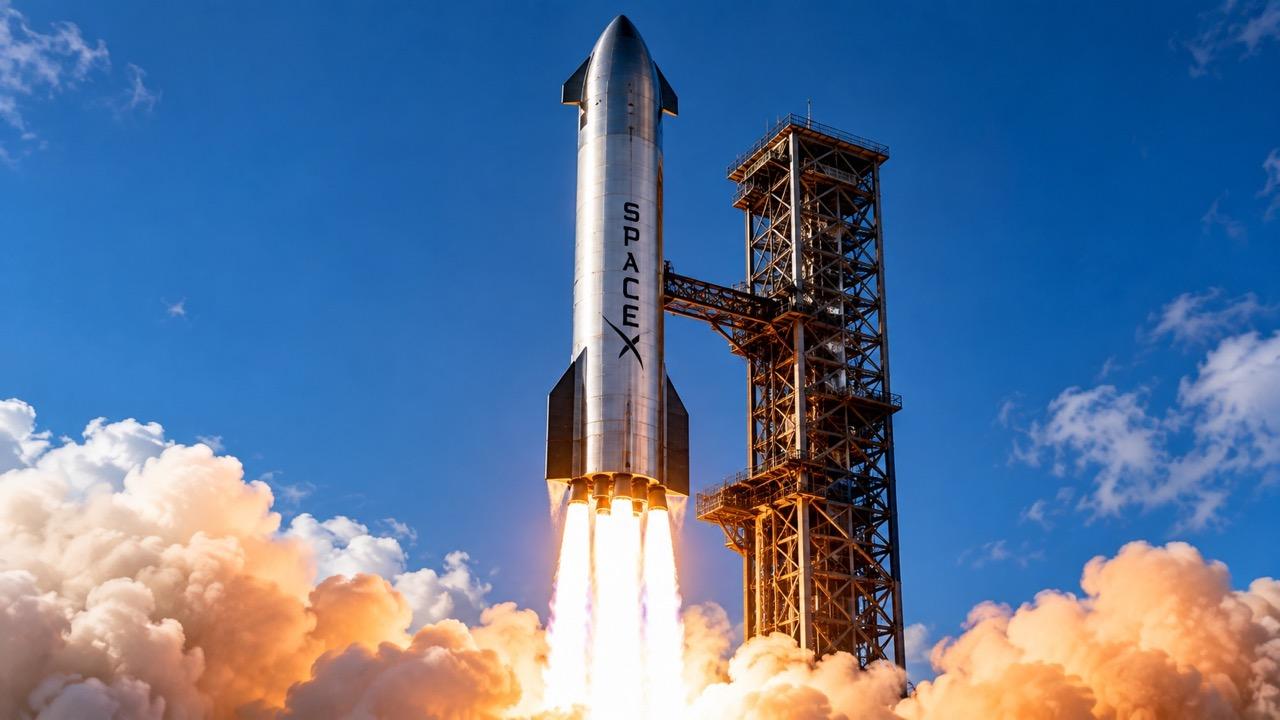
- SpaceX is preparing Starship Flight 14 for its first attempt to reach orbit, a milestone that could test the rocket's ability to support larger Starlink deployments and future commercial and NASA missions.
Space Exploration Technologies Corp. (NASDAQ: SPCX) is preparing to launch its massive Starship-Super Heavy vehicle on Monday, Sept. 28, in what would be the program's first attempt to reach Earth orbit.
The mission, designated Starship Flight 14, is scheduled to lift off from SpaceX's Starbase facility in South Texas during a 75-minute window beginning at 7:15 a.m. Central Time, or 8:15 a.m. Eastern. The Federal Aviation Administration issued launch and reentry authorization for the mission on Sept. 26.
The flight carries added significance because SpaceX plans to deploy 26 next-generation Starlink V3 satellites if the vehicle reaches the planned orbit. The company is using the mission to test not just Starship's orbital capabilities but also its potential as a higher-capacity launch platform for the satellite network.
Starship Flight 14 Has a Different Mission
Starship has completed 13 integrated test flights since its first launch in 2023, but those missions were flown on suborbital trajectories. Flight 14 is designed to take the upper stage into orbit for the first time.
The vehicle consists of the Super Heavy booster and the Starship upper stage. For Flight 14, Booster 21 will provide the initial thrust while Ship 41 will attempt the orbital portion of the mission. SpaceX does not plan to recover either stage on this flight.
After liftoff, the mission will initially follow a trajectory similar to earlier Starship tests. If the vehicle remains healthy, Ship 41 is expected to reignite one of its Raptor engines roughly 25 minutes into the flight to perform an orbital-insertion burn.
That step is critical because reaching a trajectory that can remain in orbit is different from simply achieving a high-altitude suborbital flight. A successful insertion would represent a new phase of Starship development.
If the orbital maneuver proceeds as planned, SpaceX intends to release the 26 Starlink V3 satellites beginning roughly 34 minutes after liftoff. The deployment sequence is expected to take about 30 minutes, with the satellites released individually at approximately one-minute intervals.
Three of the satellites will also carry imaging capabilities intended to capture footage of Starship's heat-shield tiles during the mission, giving engineers additional data about the spacecraft's performance. SpaceX's official Flight 14 mission page provides the company's mission objectives and launch information.
Why Starlink V3 Makes This Flight Important
The Starlink payload gives Flight 14 a commercial dimension beyond the orbital test itself. SpaceX has been developing Starlink V3 satellites with substantially greater capacity than earlier generations. The company's 2026 prospectus said V3 satellites are designed for up to 1 terabit per second of downlink capacity per satellite, while a single Starship launch could eventually carry as many as 60 V3 satellites.
Flight 14 will carry only 26 satellites, making the mission a smaller-scale demonstration of the deployment system. The satellites will nevertheless represent the first planned orbital deployment of the V3 generation.
That matters for Starlink because SpaceX needs a higher-capacity launch system if it intends to expand the constellation rapidly. Starship's larger payload capacity is expected to allow SpaceX to put significantly more satellite capacity into orbit per mission than its Falcon 9 rocket can carry. SpaceX's prospectus said that Starship could eventually deploy up to 60 V3 satellites on a single mission, compared with the smaller batches typically launched by Falcon 9.
The company is also developing Starship for applications beyond Starlink. NASA has selected a modified Starship vehicle as a lunar lander for its Artemis program, while SpaceX has described the rocket as a future platform for transporting cargo and people beyond Earth orbit.
The first orbital attempt therefore provides data relevant to several parts of SpaceX's business. A successful mission would not mean Starship is ready for routine commercial operations, but it would give engineers information about orbital flight, spacecraft systems, payload deployment and reentry.
The planned mission is expected to last roughly nine hours and 50 minutes. After approximately six orbits, SpaceX plans to conduct an 11-second deorbit burn before a controlled splashdown in the Pacific Ocean off the western coast of South America. The booster is expected to splash down in the Gulf of Mexico much earlier in the mission.
The test comes as SpaceX continues to build its public-market profile following its 2026 listing under the SPCX ticker. For investors watching SPCX, the immediate significance of Flight 14 is not a direct change to quarterly earnings but what the test could reveal about the technology underpinning SpaceX's longer-term expansion plans.
A successful orbital insertion, Starlink deployment and controlled reentry would mark several important technical milestones in a single mission. A partial success or failure would likewise provide data for subsequent flights.
SpaceX has already indicated that the next flight could include an attempt to catch the Starship upper stage, depending on the outcome of Flight 14.