
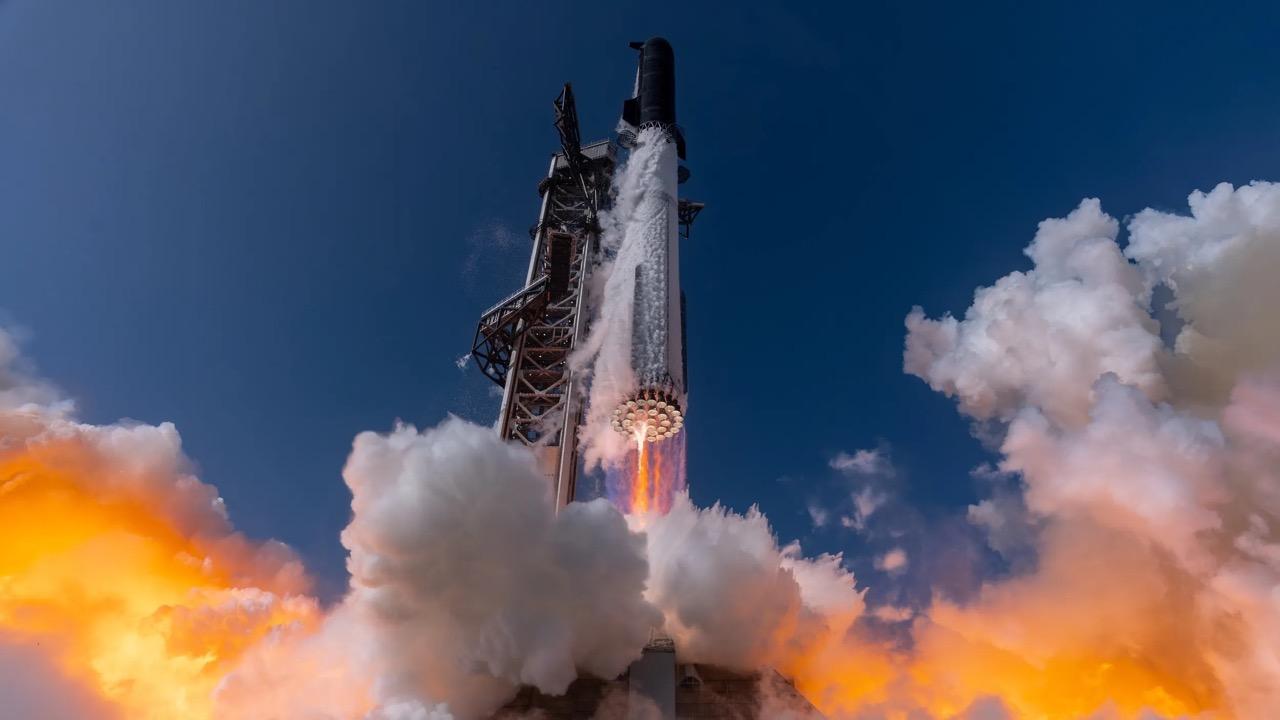
SpaceX (SPCX) is targeting Sept. 22 for the 14th test flight of its Starship rocket, with the mission set to attempt the vehicle’s first orbital flight and deploy 26 next-generation Starlink V3 satellites, the company said Tuesday.
SpaceX said the 75-minute launch window is scheduled to open at 7:15 a.m. CT from Starbase in South Texas, subject to regulatory approval. The company cautioned that the timing could change as preparations continue.
The mission would represent a major change from Starship’s previous test flights. Rather than following a suborbital trajectory, the upper stage is planned to enter orbit at an altitude of about 275 kilometers and complete approximately six revolutions around Earth before making a controlled splashdown in the Pacific Ocean west of Chile. SpaceX expects the mission to last nearly 10 hours.
26 Starlink V3 Satellites on Board
Flight 14 is also scheduled to carry the first operational batch of Starlink V3 satellites into orbit. SpaceX plans to deploy 26 satellites during the mission. The company says each V3 spacecraft is designed to add about 1 terabit per second of capacity to the Starlink constellation, putting the total potential capacity added by this launch at roughly 26 Tbps.
SpaceX's prospectus previously said its V3 satellites are designed to provide 1 Tbps of downlink capacity per satellite and that Starship is expected to eventually carry as many as 60 V3 spacecraft on a single launch.
Three of the 26 satellites will also carry cameras intended to capture images of Starship’s heat shield after deployment. The imagery will give SpaceX additional data on the condition of the heat-shield tiles during the flight.
Booster Recovery Is Another Key Test
The Super Heavy booster will have its own set of objectives during Flight 14. SpaceX plans to test the booster through liftoff, ascent, stage separation, boostback, and a landing burn before targeting an offshore landing area in the Gulf of America.
The company said it made hardware and software changes following problems encountered during Flight 13. During that flight, all 33 booster engines were used during the boostback maneuver, but ice-related issues involving three center engines caused the burn to end earlier than planned.
Eight of the 13 engines intended for the final landing burn restarted before the booster made a hard splashdown. For Flight 14, SpaceX has modified the engine filtration system and made software changes intended to improve engine relight reliability.
Starship Will Test Orbital Operations
The upper stage, meanwhile, is expected to perform several operations that have not previously been demonstrated during an orbital Starship mission. After separation, Starship is scheduled to conduct an orbital-insertion burn roughly 25 minutes after liftoff. Payload deployment is expected to begin about 34 minutes into the flight and continue for roughly 30 minutes.
The vehicle is then scheduled to remain in orbit for several hours before performing a deorbit burn using a single Raptor engine. SpaceX plans to proceed with the orbital-insertion maneuver only after flight controllers determine that the vehicle has enough redundancy to complete the later deorbit operation.
The published timeline calls for deorbiting at roughly 8 hours and 52 minutes into the mission, followed by atmospheric entry and a Pacific Ocean splashdown about 10 hours after liftoff.
Heat Shield Gets Further Modifications
SpaceX is also using Flight 14 to test additional heat-shield changes based on information gathered from Flight 13. The company said it has added retention mechanisms to tiles in areas considered vulnerable to shedding during ascent. Engineers have also addressed areas where plasma could potentially travel behind tiles and introduced additional curved tiles designed to reduce heating around gaps.
Two tiles recovered from Ship 40 are scheduled to fly again on Ship 41, marking the first planned reuse of Starship heat-shield tiles.
Why Flight 14 Matters
Reaching orbit would move Starship into a new stage of development by allowing SpaceX to test the vehicle during a much longer flight while carrying a real satellite payload. The mission also provides an early test of Starship’s role in deploying SpaceX’s next-generation Starlink constellation. SpaceX has said its existing Falcon rockets cannot deploy V3 satellites and that Starship will be central to expanding the next-generation constellation.
SpaceX is not planning to catch either Starship or the Super Heavy booster with the launch tower during Flight 14. The mission instead focuses on demonstrating orbital flight, payload deployment, controlled reentry, and further booster and heat-shield testing.
The webcast is expected to begin about 30 minutes before liftoff, according to SpaceX.