
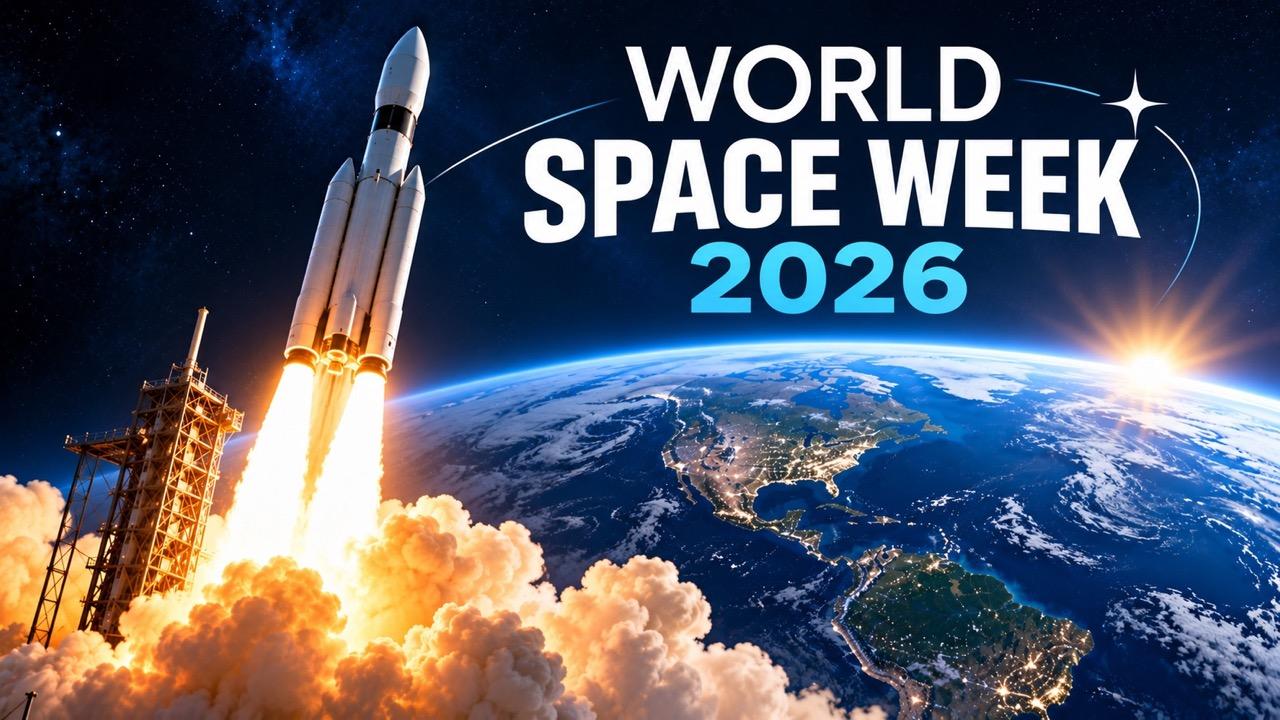
- World Space Week 2026 runs from October 4 through October 10 under the theme “Rocket Revolution,” highlighting how advances in launch technology are changing access to space and expanding participation in the global space sector.
World Space Week is an annual United Nations observance focused on the contribution of space science and technology to humanity. The United Nations established World Space Week through General Assembly Resolution 54/68 on December 6, 1999, designating October 4-10 as the annual period for the observance.
The dates were selected because of two major milestones in space history. On October 4, 1957, the Soviet Union launched Sputnik 1, the first human-made satellite to orbit Earth. Ten years later, on October 10, 1967, the Outer Space Treaty entered into force, establishing fundamental principles governing the exploration and use of outer space.
World Space Week is now described by the UN as the world's largest annual space event. Its objectives include educating the public about space activities, encouraging students to pursue science and technology, demonstrating public support for space programs, and promoting international cooperation.
The observance is not limited to government space agencies. Schools, universities, museums, companies, science organizations, and community groups can organize activities during the week. The World Space Week Association says events have been held in more than 100 countries, giving the observance a global educational and outreach role.
What Does “Rocket Revolution” Mean in 2026?
The 2026 theme, “Rocket Revolution,” focuses on the rapid changes taking place in space launch. The UN says access to space was once largely restricted to a relatively small number of government programs. Commercial launch companies, reusable rockets, startups, university teams, and additional national space programs have since expanded the number of organizations capable of participating in space activities.
Reusability is an important part of that change. Rockets designed to fly multiple times can potentially reduce the amount of hardware that must be manufactured for every mission and support more frequent launches. The expansion of commercial launch providers has also increased the number of organizations seeking to put satellites, spacecraft, and other payloads into orbit.
The theme therefore represents more than advances in rocket engines. It encompasses changes in who can reach space, how frequently launches can occur and what space infrastructure can be used for.
That shift is visible in the rapidly expanding commercial space economy. The number of satellites and launch missions has increased as companies build communications networks, Earth-observation systems and other space-based services. Recent developments involving SpaceX's Starship program illustrate how reusable launch systems are being developed for larger payloads and future missions.
The theme also has an economic dimension. As launch becomes more accessible, companies can develop businesses around satellite communications, navigation, Earth observation, scientific research and other services that depend on reliable access to orbit.
That commercial expansion is increasingly visible in financial markets. SpaceX's 2026 public listing gave public-market investors direct exposure to one of the world's largest launch and satellite companies, while Rocket Lab is developing launch capabilities intended to compete for commercial and government missions.
The rocket industry is not the only area affected. More frequent and affordable access to orbit can support the deployment of satellite networks, Earth-imaging constellations, and emerging technologies such as orbital computing.
Why World Space Week Matters Beyond Space Exploration
World Space Week also represents an effort to connect space technology with everyday economic and social activity. The UN Office for Outer Space Affairs works to promote international cooperation in the peaceful uses of outer space and to help countries use space science and technology for sustainable economic and social development.
Satellites already support services used around the world, including communications, navigation, weather forecasting, environmental monitoring and disaster response. This makes space infrastructure increasingly relevant to governments, businesses and consumers far beyond the traditional aerospace industry.
The 2026 program also places significant emphasis on education and workforce development. A presentation to the UN Committee on the Peaceful Uses of Outer Space said the year's theme would highlight launch innovation, reusability, affordability, increased launch cadence, expanded access to space and development of the future workforce.
The World Space Week Association reported that activities in 2025 were held in more than 100 countries and that its global program recorded more than 50,000 events. Its 2026 calendar includes educational programs, public events and discussions focused on the year's rocket theme.
World Space Week 2026 therefore represents both a celebration of the history of space exploration and a look at how the industry is changing. The “Rocket Revolution” theme puts the spotlight on the technologies making access to space more frequent and potentially more widely available.
The week also underscores the role of international cooperation. The same October 4-10 period connects the beginning of the Space Age with the international legal framework established by the Outer Space Treaty, reflecting the UN's broader emphasis on the peaceful use of space.
As commercial companies, national agencies, universities, and startups expand their roles, World Space Week 2026 provides a global platform for examining how those changes could shape the next phase of space exploration and the growing space economy.