
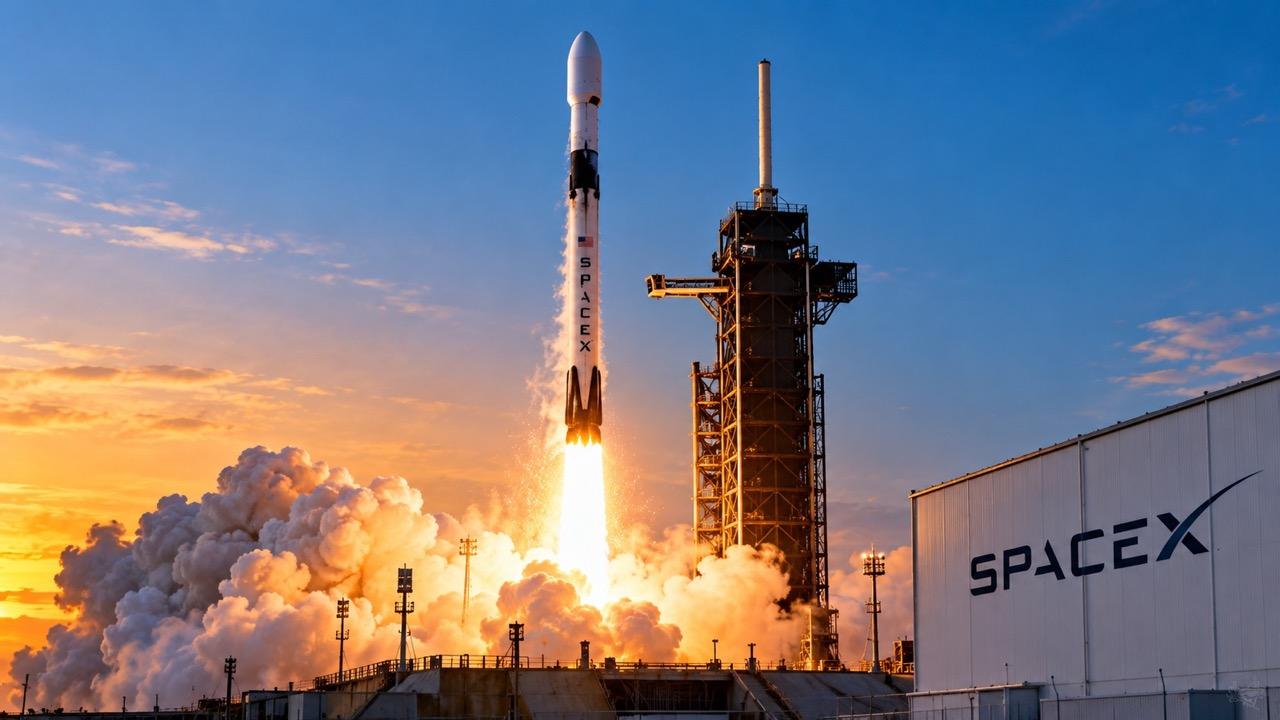
- A tightening supply of commercial rocket launches is creating an opportunity for SpaceX rivals as Falcon 9 capacity becomes increasingly difficult to secure and the company shifts toward Starship.
SpaceX's dominance of the global launch market has created an unusual problem for the space industry: customers that once depended on the company's frequent Falcon 9 flights are increasingly looking elsewhere for launch capacity.
The shift comes as SpaceX (NASDAQ: SPCX) reserves more Falcon 9 missions for its own Starlink constellation and prepares to transition toward Starship. Reuters reported in August that Starlink accounted for about 79% of SpaceX's Falcon 9 manifest in 2026, compared with 54% in 2020, based on launch data compiled by astrophysicist Jonathan McDowell. At least seven spacecraft companies had reportedly been told Falcon 9 was fully booked for some missions through 2028 or 2029.
The shortage is significant because Falcon 9 has become one of the industry's most frequently used and reliable launch vehicles. SpaceX's own data show the Falcon 9 had completed roughly 620 flights by March 31, 2026, while more than 80% of global mass placed into orbit since 2023 had been carried by SpaceX vehicles.
The company's decision to prioritize its own satellites is therefore creating a market opportunity for competitors that have spent years trying to establish viable alternatives.
Falcon 9 Transition Creates a Launch Capacity Gap
The immediate issue is not that satellites are becoming less important. Demand for launches is increasing as operators deploy communications networks, Earth-observation systems, national-security satellites and other spacecraft.
The space economy's expanding launch activity remains highly concentrated. The OECD said the US accounted for 55% of global launches in 2025 and 87% of objects launched, with SpaceX responsible for most US missions.
SpaceX is simultaneously developing Starship as the successor to its current launch architecture. The company's own materials describe Starship as a fully reusable system intended for applications including Starlink satellites, heavy cargo, deep-space missions and future interplanetary travel.
That transition creates uncertainty for customers that need launch slots before Starship reaches the cadence and reliability required for routine commercial operations.
SpaceX still operates Falcon 9 and maintains a rideshare program, but the availability of that capacity is becoming more constrained. The company's Falcon 9 program remains central to its launch business, while its growing Starlink requirements consume a larger share of available missions.
For satellite companies, the result can be higher launch costs, longer waiting periods or a greater need to reserve capacity years ahead. The change could also benefit launch providers that can offer customers alternatives rather than forcing them to compete for limited Falcon 9 slots.
Rocket Lab and Blue Origin Target a Bigger Market
Rocket Lab USA Inc. (NASDAQ: RKLB) is among the companies positioned to benefit, although its larger Neutron rocket is not yet operational. Rocket Lab has accumulated a significant launch backlog. In May, the company announced a multilaunch agreement covering five Neutron launches and three Electron missions, with the launches scheduled across 2026 through 2029. The deal brought Rocket Lab's overall launch manifest above 70 missions and its backlog above $2.2 billion.
Neutron is particularly important because Rocket Lab is attempting to move from the small-launch market into medium-lift missions that can serve larger commercial and government payloads. The company said in August that the first Neutron vehicle was expected to reach the launch pad during the fourth quarter, although the timing of its inaugural flight remained uncertain.
Blue Origin is another potential beneficiary. Its New Glenn rocket is designed for reusable heavy-lift missions, with the company targeting a minimum of 25 flights for the reusable first stage. Blue Origin says New Glenn can carry more than 45 metric tons to low Earth orbit.
The US government is already expanding the number of launch providers eligible to compete for national-security missions. The Space Force added Rocket Lab and Stoke Space to the National Security Space Launch Phase 3 Lane 1 program in 2025, then added Impulse Space and Relativity Federal in July 2026, bringing the number of providers to seven.
That diversification effort is important because the launch-capacity problem extends beyond commercial satellites. The US government also needs reliable access to orbit for national-security payloads.
SpaceX remains deeply involved. The Space Force awarded the company two Lane 1 task orders worth a combined $1.6 billion for 18 Falcon 9 launches supporting its Space-Based Sensing and Targeting program, with those missions expected to be completed by the end of 2027.
The emerging opportunity for competitors is therefore not simply about replacing SpaceX. It is about capturing portions of a launch market that SpaceX can no longer serve as broadly while its own constellation and next-generation rocket programs consume capacity.
For investors, that creates a potentially important theme across SpaceX and the broader space economy. SpaceX's public listing has made launch-industry economics more visible to equity investors, while competitors such as Rocket Lab are developing businesses around the same structural demand for access to orbit.
The central question is whether those companies can turn today's shortage into sustainable launch businesses. SpaceX built its advantage through high launch frequency, reusable hardware and economies of scale. Replicating that model will require years of development, successful test flights and much higher launch cadence.
For now, the SpaceX rocket shortage gives competitors something the industry has rarely had: a large and growing pool of customers actively looking for another way into orbit.