
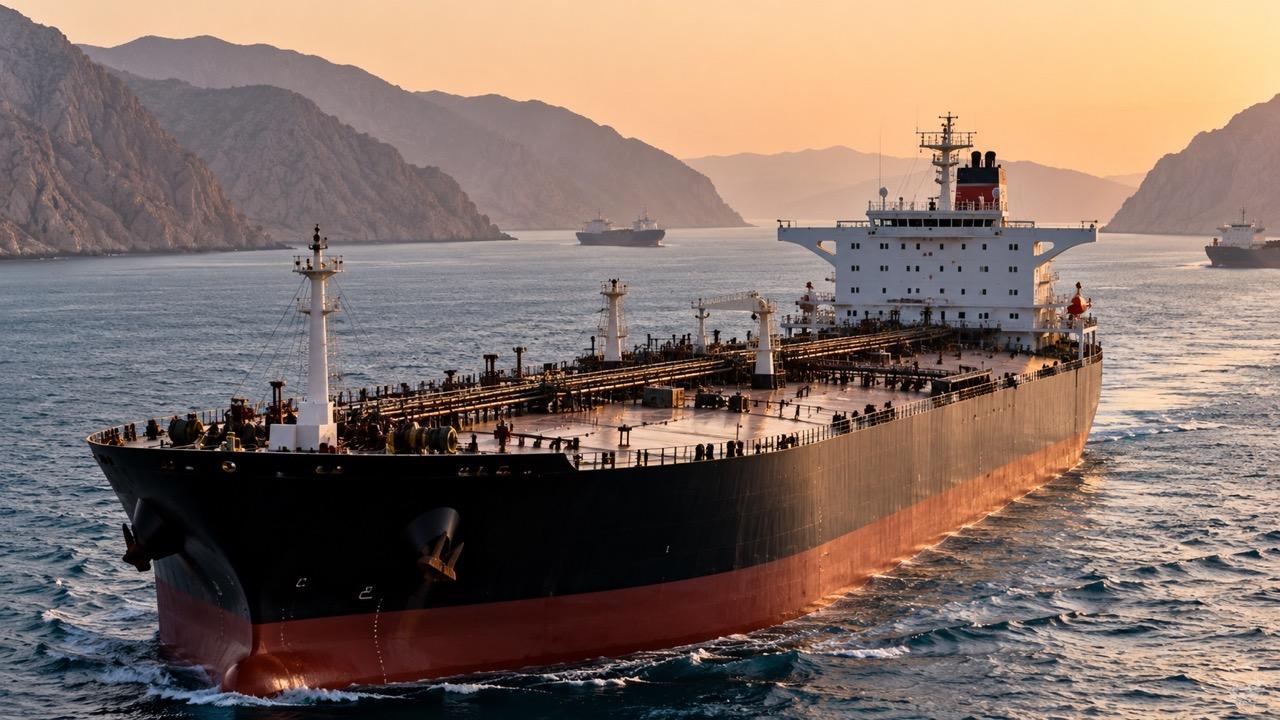
- Sailors are being offered as much as $25,000 for round trips through the Strait of Hormuz as Gulf producers absorb record tanker costs to keep crude moving.
Gulf oil producers are paying extraordinary premiums to keep crude exports moving through the Strait of Hormuz, with some sailors being offered as much as $25,000 for a single round trip into the Persian Gulf, according to The Wall Street Journal.
The payments reflect the growing risks involved in transporting crude through the strategic waterway after a renewed series of attacks on commercial vessels.
The arrangement is part of a system known as shuttle runs. Very large crude carriers, or VLCCs, enter the Gulf through Hormuz, load crude at regional ports and then leave the waterway before transferring their cargo to another tanker waiting offshore.
That approach allows oil producers to continue exporting barrels without requiring the final destination vessel to enter the most dangerous part of the route. The economics have changed dramatically since the conflict began. Shipbrokers told the Journal that a round trip through Hormuz can now cost producers $30 million to $40 million, excluding insurance, equivalent to roughly $15 to $20 per barrel.
The extraordinary shipping costs come even as Middle East crude exports have recovered. Reuters reported that regional crude exports temporarily exceeded pre-war levels in September, with Kpler data showing a seven-day average of 18.3 million barrels per day on Sept. 30.
Tanker Costs Surge as Gulf Oil Takes a More Complicated Route
The surge in shipping costs is changing the economics of Gulf crude. A VLCC traveling from the Persian Gulf to China cost more than $1.2 million per day to hire in late September, according to Clarksons Research data cited by the Journal. That compares with about $231,400 per day before the war and less than $40,000 per day in early January.
The increase reflects the additional risks, longer voyages, limited tanker availability and higher insurance costs associated with the conflict. Reuters described the problem as increasingly one of oil logistics rather than simply oil supply. Tanker freight and insurance costs have climbed sharply while ship-to-ship transfers and alternative routes have become necessary to keep barrels moving.
The surge in oil prices above $100 has therefore occurred even as Gulf producers have managed to restore significant export volumes. The Strait of Hormuz remains critical to the global energy system. The US Energy Information Administration estimates that 20.9 million barrels per day of oil flowed through the waterway during the first half of 2025, equivalent to about 20% of global petroleum liquids consumption.
Pipeline alternatives provide some relief, but their capacity is limited compared with the volumes normally transported through the strait. Saudi Arabia and the UAE together have about 4.7 million barrels per day of bypass capacity, according to the EIA.
That helps explain why producers are willing to absorb extreme transportation costs rather than leave crude stranded.
$25,000 Crew Payments Show the Human Cost of the Oil Trade
The financial incentives are also reaching individual crews. A ship-staffing company in Shandong is offering up to $25,000 for a round trip to recruit oilers and ordinary seamen for VLCC voyages into the Persian Gulf, according to the Journal. For some lower-paid crew members, the payment can represent more than a year of normal wages.
Other sailors have reportedly received two or three times their usual monthly pay for periods spent operating in the conflict zone. The payments reflect a fundamental problem for shipowners: high freight rates can make the voyages extremely profitable, but vessels still require crews willing to make the trip.
The risks are substantial. Nine commercial vessels were attacked near the Strait of Hormuz during the two weeks covered by the Journal's reporting, resulting in two seafarer injuries and one death, according to the International Maritime Organization and UK Maritime Trade Operations.
Some crew members have also reported GPS disruptions while passing through the strait. One sailor told the Journal that his vessel temporarily relied on radar-based navigation after losing its GPS signal during nighttime transits.
The number of tankers being used for shuttle operations has also increased. Vortexa data cited by the Journal showed the core shuttle fleet rising from 30 vessels at the end of August to 39, with Saudi Arabia's participation growing rapidly.
The expanding fleet illustrates how the conflict has created a new layer of infrastructure around Gulf oil exports. Tankers now load inside the Gulf, transfer cargoes outside Hormuz, and rely on additional vessels to complete the journey to international markets.
Saudi Arabia has also been using its East-West pipeline to move crude toward the Red Sea after attacks disrupted the system, while the UAE continues to rely on its pipeline to Fujairah. Yet those alternatives cannot fully replace Hormuz. Most Gulf oil still depends on the waterway, meaning the cost and availability of tankers remain critical variables for the global crude market.
For oil producers, the decision is increasingly straightforward: paying millions of dollars to move crude can still be preferable to leaving cargoes trapped inside the Gulf. For consumers and investors, however, the resulting freight, insurance, and security costs add another layer of pressure to an already volatile oil market.