
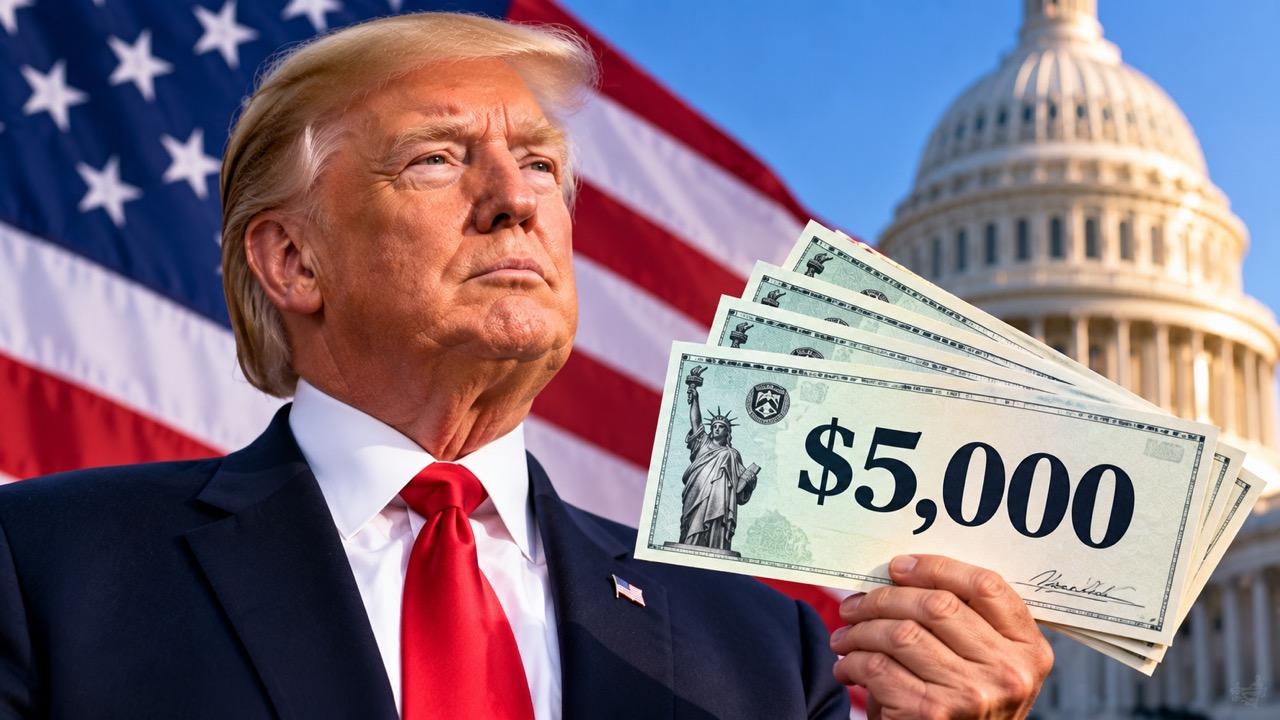
- Donald Trump has renewed his promise of $5,000 payments to adult US citizens if Republicans retain control of Congress, but the proposed dividend remains without a finalized funding mechanism, eligibility framework or congressional authorization.
President Donald Trump has renewed his proposal to send $5,000 to adult US citizens if Republicans retain control of the House and Senate in the November 3 midterm elections, putting the controversial cash-payment plan back at the center of the campaign.
Trump repeated the pledge in a video posted to Truth Social on Saturday, according to CNBC's Oct. 4 report, saying the payments would follow a Republican victory in both chambers. The proposal was first announced at the Republican National Committee's midterm convention in Dallas in September.
The pledge is separate from smaller payments already moving through the federal government. The White House has announced one-time $90 payments to more than 20 million eligible Medicare Part B beneficiaries, while the administration has also begun distributing $500 Affordable Care Act refunds to more than 950,000 people.
The three programs have different funding sources and eligibility rules. The $90 Medicare payment is being financed through the Medicare Improvement Fund, while the $500 ACA payments are tied to the administration's handling of HealthCare.gov user fees. The proposed $5,000 dividend has not yet been established by law.
Trump’s $5,000 Dividend Faces a Trillion-Dollar Funding Challenge
The scale of the proposed payment is the biggest unresolved financial question. The Census Bureau's latest available data put the number of US citizens of voting age at about 245.3 million. At $5,000 per person, distributing the full payment to that population would cost roughly $1.23 trillion.
That estimate would change if Congress established income limits or other eligibility restrictions. Trump has previously indicated that the payment could be financed through tariff revenue, although he has not presented a detailed mechanism showing how the government would collect and distribute enough money to cover the proposed checks.
The funding question is particularly significant because the federal government is already operating with a large deficit. The Congressional Budget Office projects a $1.9 trillion federal deficit for fiscal 2026, with debt held by the public reaching 101% of GDP this year.
The proposal would also require congressional action. A Congressional Research Service review of federal spending authority notes that Congress holds the constitutional power of the purse, meaning federal money generally cannot be drawn from the Treasury without an appropriation made by law.
That leaves several practical questions unanswered, including how the checks would be authorized, who would qualify, when payments would begin and whether Congress would approve the necessary spending.
The proposal has also drawn attention because Trump has previously floated other broad-based cash payments that did not materialize. Earlier ideas included payments connected to Department of Government Efficiency savings and tariff revenue.
$90 Medicare Payments and $500 ACA Refunds Add to Cash-Payment Push
The renewed $5,000 pledge comes as the administration is already putting smaller payments into circulation. The White House said eligible Medicare beneficiaries will receive a one-time $90 payment to help offset Part B premiums. Most eligible recipients are expected to receive the money by direct deposit, while others will receive paper checks.
Separately, the administration began sending $500 ACA refund payments on Sept. 30 to eligible marketplace enrollees in 30 states using HealthCare.gov. The payments are separate from the regular ACA premium tax-credit system.
Those programs provide a near-term distinction from the proposed $5,000 dividend. The Medicare and ACA payments have identified funding mechanisms and defined eligibility rules, while the larger dividend remains a political proposal that would require additional legislation.
Public skepticism also remains significant. An Economist/YouGov survey conducted Sept. 11-14 found that 48% of registered voters favored sending $5,000 to every adult citizen, compared with 40% who opposed it. But only 21% said Trump would probably or definitely follow through if Republicans retained control of Congress, while 57% said he would not.
That gap highlights the central issue surrounding the proposal: interest in receiving the money is considerably stronger than confidence that the checks will actually be delivered.
With the midterm elections less than a month away, Trump's cash-payment proposals are likely to remain closely tied to the economic debate. For households, however, the $5,000 dividend should not be treated as an approved federal benefit. No payment schedule has been established, and the proposal still faces the fundamental questions of funding and congressional authorization.