
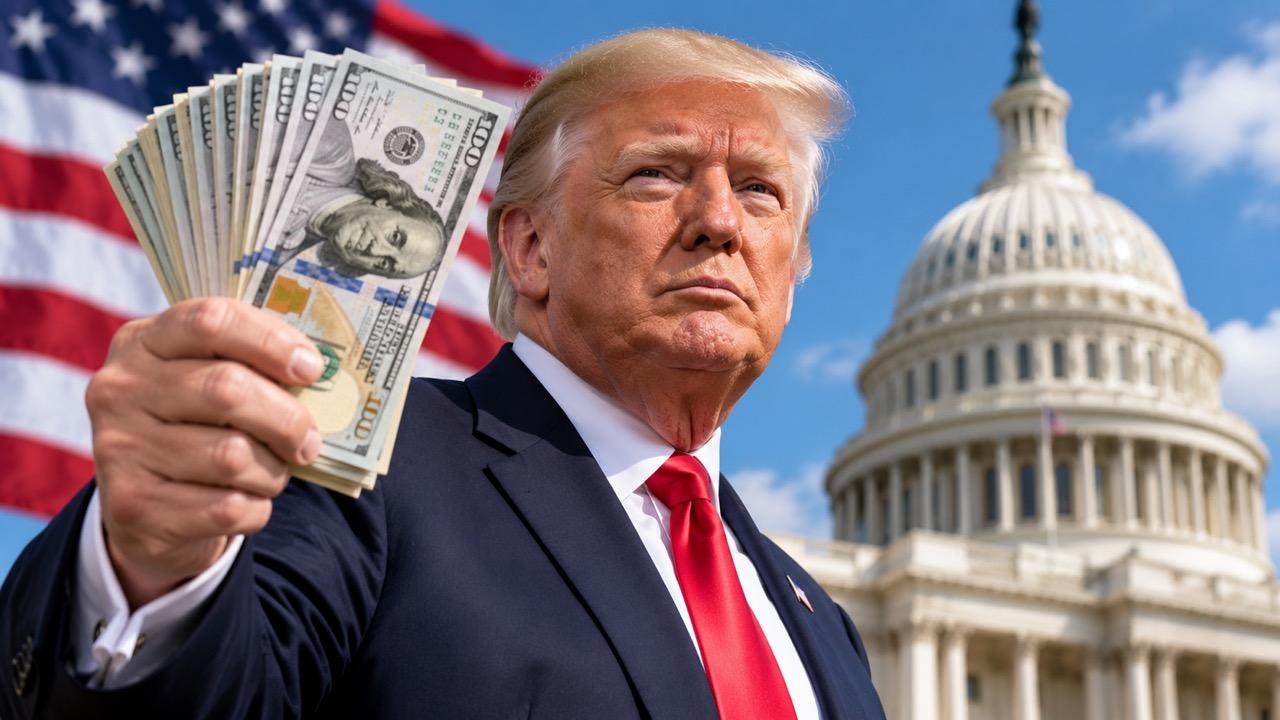
- President Donald Trump has renewed his proposal for a $5,000 payment to adult US citizens if Republicans retain control of the House and Senate, but Congress has not authorized the checks.
President Donald Trump’s proposed $5,000 payment is a planned “Trump Dividend,” not an approved federal stimulus check. Trump first announced the proposal in September and has since repeated the pledge as Republicans campaign ahead of the Nov. 3 midterm elections.
Trump said the payment would go to every adult US citizen if Republicans retain both chambers of Congress. The White House also described the proposal as a $5,000 cash payment for every adult American citizen in its official announcement.
The proposal has since become one of several direct-payment measures associated with the 2026 election campaign. Wealthier Today has separately reported on the administration’s renewed $5,000 check promise, as well as the $500 ACA refunds already being distributed to eligible health insurance marketplace enrollees.
Who Could Qualify for the $5,000 Trump Payment?
Under Trump’s stated proposal, the intended recipients are adult US citizens. Trump has repeatedly tied the payment to a Republican victory in both the House of Representatives and Senate. However, there is no final federal eligibility rule.
Trump’s original announcement did not establish an income threshold, age cutoff beyond being an adult, tax treatment, payment method, or other eligibility requirements. Vice President JD Vance subsequently suggested that wealthy Americans could be excluded, but no formal income limit has been announced. Reuters reported that the proposal initially covered roughly 240 million adult US citizens.
That population figure is consistent with Census Bureau data. The 2024 American Community Survey estimated about 245.3 million US citizens age 18 and older. A $5,000 payment to that population would cost roughly $1.23 trillion before any exclusions or additional eligibility restrictions.
There is also no application process. Americans should therefore be cautious about websites or social media posts claiming people can currently register for a Trump $5,000 check. No federal program has been established that allows eligible Americans to claim the proposed payment.
The proposal is also separate from the Medicare $90 payment announced by the administration. That payment has an established funding mechanism and defined eligibility rules, while the $5,000 dividend remains contingent on future congressional action.
The same applies to the 2027 Medicare premium changes, which are part of an existing Medicare program rather than a proposed cash distribution.
When Could the $5,000 Checks Be Sent?
There is currently no confirmed payment date for the Trump $5,000 dividend. Trump has said the payment would follow a Republican victory in the November midterms. On Oct. 3, he again said he would give adult citizens $5,000 if Republicans win both chambers and said he looked forward to signing the checks, according to current reporting.
That does not mean payments have been authorized. House Speaker Mike Johnson has said Congress would need to approve the proposal. Federal spending is generally subject to congressional appropriations under the Constitution, which provides that money cannot be drawn from the Treasury without an appropriation made by law. The Congressional Research Service explains Congress’s central role in controlling federal spending.
The cost is the largest unresolved issue. At approximately $1.2 trillion for 240 million adults, the proposed dividend would represent a substantial federal expenditure. The Congressional Budget Office currently projects a $1.9 trillion federal deficit for fiscal 2026, meaning the proposed payment would be equivalent to a large share of the government’s projected annual shortfall.
Trump has pointed to tariff revenue as a potential source of funding. However, the administration has not released a detailed funding plan showing how tariff collections would cover the full cost of the proposed checks. FactCheck.org found that the tariff revenue cited by Trump would take years to cover a $1.2 trillion payout at the levels available when the proposal was announced.
That leaves several important questions unanswered: whether high-income Americans would be excluded, whether Congress would approve the spending, how the payments would be administered, and when the money could actually reach households.
The proposal also arrives as Americans remain focused on household finances and the cost of living. Recent US income data showed median household income reached a record $87,460 in 2025, while consumer spending pressures continue to influence household behavior.
For now, the answer to “Who gets the Trump $5,000 payment?” is conditional: Trump has proposed the money for adult US citizens if Republicans retain both chambers of Congress, but the payment has not been enacted, and no one is currently entitled to receive it.
The next major development would be legislation establishing the program, its funding, eligibility rules, and distribution schedule.