
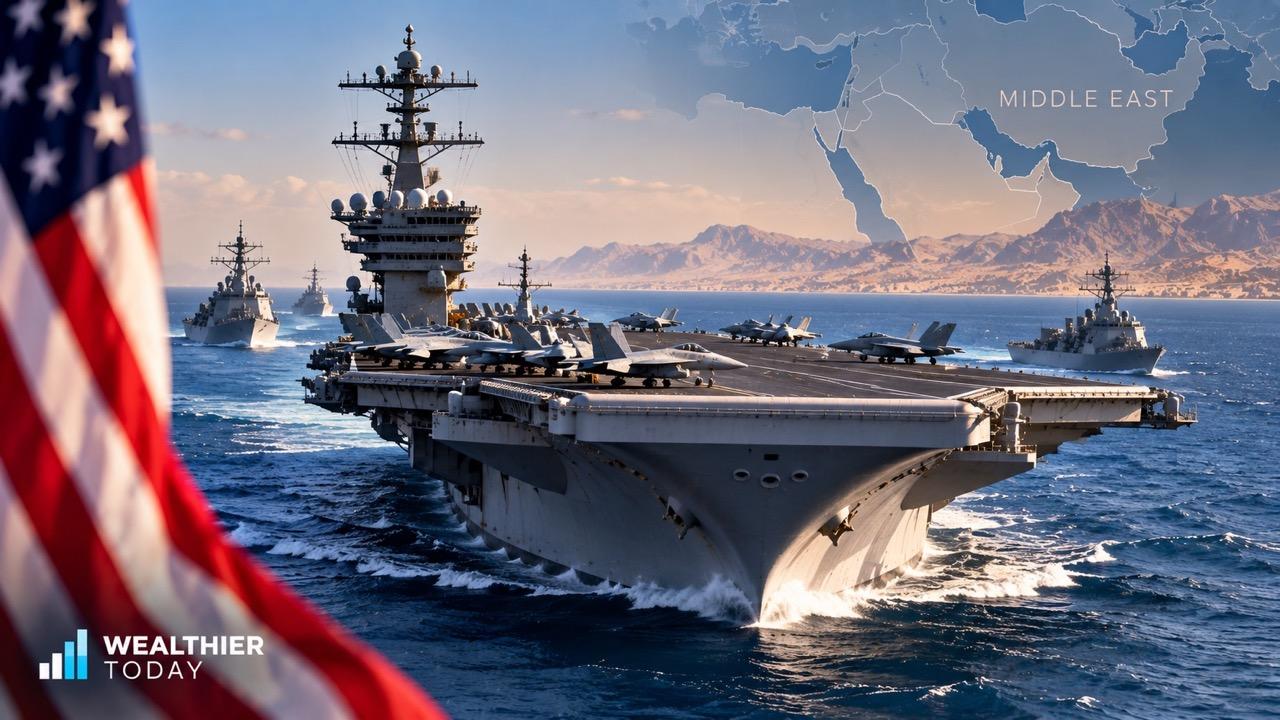
- The Pentagon is preparing another major deployment to the Middle East as US officials assess military options amid continuing tensions with Iran.
The US is preparing to send a third aircraft-carrier strike group and as many as 10,000 additional troops to the Middle East, according to officials cited by The Wall Street Journal. The deployment would add roughly 9,000 to 10,000 sailors and Marines to the region. The ships, aircraft and personnel are expected to arrive by the end of November, according to the Journal.
The move comes as tensions between Washington and Tehran remain unresolved and the US military maintains a large presence around the Strait of Hormuz, a critical route for global energy shipments.
USS Theodore Roosevelt Heads Toward Middle East
The USS Theodore Roosevelt carrier strike group left San Diego on Sept. 27 as part of a scheduled deployment. The USS Makin Island Amphibious Ready Group departed the following day with Marines from the 13th Marine Expeditionary Unit.
Two other US aircraft carriers, the USS George H.W. Bush and USS George Washington, are already in the region. If the Washington remains after the Roosevelt arrives, three carrier strike groups would be operating in the Middle East at the same time.
The additional forces would join more than 50,000 US service members already stationed in the region, according to the officials cited by the Journal. The final size of the naval force remains uncertain. The George Washington could leave the region and return to its home port in Japan, which would leave two carrier groups in the area.
The deployment also includes amphibious forces from the Makin Island group. The Pentagon has separately extended the deployments of air-defense units and the Army's 82nd Airborne Division, according to the Journal.
Iran Tensions Keep Strait of Hormuz in Focus
The military buildup follows the collapse of a ceasefire between the US and Iran and renewed disagreements over the Strait of Hormuz. President Donald Trump has said he could resume strikes against Iran after the November midterm elections if an agreement is not reached. Those comments were reported by the Journal in connection with the latest deployment.
Iran had proposed a seven-day ceasefire that would have involved reopening the Strait of Hormuz and restarting negotiations over its nuclear program in exchange for the US lifting its blockade of Iranian ports, according to the Journal's report.
The waterway remains particularly important to energy markets because roughly one-fifth of the world's oil normally moves through the Strait of Hormuz. Recent developments around the route have already contributed to volatility in crude prices and renewed attention on Middle East oil exports and Hormuz disruptions.
The US Navy has maintained about 20 ships in the region in recent months to enforce the blockade and assist with commercial shipping through the strait, according to Navy officials cited by The Journal.
The additional deployments will also place further demands on the Navy, which has faced supply shortages and high deployment levels during the conflict. The Journal reported that Iranian forces have recently fired ballistic missiles at US warships.