
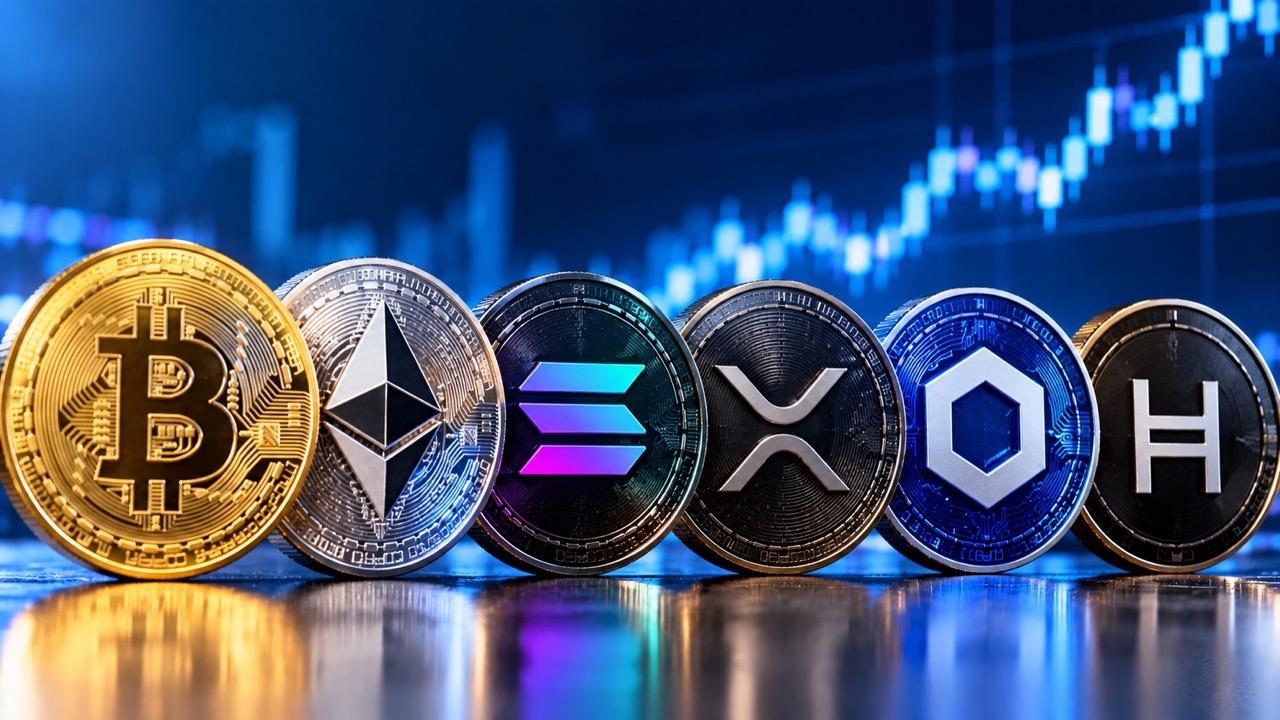
- Unlike Bitcoin, several major cryptocurrencies are tied to networks designed to provide specific services, including payments, tokenization, decentralized finance, and cross-chain infrastructure.
Bitcoin remains the largest cryptocurrency by market value, but it is not the only digital asset with a substantial technology ecosystem developing around it. A growing group of blockchain networks is being used to build financial applications, payment systems, tokenized assets, and infrastructure for other digital networks.
That makes cryptocurrencies like Bitcoin a broader category than simple digital store-of-value alternatives. The more useful comparison is whether a token sits at the center of a network with measurable activity and a product that developers, institutions, or consumers can actually use.
Five projects stand out on that basis: Ethereum, Solana, XRP, Chainlink and Hedera.
1. Ethereum: The Largest Onchain Financial Ecosystem
Ethereum (ETH) remains one of the clearest Bitcoin alternatives because its primary product is the blockchain infrastructure itself. Unlike Bitcoin's principal role as a monetary network, Ethereum provides smart-contract infrastructure for decentralized applications, stablecoins, decentralized finance, and tokenized real-world assets.
Ethereum's institutional data currently lists about $149 billion in stablecoin value across its ecosystem and more than $53 billion in DeFi value. Its institutional platform also says Ethereum and its layer-2 networks account for 36% of on-chain real-world assets.
That gives ETH a product ecosystem extending well beyond speculation. The main risk is that network adoption does not automatically translate into equivalent returns for the token.
Wealthier Today's recent coverage of Ethereum and Solana ETF filings also shows how institutional investment products are expanding beyond Bitcoin, although individual fund proposals remain subject to regulatory approval.
2. Solana: Building Around Payments and High-Speed Transactions
Solana (SOL) has increasingly positioned its network around payments, stablecoins, and applications that require high transaction throughput. Solana's own documentation says the network processed more than $1 trillion in stablecoin volume during 2025 and is designed for payment applications including remittances, global payouts, merchant payments and treasury operations.
The network has also attracted traditional payment companies. MoneyGram joined Solana's Developer Platform in June 2026 and became an active network validator, while Western Union launched a stablecoin-based Visa card on Solana in August.
That provides a more concrete growth product than a simple token narrative: the underlying network is being developed as infrastructure connecting blockchain applications with existing payment systems.
3. XRP: Payments and Tokenized Assets
XRP is closely associated with payments because it is the native asset of the XRP Ledger, which supports direct XRP transfers, cross-currency payments, and payment channels. The XRP Ledger says direct XRP payments typically settle in eight seconds or less, while its broader payment architecture supports transactions involving different currencies.
The network is also expanding into real-world asset tokenization. XRPL documentation describes tools for issuing and managing tokenized assets, including Multi-Purpose Tokens, native compliance controls, and integrated trading infrastructure.
That gives XRP exposure to two distinct blockchain use cases: payments and financial-asset infrastructure.
4. Chainlink: Infrastructure for Connecting Blockchains and Markets
Chainlink (LINK) is different from the other assets on this list because its core product is not a general-purpose blockchain. It provides oracle and interoperability infrastructure that allows blockchain applications to access external data and communicate across networks.
Chainlink reported that its infrastructure had facilitated $34.18 trillion in transaction value and that its Cross-Chain Interoperability Protocol had transferred $24.12 billion in cumulative value as of September 2026.
The company also launched CCIP 2.0 in September, targeting institutional digital-asset transfers and tokenized financial markets. Chainlink said the release was designed for institutions and digital-asset issuers deploying assets across multiple blockchains.
That makes LINK a particularly direct bet on the infrastructure required if tokenized assets and cross-chain finance continue expanding.
5. Hedera: Enterprise Payments and Tokenization
Hedera (HBAR) is another cryptocurrency whose network is being developed around specific enterprise applications. Hedera's network documentation highlights payments, stablecoins, tokenization and enterprise settlement. The company says the network can process more than 10,000 transactions per second with fixed fees and settlement finality measured in seconds.
There are also concrete developments around tokenized securities. In June, digital-asset platform Archax announced real-time streaming cash flows for tokenized securities on Hedera, using USDC for investor payments.
Hedera has also been integrated into Axelar's cross-chain network, expanding access to tokenization, trading, and decentralized-finance applications across multiple blockchains.
The 5 Cryptocurrencies Like Bitcoin That Just Work
These five cryptocurrencies are not interchangeable with Bitcoin, and their underlying businesses and token economics differ substantially. Ethereum is focused on broad onchain financial infrastructure, Solana on high-throughput applications and payments, XRP on payments and tokenization, Chainlink on blockchain connectivity and data, and Hedera on enterprise-oriented applications.
The distinction is important for anyone researching Bitcoin alternatives. A growing user base, transaction activity or institutional integration can demonstrate that a blockchain product is being used, but none of those factors guarantees that its associated token will appreciate.
For investors evaluating the next generation of crypto assets, the more useful question may therefore be less about which coin could copy Bitcoin's price performance and more about which networks are developing products that can generate sustained demand for blockchain infrastructure.