
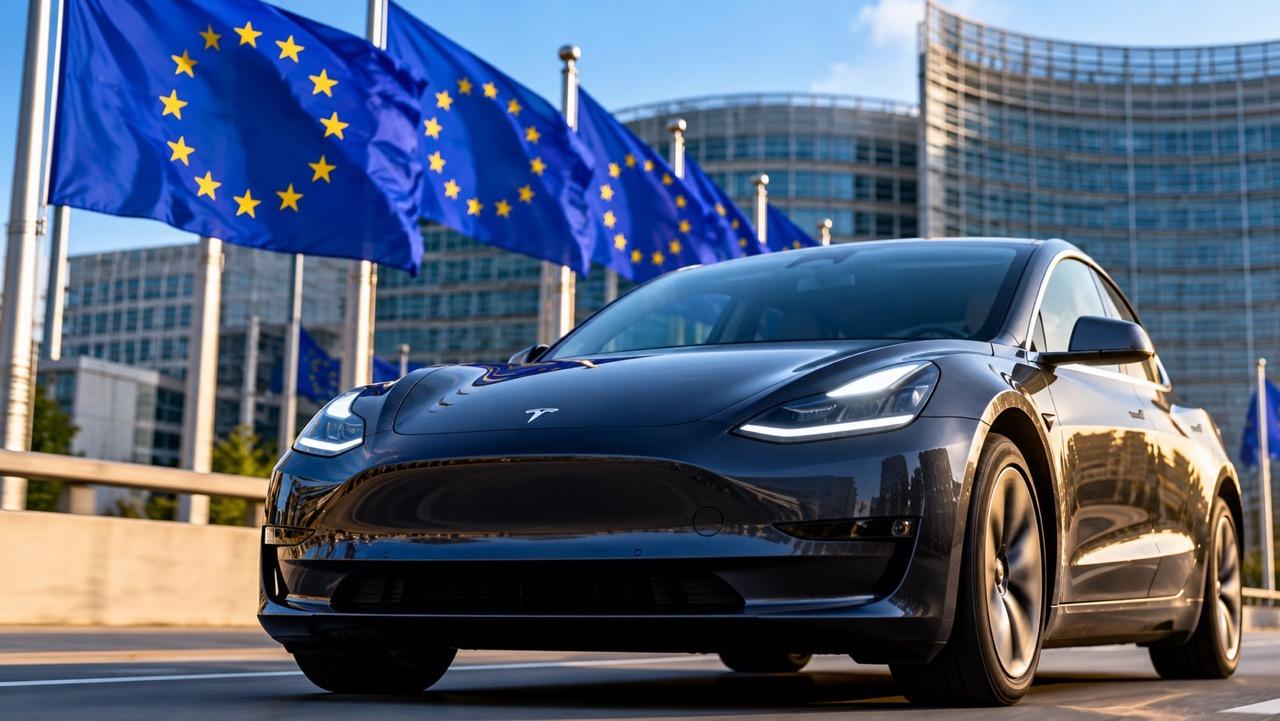
- Tesla is intensifying its push for EU-wide approval of Full Self-Driving as Germany backs a faster rollout, while regulators and safety researchers continue to question aspects of the system.
Tesla Inc. (NASDAQ: TSLA) is pressing European regulators to approve its Full Self-Driving (FSD) Supervised driver-assistance system across the European Union, with Germany now supporting a faster approval process despite continuing safety and regulatory concerns.
A Reuters investigation published Oct. 7 found that Tesla has lobbied European regulators extensively, sought changes to aspects of the Dutch safety review and promoted company research supporting claims that FSD can improve road safety. Seven traffic-safety researchers who reviewed Tesla's European research for Reuters said the data does not establish the company's broader claim that FSD prevents fatal crashes.
The findings add another layer to Tesla's European expansion efforts as the company attempts to regain market share amid stronger competition from European and Chinese electric-vehicle manufacturers. Tesla's European FSD campaign has become an increasingly important part of the company's broader technology strategy, alongside its efforts in robotaxis and autonomous driving.
Why Tesla Needs EU Approval for FSD
Tesla's FSD Supervised system can steer, brake, accelerate, change lanes and navigate routes, but Tesla itself says the technology requires active driver supervision and does not make its vehicles autonomous. Its official description of FSD also notes that feature availability depends on regulatory approval in individual markets.
The European regulatory process is particularly important because Tesla is seeking authorization that would allow the system to operate beyond the restrictions generally applied to hands-free driver-assistance systems.
The Netherlands became the critical starting point after Dutch vehicle regulator RDW approved Tesla's system earlier this year and moved to seek EU-wide authorization. An EU-wide approval requires a qualified majority of member states: at least 15 of the bloc's 27 countries representing at least 65% of the EU population.
The vote has already been delayed. A September Reuters report said the next apparent opportunity for a decision was not before December, after an October meeting agenda listed continued discussions rather than a final vote.
Germany has since emerged as a supporter. German Transport Minister Steffen Bilger said the country would advocate for prompt EU approval after discussions with Tesla over technical and liability issues.
Germany has also agreed with Tesla that the system can operate up to 10% above the posted speed limit in certain circumstances, according to Reuters. Speed-limit behavior remains one of the most contentious issues surrounding the European rollout.
The issue matters for investors watching Tesla stock, particularly as the company's valuation increasingly reflects expectations surrounding autonomous driving rather than its traditional electric-vehicle business. Tesla has remained one of the major companies supporting the broader technology-led stock market rally, alongside Nvidia, Microsoft and other megacap names.
Tesla Safety Claims Face Scrutiny
Tesla's European safety case is built partly around an evidence dashboard comparing FSD-equipped vehicles operated by professional Tesla engineering drivers with manually driven Tesla vehicles. Reuters reported that the European FSD sample contains far fewer miles than the manually driven comparison group, making direct crash-rate comparisons difficult. Tesla instead used driving behaviors such as hard braking, acceleration, cornering, horn use and turn-signal behavior as surrogate measures.
Researchers interviewed by Reuters said some of those measures can provide useful information about driving behavior but do not establish that FSD prevents fatal crashes.
Tesla's own European research also states that some of its comparisons cannot be interpreted as causal estimates. That limitation is important because a reduction in a particular driving behavior does not necessarily translate into a corresponding reduction in crashes or fatalities.
Tesla nevertheless has promoted the technology as a potential life-saving system. Reuters reported that Elon Musk has used social media to argue that regulatory delays could cost lives, while Tesla supporters have contacted European regulators urging faster approval.
The regulatory debate comes as Tesla continues building its broader autonomous-driving strategy. The company has already begun limited robotaxi operations in the US, while its European FSD rollout remains dependent on regulatory approval.
For investors, the dispute creates two competing narratives. Tesla's supporters see wider FSD approval as a potential catalyst for software, autonomous-driving and future robotaxi businesses. Regulators and safety researchers remain focused on whether the evidence is sufficient to justify expanding the system's permitted operating range.
That question comes as Tesla's market value remains heavily influenced by expectations for autonomous technology. Recent strength in Tesla shares has also contributed to Elon Musk's wider wealth rebound, alongside the performance of SpaceX.
The EU decision will therefore have significance beyond the availability of another Tesla software feature. It could provide an important regulatory precedent for advanced driver-assistance systems across Europe while testing how regulators balance technological innovation, manufacturer evidence and road-safety requirements.