

- UBS raised its Brent crude forecast for Q4 2026 to $100 a barrel from about $80, citing fragile Middle East oil flows and continuing attacks on energy infrastructure and shipping routes.
UBS has raised its Brent crude oil price forecasts for 2026 and 2027, arguing that the recovery in Middle East oil flows remains more vulnerable than previously expected. The Swiss bank now expects Brent to average $100 a barrel in the fourth quarter of 2026, up from a previous forecast of roughly $80. It also raised its full-year 2026 average forecast to $91.57 a barrel from $83.74, according to the Reuters report.
The revision comes even as oil prices moved lower Tuesday. Brent futures were recently around $98.48 a barrel, while US West Texas Intermediate crude traded near $87.70, as stronger Middle East exports and plans by G7 countries to release emergency oil and diesel stocks eased some immediate supply concerns.
The latest move follows weeks of sharp volatility. Wealthier Today recently reported on Brent falling below $100 as Middle East exports recovered, while an earlier oil-market report detailed the continuing disruption around the Strait of Hormuz.
Why UBS Is Raising Its Brent Oil Forecast
UBS said oil flows through the Strait of Hormuz have recovered significantly in recent weeks, but the improvement has come with substantial disruption and remains vulnerable to further attacks. The bank's latest view assumes that regional oil flows will gradually normalize through the first half of 2027, based on the possibility of an arrangement similar to the June US-Iran memorandum being reached by the end of this year. UBS is nevertheless maintaining a higher near-term risk premium because the timing and durability of that recovery remain uncertain.
The Strait of Hormuz remains central to the outlook because it is one of the world's most important oil shipping routes. Disruptions have forced producers and traders to rely more heavily on alternative export routes, ship-to-ship transfers and other workarounds.
The US Energy Information Administration's latest oil outlook shows just how significant those disruptions have been. EIA said Brent averaged $114 a barrel in September, up $23 from August, after attacks on Middle East oil infrastructure and tankers. It estimated that crude production shut-ins averaged 4.8 million barrels per day in September, down from 5.8 million barrels per day in August but still substantial.
EIA expects Brent to average $105 a barrel in Q4 2026, $14 higher than its previous forecast, before declining as Middle East production and exports recover. That makes the latest UBS forecast particularly relevant for investors watching oil prices above $100 and their impact on energy producers, refiners, airlines and other fuel-sensitive businesses.
UBS also warned that renewed attacks or additional supply disruptions could push Brent above $120 a barrel. Conversely, a faster US-Iran agreement and quicker restoration of oil flows could cause prices to decline faster than the bank currently expects.
UBS and EIA See Different Oil Paths Into 2027
The longer-term outlook remains considerably less bullish than the immediate supply-risk picture. EIA's October forecast calls for Brent to average $84 a barrel in 2027, compared with its $96 average estimate for 2026. The agency expects oil production and exports from the Middle East to gradually increase as alternative routes and facilitated transit through the Strait of Hormuz expand.
EIA expects most regional production to return toward pre-conflict levels by the end of the second quarter of 2027 and forecasts Brent falling to an average of $87 a barrel in that quarter. By the fourth quarter, it sees the benchmark averaging $74 as global inventories rebuild.
UBS is also assuming normalization during 2027, but its latest revision reflects greater concern about how long supply disruptions could persist. The bank's September outlook had already placed Brent at $95 for year-end 2026 and $90 for March 2027, underscoring how quickly its expectations have changed as the conflict and supply picture have evolved.
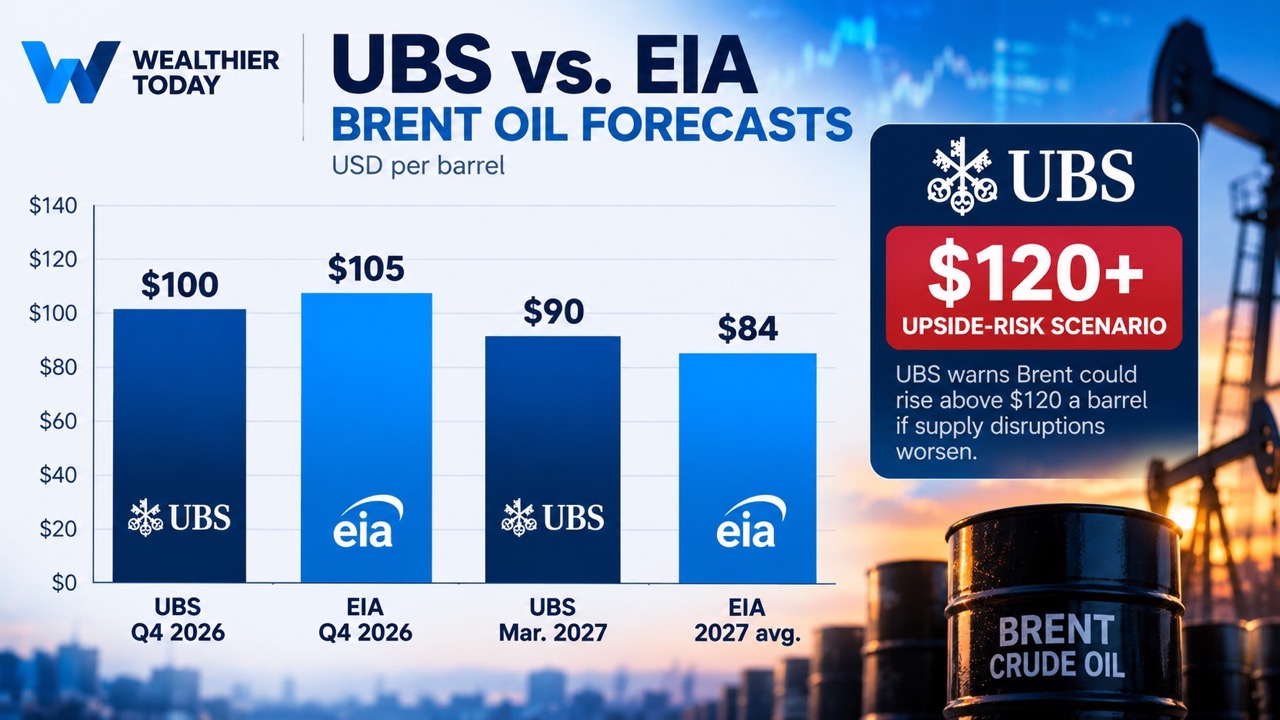
The difference between the two forecasts highlights the main uncertainty facing the crude market: how quickly Middle East production and transportation networks can return to normal.
That question also matters for consumers. Higher crude prices can feed into gasoline, diesel, transportation, and other costs, while prolonged fuel-market tightness can put additional pressure on inflation. EIA said US gasoline averaged $4.35 a gallon in September and diesel averaged $6.29, with diesel expected to remain above $6 in October.
Wealthier Today's recent coverage of US gasoline prices and the impact of higher oil prices on the stock market shows why the crude outlook extends beyond energy markets.
For now, UBS expects Brent to remain elevated because the supply recovery is not yet considered secure. Tuesday's decline below $100 shows that improving exports and emergency stockpile releases can quickly relieve some pressure, but the bank's latest forecast indicates that the risk of another supply shock remains a major factor in oil pricing.