
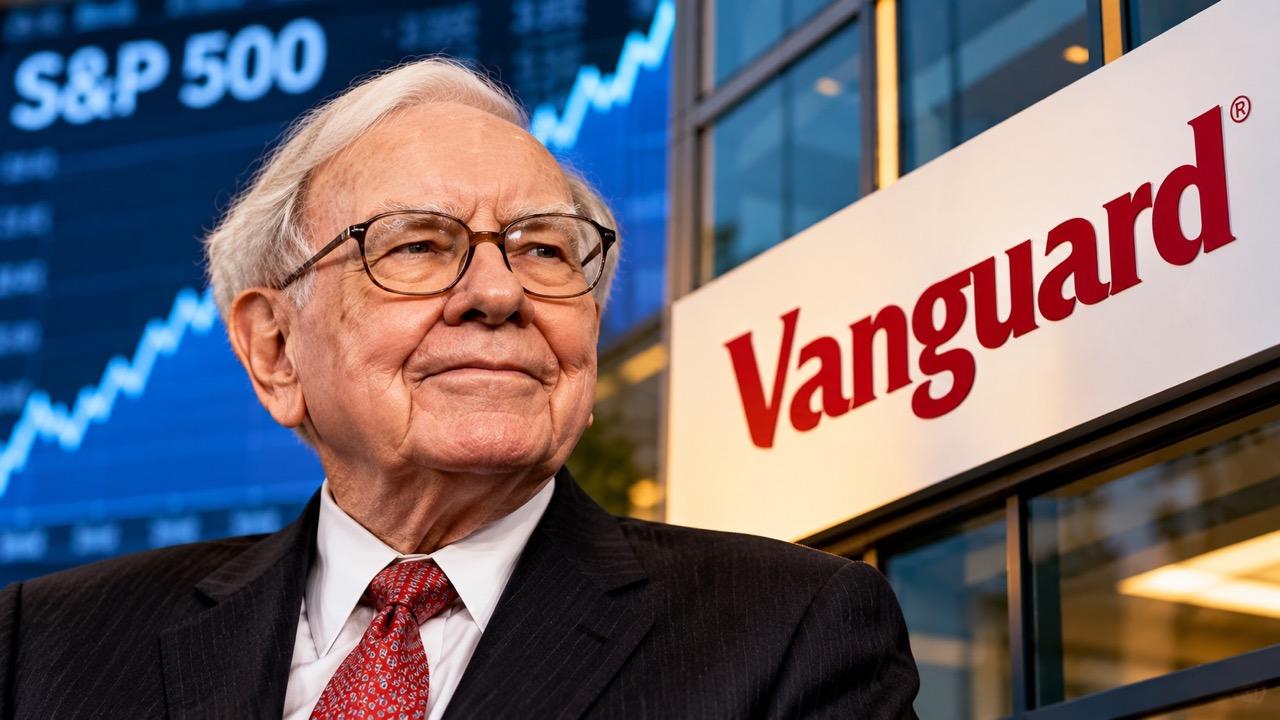
- Warren Buffett has repeatedly recommended low-cost S&P 500 index funds for ordinary investors, with the Vanguard S&P 500 ETF emerging as one of the clearest ways to follow that strategy.
Warren Buffett's investing advice for most individual investors remains considerably simpler than the stock-picking strategy associated with his career at Berkshire Hathaway Inc. (NYSE: BRK.A, BRK.B).
The longtime investor has repeatedly argued that most people are better served by owning a low-cost S&P 500 index fund than attempting to select individual stocks or pay high fees to professional managers.
A recent Yahoo Finance report revisited that strategy and highlighted the Vanguard S&P 500 ETF (NYSEARCA: VOO), including an illustration showing how investing $400 a month could potentially grow to about $820,000 over three decades if returns averaged roughly 10% annually.
That figure is a projection, not a guaranteed outcome. It assumes a constant rate of return over the entire period and does not mean investors should expect the S&P 500 to produce the same return every year.
Buffett's underlying message has been consistent for years: keep costs low, diversify broadly and give investments time to compound.
Why Buffett Favors Vanguard's S&P 500 Strategy
Buffett's recommendation for ordinary investors goes back well before the latest discussion surrounding VOO. In Berkshire Hathaway's 2013 shareholder letter, Buffett said the trustee handling cash left to his wife should put 90% into a very low-cost S&P 500 index fund and 10% into short-term US government bonds, adding that he suggested Vanguard's fund.
The recommendation is preserved in Berkshire Hathaway's archive of shareholder letters. Buffett has also made the case that most investors do not need to outperform the market through frequent trading. His approach recognizes that professional investors face the same market but also incur research expenses, trading costs and management fees.
The SEC's Investor.gov guidance on index funds similarly notes that passive funds can have lower costs because they generally trade less frequently than actively managed funds. Fees still reduce returns, however, and index funds remain exposed to the risks of the markets they track.
VOO provides exposure to the S&P 500, an index made up of large US companies across major sectors of the economy. Vanguard's latest fund information shows VOO has 505 holdings and an expense ratio of 0.03%.
The fund had about $1.05 trillion in net assets as of Aug. 31, 2026, according to Vanguard. The sheer scale illustrates how large passive investing has become. Investors do not need to select individual companies to participate in the performance of the largest publicly traded US businesses.
For investors researching how much $10,000 invested in the S&P 500 could grow, the same compounding principle applies, although actual results depend on market performance, contribution timing and investment costs.
What the $400 Monthly Example Really Means
The $820,000 figure highlighted by Yahoo Finance is best understood as a hypothetical compounding example, rather than a forecast for VOO. Someone investing $400 every month for 30 years would contribute $144,000 of their own money. Reaching approximately $820,000 would require returns of roughly 10% annually, assuming monthly contributions and uninterrupted compounding.
Actual market returns do not arrive at a fixed rate. The S&P 500 can rise sharply in some years and decline substantially in others. An investor contributing money throughout a downturn could buy more shares at lower prices, but someone approaching retirement during a major market decline could face a very different outcome.
VOO also carries the same broad market risks associated with the S&P 500. Because the index is weighted by market capitalization, the largest companies account for a significant portion of the fund. Investors therefore receive diversification across hundreds of companies but not equal exposure to every constituent.
That matters as the S&P 500 becomes increasingly influenced by large technology and AI-related companies. Recent stock market gains driven by megacap technology companies have reinforced the role those businesses play in the index.
Buffett's strategy also does not mean every investor should put 100% of their money into an S&P 500 ETF. His own frequently cited example included a 10% allocation to short-term government bonds, reflecting the importance of liquidity alongside long-term equity exposure.
Investors considering long-term investments for 2026 therefore have to consider their time horizon, risk tolerance and need for income rather than simply copying a single asset allocation. The broader lesson from Buffett's index-fund advice is straightforward: the strategy relies less on predicting the next winning stock and more on owning a broad collection of businesses at a low cost for a long period.
That philosophy has become increasingly relevant as passive funds have grown into a major part of the US investment market. But the potential for long-term compounding comes with market risk, and past returns do not guarantee future performance.
For investors looking at VOO today, the important question is therefore not whether Buffett's name guarantees a return. It is whether a low-cost S&P 500 fund fits their own investment horizon and ability to withstand market declines.