
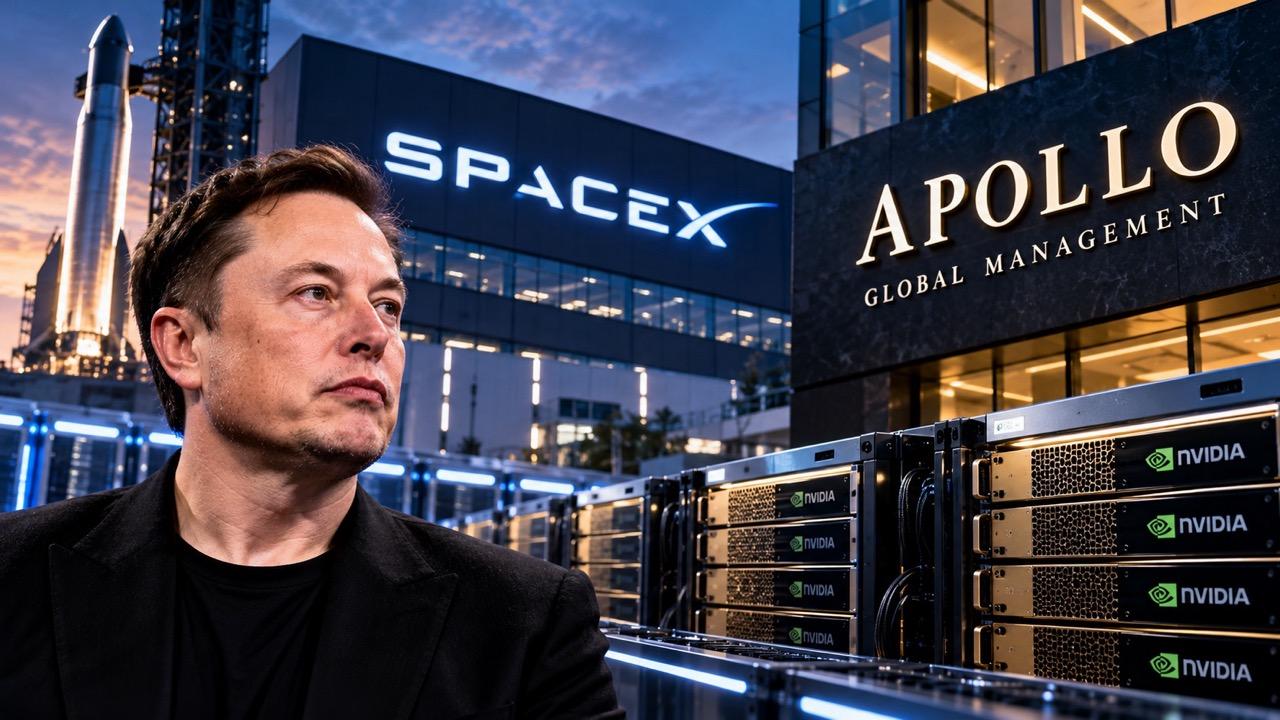
SpaceX has agreed to a roughly $40 billion financing arrangement with an affiliate of Apollo Global Management to acquire artificial intelligence chips and server hardware that will be leased to the Elon Musk-led company, according to a Reuters report.
Under the agreement, the Apollo-managed entity will purchase the equipment and lease it to SpaceX, spreading the principal payments over the lease terms rather than requiring SpaceX to fund the entire hardware purchase upfront. Each lease is expected to run for slightly more than five years from the equipment's delivery date, according to a regulatory filing cited by Reuters.
SpaceX aims to finalize the arrangement by the end of 2026, with the leases expected to begin in the first half of 2027 as the hardware arrives. The deal will support the company's expanding AI computing operations, which require substantial investment in processors, servers and data-center infrastructure.
The financing comes as demand for AI computing capacity drives technology companies to commit billions of dollars to new infrastructure. It also adds to the scale of SpaceX's spending as it expands beyond rocket launches and satellite internet to build a larger AI business.
SpaceX's $40 Billion AI Chip Financing Deal Explained
The agreement follows comments from Musk on October 25, when he said SpaceX had secured $40 billion in debt financing for graphics processing units, or GPUs. These specialized processors are widely used to train and run AI models.
The structure described in the subsequent Reuters report involves an Apollo-managed entity buying the chips and server hardware before leasing them to SpaceX. While Musk characterized the financing as debt funding, the reported arrangement is specifically structured around equipment purchases and leases.
Reuters previously reported that SpaceX had been in discussions with banks and asset managers to raise approximately $40 billion to purchase Nvidia Corp. (NASDAQ: NVDA) chips. The new arrangement provides a framework for financing the hardware needed to expand the company's computing capacity.
The financing is significant because SpaceX is already planning an exceptionally large investment cycle. Chief Financial Officer Bret Johnsen has said the company expects capital expenditure of between $35 billion and $40 billion in the fourth quarter of 2026.
That spending reflects SpaceX's effort to meet demand for AI computing while continuing to fund its aerospace and satellite operations. The company is also pursuing long-term ambitions involving the Moon and Mars, making the allocation of capital across its businesses an important consideration.
Wealthier Today previously examined the company's changing financial profile in its report on SpaceX's third-quarter profit and growing AI business. The expansion of its computing operations is becoming an increasingly important part of the company's growth strategy.
What the Apollo Financing Means for SpaceX's AI Expansion
The arrangement gives SpaceX access to AI chips and server hardware through a leasing structure. That can spread payments across several years, although it does not eliminate the cost of the equipment or the financial obligations created by the leases.
The scale of the commitment also highlights the capital required to compete in AI computing. Companies building large data centers must finance not only processors but also networking equipment, power systems, cooling infrastructure and facilities capable of supporting intensive workloads.
SpaceX is entering this market at a time when investors are paying closer attention to how AI infrastructure providers finance their expansion. Musk recently warned that many specialized AI cloud providers could face financial pressure as debt financing becomes more difficult to secure. The contrast between SpaceX's financing arrangement and the challenges facing some smaller competitors has become part of the broader debate about AI infrastructure spending.
The company's ability to fund this expansion will depend on demand for computing capacity, the timing of hardware deliveries and its ability to generate revenue from the resulting infrastructure. Wealthier Today's coverage of the $1.2 trillion AI infrastructure spending outlook for 2027 explores the growing financial commitments across the industry.
The Apollo agreement is expected to be finalized by year-end, with leasing beginning in the first half of 2027. Until the hardware is delivered and deployed, the full operational contribution of the arrangement remains ahead.
For SpaceX, the deal represents a major financing commitment to AI infrastructure. It also reinforces the importance of capital spending and computing capacity to the company's next phase of expansion, alongside its established launch and satellite businesses.