
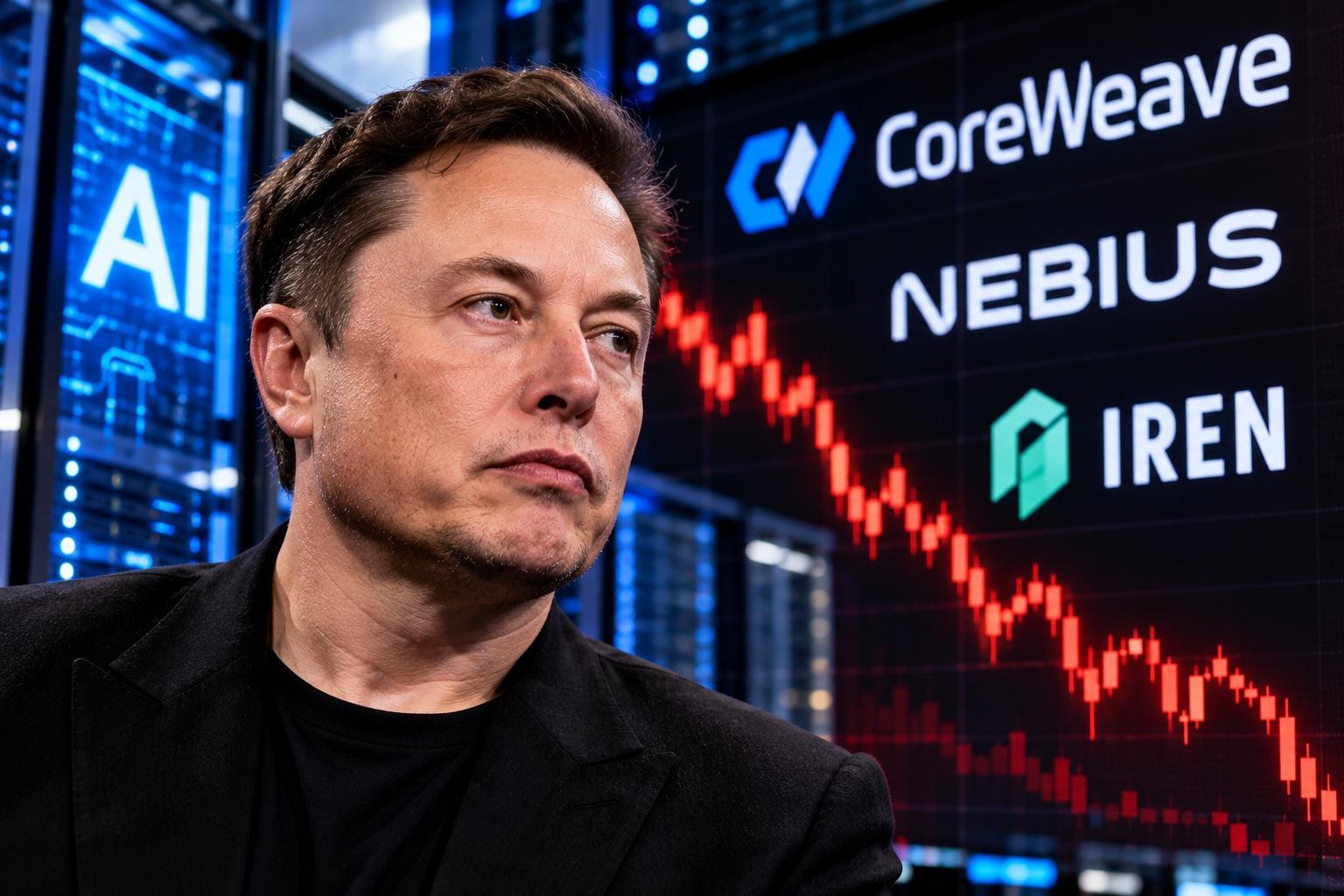
AI infrastructure stocks fell on October 26 after Elon Musk warned that more than 200 specialized cloud computing companies could face business failures or consolidation, intensifying concerns about debt, financing and the returns on artificial intelligence investment.
CoreWeave Inc. (NASDAQ: CRWV) dropped 4.5% in premarket trading, while Nebius Group N.V. (NASDAQ: NBIS) fell 3.4% and IREN Ltd. (NASDAQ: IREN) declined 3.3%, according to Reuters. Other AI infrastructure companies, including Applied Digital and TeraWulf, also moved lower.
The selloff followed Musk’s warning on X that debt markets had largely closed access to financing for companies without significant revenue independent of AI data centers. He argued that the sector’s more than 200 neocloud providers could face widespread failures, with only a limited number surviving independently.
The comments put fresh pressure on a sector already facing questions about whether its heavy investment in computing equipment and data centers will generate adequate returns. CNBC also reported on the decline in neocloud stocks following Musk’s warning.
Why Elon Musk’s Warning Is Hitting Neocloud Stocks
Neocloud companies rent computing capacity, often powered by Nvidia (NASDAQ: NVDA) graphics processing units, to businesses developing and running AI models. Their growth has benefited from demand for advanced computing, but the business requires substantial upfront spending on chips, data centers, electricity and related infrastructure.
That spending can create financial pressure when companies borrow heavily before new facilities begin generating revenue. Construction delays, power constraints or slower-than-expected customer demand can leave operators carrying financing costs without receiving the anticipated cash flow.
Musk contrasted the sector’s financing position with that of SpaceX, which he said had secured $40 billion in debt for graphics processing units. He argued that SpaceX has an advantage because it has revenue from Starlink satellite services and rocket launches in addition to its AI infrastructure business.
Musk also said SpaceX would not buy struggling neocloud companies. His comments came as investors questioned whether companies relying heavily on AI data-center revenue can continue raising money at a sustainable cost.
The concerns are not limited to Musk’s remarks. Reuters reported that CoreWeave’s borrowing costs and bond-market weakness have added to investor worries about its financial position. Research firm Gartner has also highlighted the sector’s exposure to rising leverage, with its analysis suggesting that many neocloud providers could lose their independence over time.
Wealthier Today previously examined the pressure on CoreWeave bond yields as investors reassessed AI debt risks. The same financing concerns are relevant across the sector, particularly for operators that must continue investing to meet customer commitments.
AI Demand Remains Strong, but Investors Want Better Returns
The pressure on neocloud shares highlights a growing distinction in the AI market: demand for computing power can rise even while investors become more cautious about the companies supplying it.
Major technology businesses continue to commit large sums to AI infrastructure. Goldman Sachs has projected that the five largest US hyperscalers could spend approximately $1.2 trillion on AI infrastructure in 2027, underscoring the scale of the investment cycle. But spending forecasts alone do not guarantee that every data-center operator will earn attractive returns.
Wealthier Today’s coverage of Goldman Sachs’ AI infrastructure spending outlook explores the capital requirements behind the expansion. Investors are increasingly asking whether revenue from AI services will grow quickly enough to cover infrastructure costs, borrowing expenses and ongoing investment.
The concern also extends to the companies developing AI models. The industry’s rapid expansion has increased demand for computing capacity, but the economics depend on how effectively providers convert customer usage into revenue. Wealthier Today’s report on OpenAI revenue and AI spending concerns examines the scrutiny surrounding that relationship.
For neocloud operators, the next test will be their ability to secure financing, bring new capacity online and generate enough cash flow to support their expansion. Companies with strong customer commitments and access to capital may be better positioned than those relying on repeated borrowing without diversified revenue streams.
The market reaction does not prove that the AI boom is ending. Instead, it shows that investors are becoming more selective about which companies can benefit from it. The outlook for neocloud stocks will depend not only on demand for AI computing but also on debt levels, funding costs, operating performance and the returns generated by new infrastructure.