
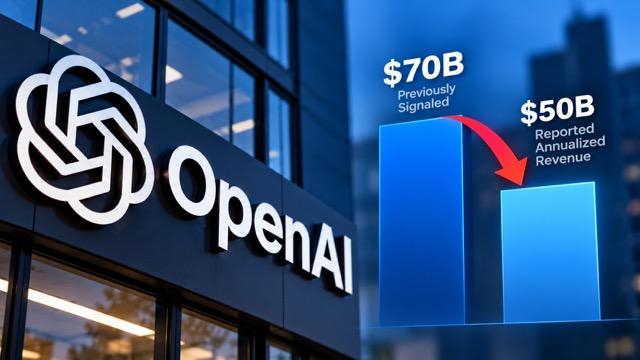
- OpenAI’s reported annualized revenue has fallen short of earlier expectations, prompting investors to reassess the financial outlook for the artificial intelligence industry and the companies supplying its computing infrastructure.
OpenAI reportedly told investors its annualized revenue was approaching $50 billion at the end of September, roughly $20 billion below the $70 billion figure previously reported by several media outlets. The discrepancy was detailed in an October 8 Reuters report, which cited a Financial Times investigation based on financial documents shared with investors.
The difference does not necessarily indicate that OpenAI’s sales have declined. Instead, the report attributed the gap to differences in how OpenAI and rival Anthropic calculate annualized revenue, particularly sales generated through cloud computing partners.
The figures matter because OpenAI is one of the central companies driving demand for advanced AI chips, cloud computing and data-center capacity. Investors have been using its reported growth to assess whether the enormous sums being committed to artificial intelligence can generate sufficient revenue to justify the spending.
OpenAI has not publicly confirmed the reported figures. Reuters said the company did not immediately respond to a request for comment and could not independently verify the Financial Times report.
The news nevertheless prompted a selloff in several AI-linked stocks on October 8. Nvidia Corp. (NASDAQ: NVDA) fell 2.9%, while Advanced Micro Devices Inc. (NASDAQ: AMD) declined 3.9% and Micron Technology Inc. (NASDAQ: MU) dropped 4.8%.
Why OpenAI’s $50 Billion Revenue Figure Matters
Annualized revenue is an estimate of how much revenue a company might generate over a year if its recent sales pace continues. It is often calculated by multiplying revenue from a shorter period by a factor that represents a full year.
The measure can help investors evaluate fast-growing private companies that do not publish the same detailed quarterly financial statements as publicly traded businesses. However, it is not the same as audited annual revenue, and the calculation can produce misleading comparisons when companies use different methods.
In OpenAI’s case, the Financial Times report said the discrepancy arose partly from efforts by investors to compare the company directly with Anthropic. Anthropic includes revenue from sales through cloud partners such as Amazon Web Services and Google Cloud in its annualized calculations, while OpenAI does not include those sales in the same way.
That distinction means the reported $20 billion gap should not automatically be interpreted as evidence of weakening demand for AI products. It highlights the need to understand what each company includes in its revenue metrics before drawing conclusions about its competitive position.
OpenAI’s reported annualized revenue of nearly $50 billion still represents substantial growth. The company reportedly generated close to $30 billion on an annualized basis in July, suggesting a sharp increase over the following months, although the figures remain based on reported investor disclosures rather than public audited accounts.
Investors are also watching the company's financing requirements. OpenAI has been discussing a potential funding round that could value it at approximately $1.4 trillion, according to earlier reporting. Wealthier Today’s coverage of OpenAI’s reported $30 billion funding target and valuation examines the scale of capital required to support its expansion.
The company has committed substantial resources to computing infrastructure and faces competition from Anthropic, Google, Meta Platforms Inc. (NASDAQ: META) and other AI developers. Its ability to turn usage growth into recurring revenue and sustainable cash generation will remain central to how investors value the business.
What the Revenue Discrepancy Means for AI Stocks
The market reaction shows how sensitive AI-related stocks have become to developments involving major model developers. Chipmakers, cloud providers and data-center operators are investing heavily to meet expected demand, but their returns depend partly on customers converting AI adoption into revenue that supports continued infrastructure spending.
Nvidia supplies processors widely used to train and run AI models. AMD competes in the accelerator market, while Micron provides memory used in computing systems. Each company has its own customer base and financial drivers, so OpenAI’s reported revenue figures do not provide a complete picture of demand across the semiconductor industry.
Cloud infrastructure providers face a related question: whether spending on AI computing capacity will translate into profitable workloads over time. Oracle Corp. (NYSE: ORCL), Microsoft Corp. (NASDAQ: MSFT) and Amazon.com Inc. (NASDAQ: AMZN) have all been expanding cloud and AI infrastructure, although their businesses extend well beyond OpenAI.
Wealthier Today’s analysis of technology stocks exposed to the AI investment cycle looks at companies positioned to benefit from continued spending, alongside the valuation and execution risks investors need to consider.
The latest report also puts greater emphasis on the relationship between AI revenue and infrastructure costs. Building and operating large AI systems requires significant spending on chips, electricity, data centers and cloud services. If customer revenue grows more slowly than infrastructure commitments, companies may face pressure to improve efficiency, secure additional financing or adjust expansion plans.
OpenAI’s reported revenue figure alone does not establish that the wider AI boom is losing momentum. Enterprise adoption, customer retention, pricing and the revenue generated by competing AI products will also influence demand. Investors can assess the broader infrastructure outlook through companies supplying power, cooling and networking for data centers, rather than relying on one private company's reported revenue metric.
For now, the key issue is transparency. More consistent disclosures about revenue, cloud-partner sales and infrastructure commitments would make it easier for investors to compare AI companies and evaluate whether their growth justifies current valuations.
OpenAI’s reported annualized revenue of nearly $50 billion indicates that its business continues to expand rapidly. But the gap between that figure and earlier reports is a reminder that investors should examine how financial metrics are calculated before using them to forecast future demand or justify stock prices.