
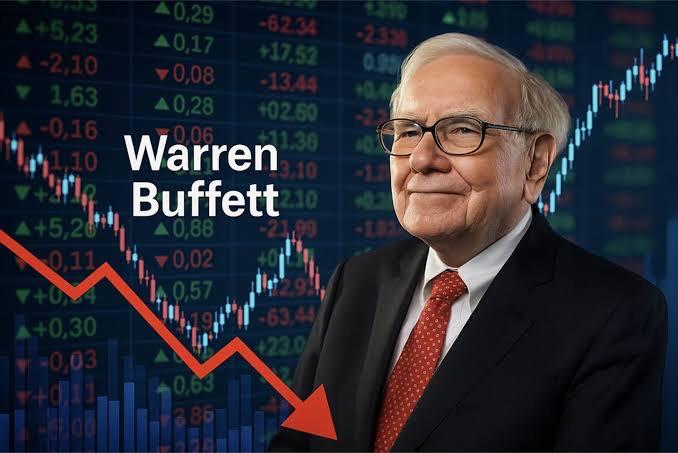
- Warren Buffett’s latest comments on stock market speculation come as investors weigh elevated valuations, rising bond yields and the risks of concentrating portfolios in high-flying stocks.
Warren Buffett has spent decades warning investors against paying too much for stocks and confusing a rising market with a low-risk investment opportunity. His recent remarks about the difficulty of finding value have renewed attention on how investors can prepare for a potential market downturn.
In a CNBC interview, Buffett said it was tough to find value when investors preferred gambling. The comment reflects his concern about speculative behavior and the challenge of identifying businesses whose share prices offer a sufficient margin of safety.
The warning does not establish that a stock market crash is imminent. Market valuations can remain elevated for extended periods, and even experienced investors cannot consistently predict the timing of a correction.
However, investors have reasons to pay attention to risk. On October 8, US stocks fell as rising oil prices and Treasury yields weighed on sentiment, with the Nasdaq Composite declining 1.25% and the S&P 500 dropping 0.47%. A single session does not prove that a broader downturn is beginning, but it illustrates how quickly market sentiment can change.
Why Buffett’s Market Warning Matters
Buffett’s caution is rooted in valuation rather than a claim that investors should abandon stocks. When share prices rise much faster than the underlying businesses’ earnings and cash flows, investors may have less protection if growth disappoints.
One measure frequently discussed in this context is the Shiller cyclically adjusted price-to-earnings ratio, or CAPE. It compares stock prices with inflation-adjusted earnings over a decade. Elevated readings have historically coincided with periods of weaker long-term returns, although the ratio is not a reliable short-term crash timer.
Another concern is the growing influence of a relatively small group of large companies on broad market indexes. Investors who buy an index fund gain exposure to many businesses, but a market-cap-weighted fund can still be heavily influenced by its largest holdings. That concentration can leave portfolios more exposed to a narrow set of companies and industries than the number of holdings suggests.
Buffett’s investment company, Berkshire Hathaway Inc. (NYSE: BRK.A, BRK.B), has also maintained substantial liquidity while waiting for attractive opportunities. Berkshire’s regulatory filing reported $359.2 billion in cash, cash equivalents and US Treasury bills held by its insurance and other businesses at June 30, 2026. That figure is not a forecast of a crash, and Berkshire’s resources and investment needs differ from those of ordinary households.
For individual investors, the practical lesson is to avoid building a portfolio around the assumption that recent gains will continue indefinitely. Reviewing long-term investment options can help investors align their holdings with their time horizon instead of chasing the market’s strongest recent performers.
How Investors Can Protect Their Portfolios if Stocks Fall
1. Diversify beyond a handful of stocks. Holding companies across different industries can reduce dependence on one business or sector. Investors should also review their exposure through funds, retirement accounts and other assets to identify overlapping holdings. Diversification can limit concentration risk, but it cannot eliminate losses during a broad market decline. Wealthier Today’s guide to investment risk and reward explains how risk, time horizon and portfolio construction fit together.
2. Keep emergency money separate from investments. Cash needed for rent, medical bills, debt payments or other near-term expenses should not depend on stock market performance. An emergency reserve can reduce the likelihood of having to sell investments at a loss to cover unexpected costs. The appropriate amount depends on household expenses, income stability and other financial obligations.
3. Avoid trying to call the market top. Selling every stock because a crash seems possible creates a second decision: when to buy back in. If prices keep rising, investors may miss further gains; if they fall, fear can delay a return to the market. Buffett has long favored a patient approach for ordinary investors over frequent trading and market timing.
4. Consider low-cost, diversified index funds. Buffett has repeatedly recommended low-cost S&P 500 index funds for many investors who do not have the time or expertise to select individual stocks. Such funds provide exposure to a broad group of large US companies, although they still fall when the wider market declines and may carry significant exposure to the biggest index constituents. Wealthier Today’s guide to building wealth with index funds outlines how investors can use regular contributions and low fees to support a long-term strategy.
5. Review debt and avoid excessive leverage. Borrowing to invest can magnify losses and may force investors to sell assets when prices are depressed. Margin positions, leveraged funds and options strategies can carry risks that are not apparent during a rising market. Investors should understand the potential loss and any cash requirements before using them.
6. Match investments to when the money is needed. Money intended for a near-term purchase generally should not be exposed to the same level of volatility as retirement investments decades away. A portfolio should reflect an investor’s financial goals, risk tolerance and need for liquidity, not just their outlook for the next market move.
Buffett’s approach is not about predicting the exact date of the next downturn. It is about avoiding unnecessary risk, refusing to overpay for uncertain future growth and maintaining the patience to act when attractive opportunities appear.
A market correction could still occur without warning, but it is not a certainty simply because valuations are high. Investors can prepare by maintaining a diversified portfolio, keeping adequate cash reserves and resisting the pressure to make major decisions based on fear or market excitement.