
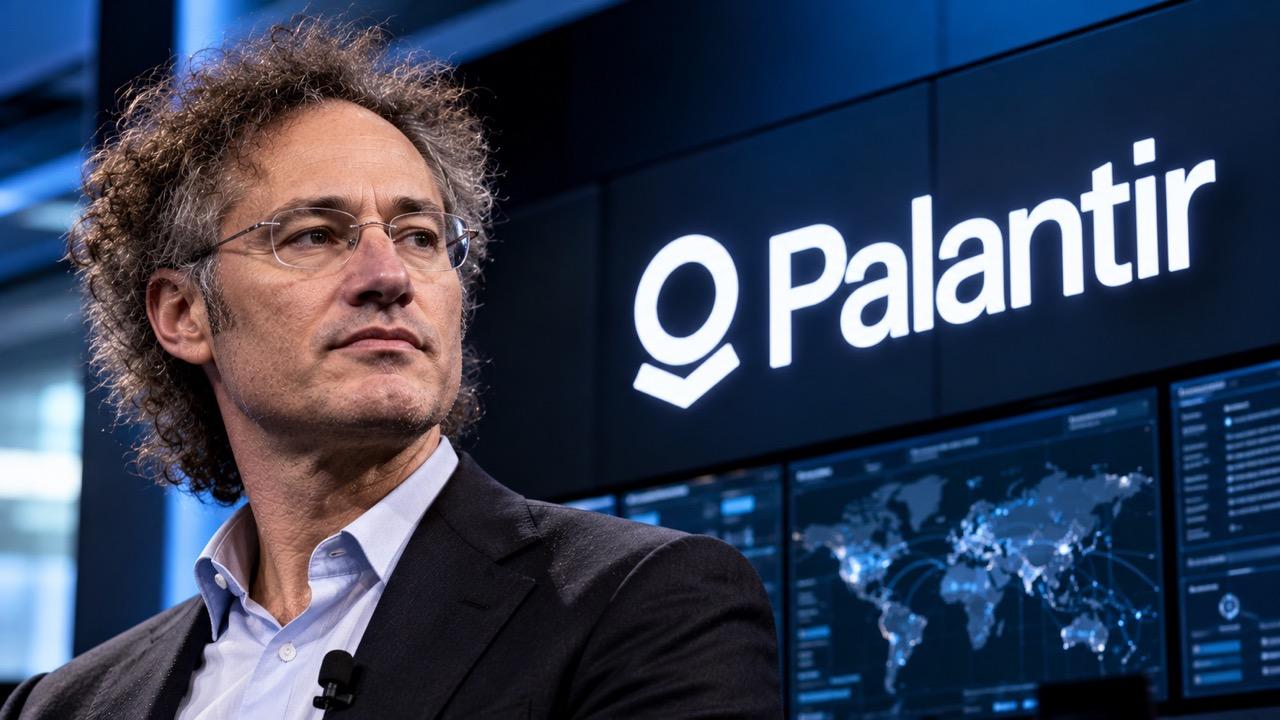
- Palantir CEO Alex Karp recalled how a senior executive pushed back against his repeated claims about Foundry’s potential, offering a glimpse into the company’s internal culture as its AI software business expands.
Palantir Technologies Inc. (NASDAQ: PLTR) CEO Alex Karp says one of his senior executives once told him to stop repeatedly promoting the potential of Foundry, warning that employees viewed his comments as disconnected froCreate a simple featured image depicting healthcarem their experience.
According to a report by Fortune, Karp recounted the exchange during a conversation with Zeta Global CEO David Steinberg at the Zeta Live ’26 conference.
Karp said Ted Mabrey, who now leads Palantir’s commercial business, urged him to stop telling employees how large Foundry could become. Mabrey reportedly warned that the repeated messaging was discouraging and made Karp appear out of touch.
Karp said the criticism prompted him to stop speaking to employees for about six months. He also described relying on long-standing colleagues who are willing to challenge his ideas rather than simply agree with him.
The remarks offer a rare account of internal disagreement at a company whose public profile is closely tied to Karp’s forceful views on artificial intelligence, enterprise software and the role of technology in business.
Foundry Becomes a Major Driver of Palantir’s Commercial Growth
The discussion comes as Foundry plays a central role in Palantir’s expansion beyond government contracts and into commercial software. The platform helps organizations integrate data from different systems, manage access and use that information to support operational decisions.
Palantir’s second-quarter 2026 results showed the pace of that expansion. US commercial revenue rose 149% year over year to $764 million, according to the company’s earnings release. Following the results, Palantir raised its full-year US commercial revenue outlook to more than $3.4 billion.
The company’s broader performance has also strengthened its position in the AI software market. Palantir reported total second-quarter revenue of $1.935 billion, up 93% from a year earlier, while US revenue increased 115% to $1.573 billion.
Investors tracking Palantir’s revenue growth and valuation have focused on whether the company can sustain that momentum while justifying the premium attached to its shares.
Foundry has also attracted customers seeking to connect AI systems with their own business data. Fortune reported that Zeta Global is rebuilding its Data Cloud on Palantir’s platform under a partnership announced in June. Steinberg said the seven-year agreement could eventually generate more than $100 million in annual sales, although that figure represents a projection rather than revenue already achieved.
The partnership illustrates how Palantir is attempting to position its software as an operating layer for businesses adopting AI, rather than simply as a tool for analyzing information.
Karp Says Palantir Rejects Conventional Software Models
Karp also used the discussion to revisit Palantir’s early difficulties raising capital. He said some investors wanted the company to develop software that customers would find difficult to replace, a model he criticized as creating dependency without delivering enough value.
Palantir instead developed a model that places engineers directly inside customer organizations to help implement and adapt its technology. The company calls this approach forward-deployed engineering. Steinberg said Zeta had adopted a similar approach after seeing how efficiently it could support customers.
Karp argued that AI is increasing the consequences of poor technology decisions. In his view, companies that fail to integrate AI effectively could lose ground to competitors, even if those competitors have historically weaker products or capabilities.
He urged business leaders to identify what differentiates their companies, understand their operations in detail and use AI to strengthen those advantages without exposing sensitive knowledge to outside model providers or competitors.
Those arguments align with Palantir’s broader commercial pitch: organizations should apply AI to their own data and processes while maintaining control over how their information is used. The company’s strategy has attracted attention as businesses increase spending on AI software and infrastructure, a trend also shaping the outlook for technology stocks tied to the AI investment cycle.
Karp’s account of Mabrey’s criticism, however, highlights a tension between the CEO’s ambitious public messaging and the need to maintain credibility with employees responsible for delivering the technology.
Palantir’s latest results demonstrate strong demand for its commercial software, but the executive exchange does not independently establish how employees generally view Karp’s leadership. It instead provides his account of one internal challenge and how he says he responded to it.
For investors, the business question remains whether Palantir can translate its rapid commercial growth into sustained revenue and profits. The company’s AI-driven growth story is attracting market attention, but its long-term performance will depend on customer adoption, execution and the ability to meet the expectations built into its valuation.