
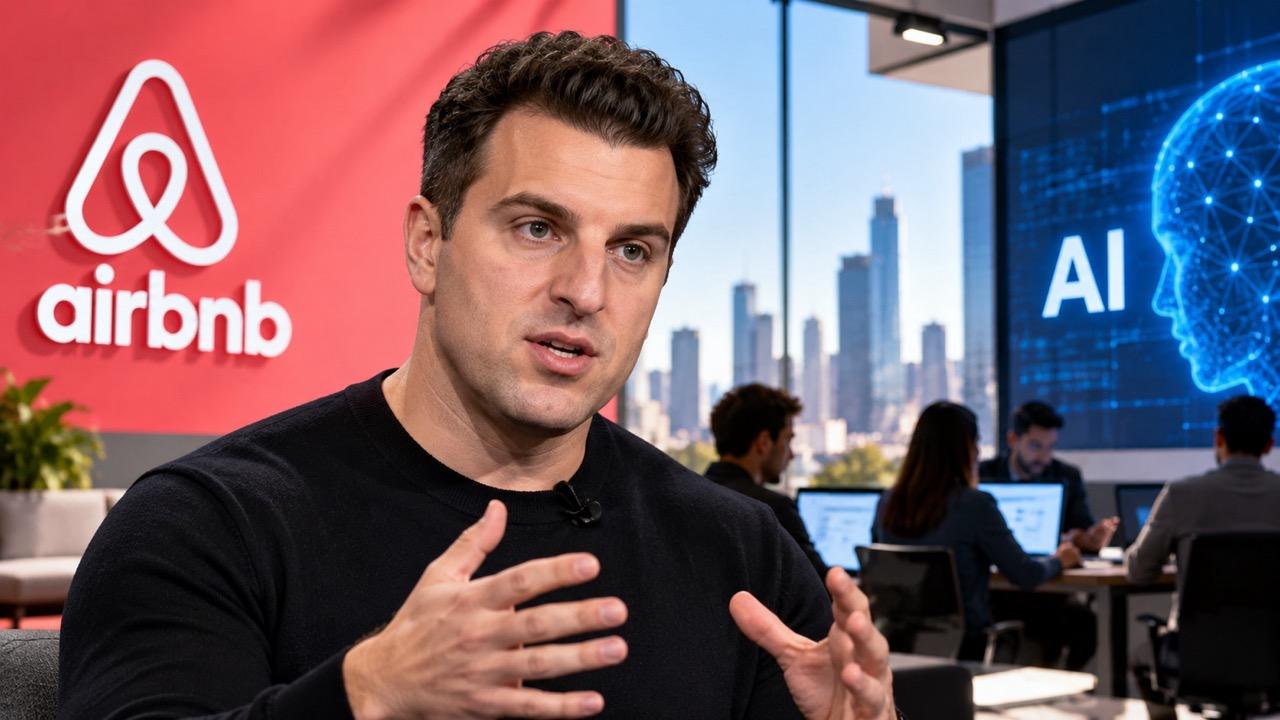
Airbnb (NASDAQ: ABNB) Chief Executive Brian Chesky has warned that managers who only supervise employees and workers who refuse to adapt to artificial intelligence could struggle to remain valuable as AI reshapes the workplace.
In an interview discussed by Fortune, Chesky argued that professionals need to combine practical contributions with the ability to work effectively alongside AI tools. His comments reflect a growing debate over how automation could change management structures and the skills employers value.
Chesky's warning does not mean that all managers or workers who are unfamiliar with AI will lose their jobs. Rather, he believes employees need to evolve as businesses adopt new technology. The distinction is particularly relevant as companies look for ways to improve productivity while reconsidering traditional roles.
Chesky Says Managers Must Combine Leadership With Hands-On Work
Chesky identified two groups at risk: managers whose responsibilities are limited to supervising people and employees who are unwilling to change how they work.
He argued that managers need to understand the work their teams produce rather than relying primarily on meetings and routine check-ins. In his view, successful leaders will increasingly combine people management with direct contributions to projects.
Chesky described this approach as becoming a hybrid manager and individual contributor. Such managers would remain responsible for their teams while also bringing practical knowledge to product development and other core activities.
He cited former Apple chief design officer Jony Ive as an example of a leader who combined technical expertise with management responsibilities. Chesky's argument is that maintaining a close connection to the work itself will become more important as AI takes on tasks that previously required larger teams.
The shift could affect how businesses structure their management layers. If AI tools make coordination and routine administrative work easier, companies may reconsider roles that focus primarily on tracking progress or relaying information between employees.
The discussion also connects with broader concerns about corporate productivity. Former Google chief executive Eric Schmidt has argued that AI could eliminate some coordination-heavy roles, while emphasizing the continuing need for people who can invent products and lead teams. His recent comments on AI and corporate jobs illustrate how executives are reassessing the division of work between employees and software.
Workers Who Resist AI Risk Falling Behind, Chesky Says
Chesky also warned that employees who refuse to learn new AI tools could lose ground to colleagues who use the technology to work more effectively. He presented adaptability as a key skill for professionals facing changes in how companies develop products and manage operations.
The Airbnb chief executive's comments reflect a wider shift in expectations across technology-driven workplaces. AI tools can already assist with coding, writing, research and data analysis, allowing some employees to complete tasks more quickly. Their usefulness, however, depends on the quality of the output and the ability of workers to evaluate the results.
That does not mean AI expertise alone guarantees job security. Employees still need judgment and relevant professional knowledge to identify problems, make decisions and determine whether AI-generated work is accurate.
Businesses are also taking different approaches to incorporating AI into their operations. Some are using it to automate repetitive tasks, while others are redesigning teams and changing the responsibilities assigned to managers.
For Airbnb, the debate is relevant to a company operating in a market where digital products and customer experience are central to its business. The company's official newsroom provides updates on its product strategy and corporate initiatives.
Chesky's central message is that employees should not assume their existing responsibilities will remain unchanged. Managers may need to become more involved in the work their teams produce, while other professionals will need to learn how AI can support their roles.
The longer-term impact on employment remains uncertain. AI adoption varies across industries, and companies will make different decisions about which tasks to automate and which responsibilities require human involvement. Chesky's comments nevertheless underscore the growing importance of adaptability as employers reassess productivity and organizational design.