
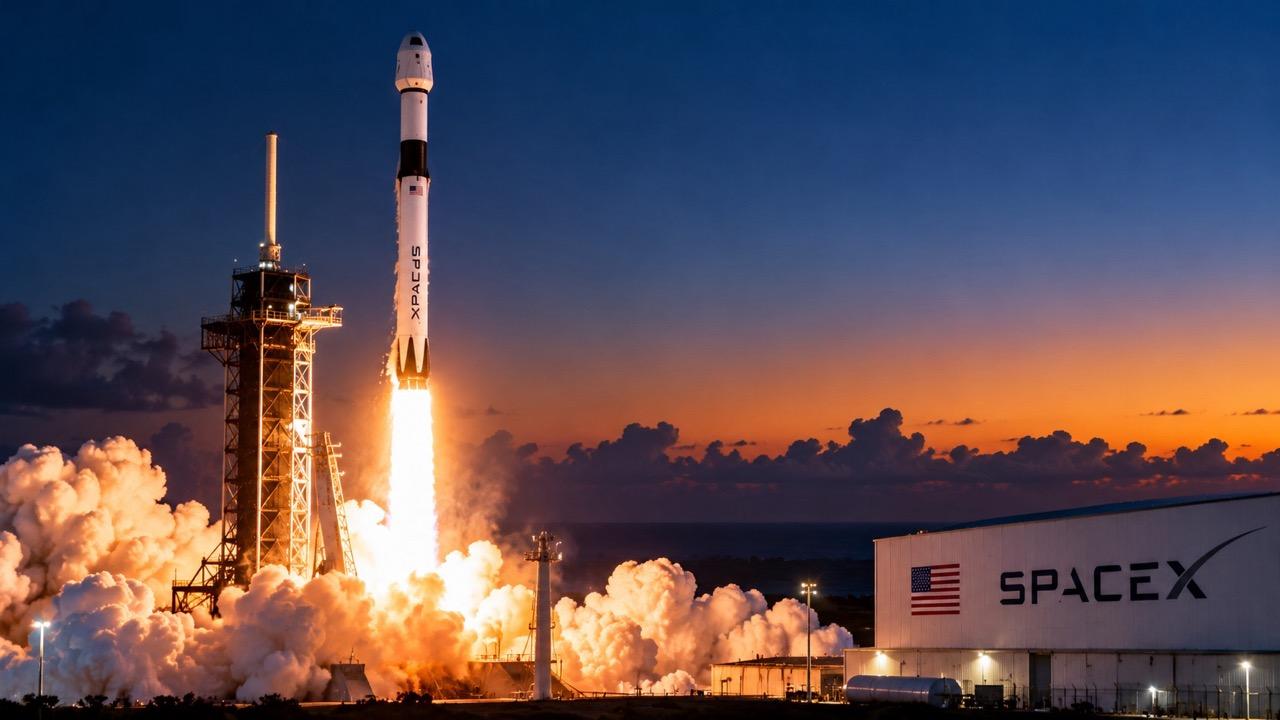
- SpaceX launched a Falcon 9 rocket carrying an uncrewed Dragon spacecraft toward the International Space Station early Tuesday, delivering more than 6,300 pounds of cargo, scientific experiments and the final pair of upgraded solar arrays for the orbiting laboratory.
SpaceX launched its 35th NASA Commercial Resupply Services mission from Cape Canaveral Space Force Station in Florida at 6:33 a.m. Eastern time on October 13. The flight, designated CRS-35, is part of NASA's ongoing program to transport supplies and research equipment to the space station using commercial spacecraft.
The official mission plan calls for the Dragon capsule to autonomously dock with the International Space Station on Thursday, October 15, at approximately 11 a.m. Eastern time, following a journey of about 52 hours.
The spacecraft is carrying more than 6,300 pounds of equipment, spare parts, crew supplies and scientific materials. One of the mission's major objectives is to deliver the final two International Space Station Roll-Out Solar Arrays, which will help compensate for declining performance in the station's original solar power system.
Final Solar Arrays and Scientific Experiments Head to Orbit
The two new solar array blankets are the seventh and eighth additions in a major power-system upgrade that began in 2021. NASA has installed six of the arrays during previous spacewalks, with the final pair scheduled for installation later this month and in early November.
The upgrades are intended to increase the station's electricity-generation capacity as its original solar wings age. The new arrays will supplement the existing power system rather than replace all eight original wings.
The mission is also carrying research equipment for studies that could benefit medicine and future spaceflight. NASA said the payload includes experiments involving lab-grown models of the human brain, three-dimensional heart tissue, artificial retinas, crop disease and antibiotic-resistant bacteria.
The brain-model investigation will examine how microgravity affects human brain tissue, while the heart research will study the behavior of three-dimensional tissue models in space. Other experiments will investigate plant health and ways to better understand or assess health risks during long-duration missions.
Details of the research payload are available in NASA's CRS-35 science overview. The spacecraft is also carrying hardware associated with maintenance of the orbiting laboratory, including equipment for station systems and a component from the station's robotic arm that was removed during a previous spacewalk.
SpaceX's Cargo Mission Supports ISS Operations
CRS-35 is the 35th SpaceX commercial resupply mission conducted for NASA. The agency uses commercial providers to deliver food, equipment and scientific materials to the station, allowing astronauts to continue research and routine maintenance in orbit.
The mission also highlights the role of reusable launch vehicles in commercial spaceflight. SpaceX said the Falcon 9 first-stage booster assigned to CRS-35 was making its eighth flight. After separating from the rocket's upper stage, the booster was scheduled to return to Landing Zone 40 at Cape Canaveral.
SpaceX's launch business has become a central part of the commercial space sector, although competition for launch capacity remains an issue as demand for satellite deployments and government missions grows. The company has increasingly focused on its own Starlink satellite network alongside external customer launches, a trend examined in coverage of the commercial rocket capacity shortage.
SpaceX is also expanding its satellite connectivity business. Its planned acquisition of additional wireless spectrum has drawn attention to potential competition with established mobile operators, as discussed in Wealthier Today's report on the SpaceX spectrum deal and US wireless carriers.
For NASA, the immediate priority is the successful arrival of the Dragon spacecraft and delivery of its payload. If the schedule holds, the capsule will dock with the International Space Station on Thursday, allowing the crew to unload supplies and prepare the new solar arrays and research equipment for use.