
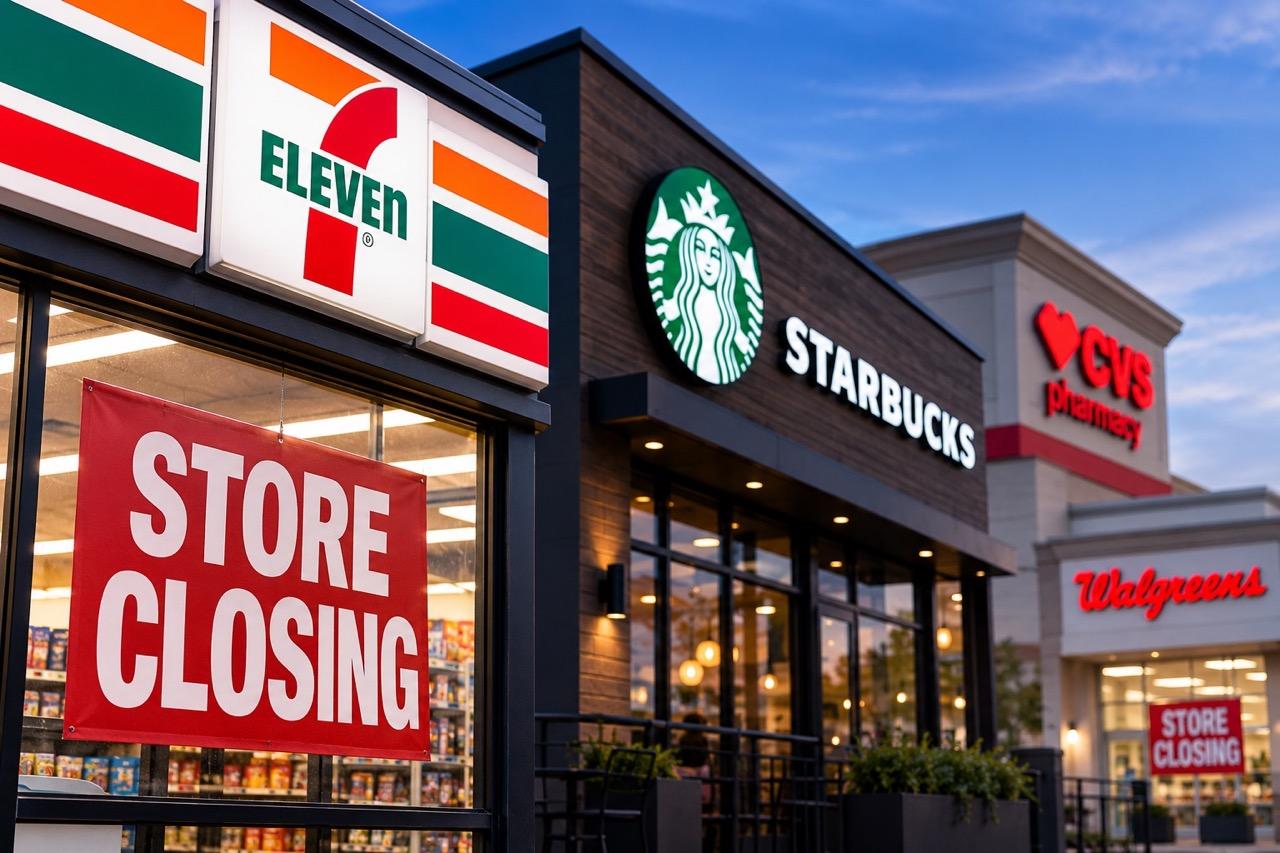
- Major retailers and restaurant chains are shrinking parts of their US footprints in 2026, with closures tied to bankruptcies, weaker store performance and restructuring plans, even as discount retailers continue opening new locations.
Thousands of US stores are closing or scheduled to close in 2026 as retailers adjust to changing shopping habits, higher operating costs and uneven consumer spending. The latest Coresight Research figures reported by Fast Company show 3,321 actual or planned closures tracked through July 3, with the research firm projecting as many as 8,228 closures for the full year.
The retrenchment is not uniform across the industry. Some companies are liquidating store fleets following bankruptcy proceedings, while others are eliminating weaker locations as part of broader turnaround plans. Meanwhile, retailers such as Dollar General and TJX Companies, the parent of T.J. Maxx, continue to expand, illustrating how store closures can coincide with investment elsewhere in the sector.
Consumer pressure is also shaping retail decisions. Dollar General’s recent comments on shoppers trading down highlight the strain that inflation and household budgets can place on retailers serving price-sensitive customers.
7-Eleven, Francesca’s and Starbucks Lead Major Closure Plans
7-Eleven: The convenience-store operator’s North American business plans to close 645 locations in fiscal 2026 while opening 205, according to company financial reporting covered by CBS News. The closure figure includes conversions to wholesale fuel stores, so it does not represent 645 straightforward exits from the broader fuel and convenience business. Coresight separately estimated 601 closures by the end of calendar 2026.
Francesca’s: The women’s boutique retailer is undergoing a major contraction following bankruptcy proceedings. Coresight estimated that 457 locations would close, with 55 already confirmed in its midyear data. The figure reflects the chain’s liquidation-related shutdowns rather than a routine store optimization program.
Eddie Bauer: The operator of Eddie Bauer’s US and Canadian stores moved to wind down its physical retail business after failing to secure a buyer. Retail Dive reported that 175 stores were subject to closure proceedings. The brand’s e-commerce and wholesale operations are separate from the store operator, so the retail shutdown does not necessarily mean the brand itself is disappearing.
Starbucks (NASDAQ: SBUX): Starbucks announced plans to close approximately 250 North American coffeehouses as part of its Back to Starbucks turnaround strategy. The company said the locations represented around 1% of its more than 18,000 coffeehouses in the region. Its official announcement said the affected locations were not consistently meeting customer-experience or financial-performance expectations.
Macy’s (NYSE: M): Macy’s continues to implement its multiyear A Bold New Chapter strategy, which targets roughly 150 underperforming department stores for closure. The program was originally announced in 2024 and its timetable has since been extended, so the full target should not be treated as 150 new closures in 2026. Recent reporting from Fast Company identified additional stores scheduled to shut.
GameStop (NYSE: GME): GameStop has continued to reduce its physical footprint as gaming shifts toward digital distribution. Coresight recorded 470 confirmed closures in its midyear data. That is a tracker figure, not necessarily a newly announced target for the remainder of 2026; the company had already closed hundreds of US stores in fiscal 2025.
Chip City Cookies: The New York-based cookie chain closed its remaining locations in early October 2026. Store Closure Watch’s reporting documented the shutdown of the chain’s remaining shops, ending its existing physical-store operation.
Wendy’s, Pizza Hut and Other Chains Are Cutting Locations
Wendy’s (NASDAQ: WEN): Wendy’s closed 289 US restaurants during the first half of 2026. The figure refers to reported closures during the period, rather than a blanket plan to close 300 additional restaurants before year-end.
Pizza Hut: The chain planned to close approximately 250 US locations in the first half of 2026, according to the same industry report. The closures reflect efforts to address weaker-performing restaurants, although the figure should be distinguished from any additional shutdowns that may be announced later.
Walgreens: Walgreens has been restructuring its store network for several years. Although Coresight initially estimated 350 closures for 2026, the company told Fast Company that it expected to close fewer than 100 US stores during the year. Its longer-term plan to eliminate underperforming locations should not be confused with that narrower 2026 estimate.
Kroger (NYSE: KR): Kroger announced a plan to close 60 underperforming supermarkets over an 18-month period in 2025. The program extends across reporting periods, so it is more accurate to describe it as an ongoing restructuring plan than as 60 newly announced 2026 closures.
Saks OFF 5TH and Saks Fifth Avenue: Saks Global has been restructuring its luxury and off-price retail operations. Closure counts vary by brand and reporting period, so combined estimates should be treated cautiously rather than presented as a single confirmed 2026 total.
Carter’s (NYSE: CRI): Reports of a plan to close approximately 150 stores through 2028, including around 60 in 2026, should be tied to a company filing or direct statement before being treated as confirmed. The timing and number of closures may differ from the full multiyear target.
Other chains, including Big Lots and Rite Aid, have also appeared in store-closure tracking as they restructure their operations. The status and count of individual locations can change as bankruptcy proceedings, lease decisions and store sales progress.
The wider trend does not mean all US retail is contracting. Coresight’s midyear data also tracked thousands of planned openings, with discount-focused chains among the retailers continuing to expand. For consumers, the practical impact will depend on which locations close, whether nearby alternatives remain available and how retailers reorganize their networks. Readers can also follow other US store-closure developments and T.J. Maxx’s closures alongside its expansion plans.
Editorial note: Closure totals in this report cover different periods and categories. Some are company-announced plans, some are research-firm estimates and others are closures already recorded. They should not be added together as if they represent a single verified count of stores closing during calendar 2026.