
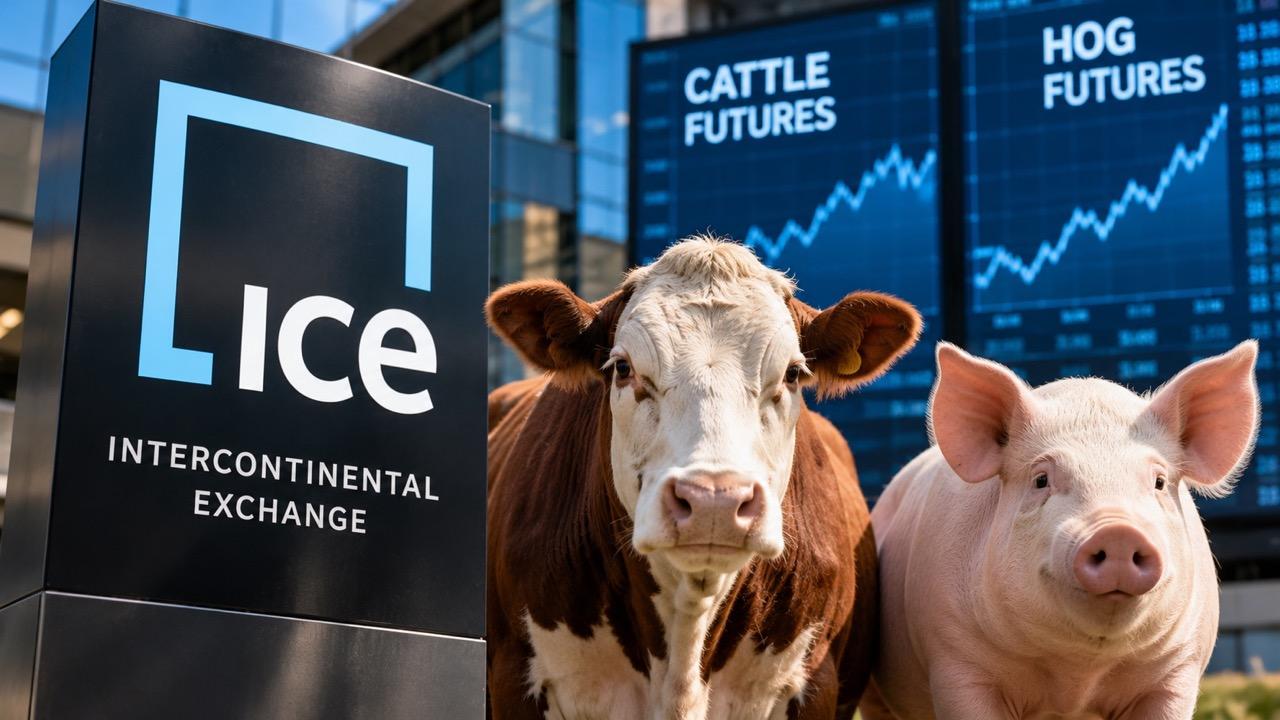
- Intercontinental Exchange plans to launch cattle and hog futures contracts on December 7, creating a new option for livestock-market hedging as the exchange seeks to challenge CME Group’s long-standing dominance in US cattle derivatives.
Intercontinental Exchange Inc. (NYSE: ICE), the owner of the New York Stock Exchange, plans to introduce futures contracts tied to cattle and hog prices on December 7, Bloomberg reported Tuesday, October 13, citing ICE executives. The proposed launch remains subject to regulatory review.
The Atlanta-based exchange operator intends to list physically settled cattle futures alongside three cash-settled contracts linked to cattle and hog prices. ICE has assigned the proposed products the trading codes COW, MOO and SOW, and plans to notify exchange members about the contracts this week.
The move would give livestock traders another venue to hedge against price swings in a market dominated by CME Group Inc. (NASDAQ: CME), which has offered cattle and hog futures since the 1960s.
ICE said it had received significant interest from customers seeking an alternative for cattle trading. Trabue Bland, the company’s senior vice president of futures markets, described the launch as an opportunity to broaden choice in the market.
Livestock derivatives have become increasingly important as cattle prices rise and meat producers, retailers and restaurants seek ways to manage input costs. The development also comes as exchanges reconsider their technology infrastructure and compete to attract trading activity.
ICE Challenges CME as Exchanges Debate Cloud Infrastructure
CME Group has been moving parts of its trading infrastructure to cloud-based systems, a shift that has prompted concerns among some trading firms and agricultural-market participants about potential costs and trading speeds.
CME previously planned to move its livestock markets’ primary systems to a new data center in Dallas. However, the company said on Monday that a newly built data center in Aurora, Illinois, was coming online faster than expected, removing the need for the interim relocation of its primary livestock market. Dallas will still serve as a disaster-recovery site.
CME has argued that cloud infrastructure can help control costs, improve efficiency and provide real-time analytical capabilities. Outgoing Chief Executive Terry Duffy has said the exchange would not move products to the cloud unless the new systems performed better than the existing setup.
ICE’s planned contracts offer a competing route for market participants who want alternatives for managing livestock-price exposure. The launch could give producers, processors and other businesses additional ways to hedge, although trading liquidity and market adoption will determine how competitive the new contracts become.
The competition comes as exchanges seek to expand their agricultural derivatives offerings. CME has introduced additional instruments to help customers manage exposure to beef prices, while ICE is preparing a broader set of cattle and hog contracts.
Rising Cattle Prices Increase Demand for Hedging Options
The US cattle herd has fallen to its smallest size in more than half a century, contributing to higher livestock prices and pressure on meat processors and some ranchers. Tight supplies have made it more difficult for businesses to manage costs and secure predictable prices.
Beef has also become an important factor in food inflation. Retailers and restaurants have responded by adjusting portion sizes, promoting less expensive cuts and offering alternative proteins as they try to manage higher costs.
For livestock producers and meat buyers, futures contracts can help reduce exposure to unfavorable price movements. A producer may use futures to protect against a decline in selling prices, while a processor can hedge against the risk of rising livestock costs. These contracts do not eliminate market risk, and their effectiveness depends on how closely futures prices track the underlying cash market.
ICE’s planned physically settled cattle futures would involve delivery under the contract’s terms, while its three cash-settled contracts would be settled financially against the relevant reference prices. The final specifications and regulatory approval will be important to prospective users.
The exchange has not yet confirmed whether the December 7 target will change following regulatory review. If the contracts launch as planned, their early trading volumes, bid-ask spreads and participation from commercial hedgers will help determine whether ICE can establish a meaningful presence alongside CME.
For now, the planned launch marks a new competitive development in livestock derivatives at a time when elevated cattle prices are increasing the importance of risk management across the beef supply chain.