
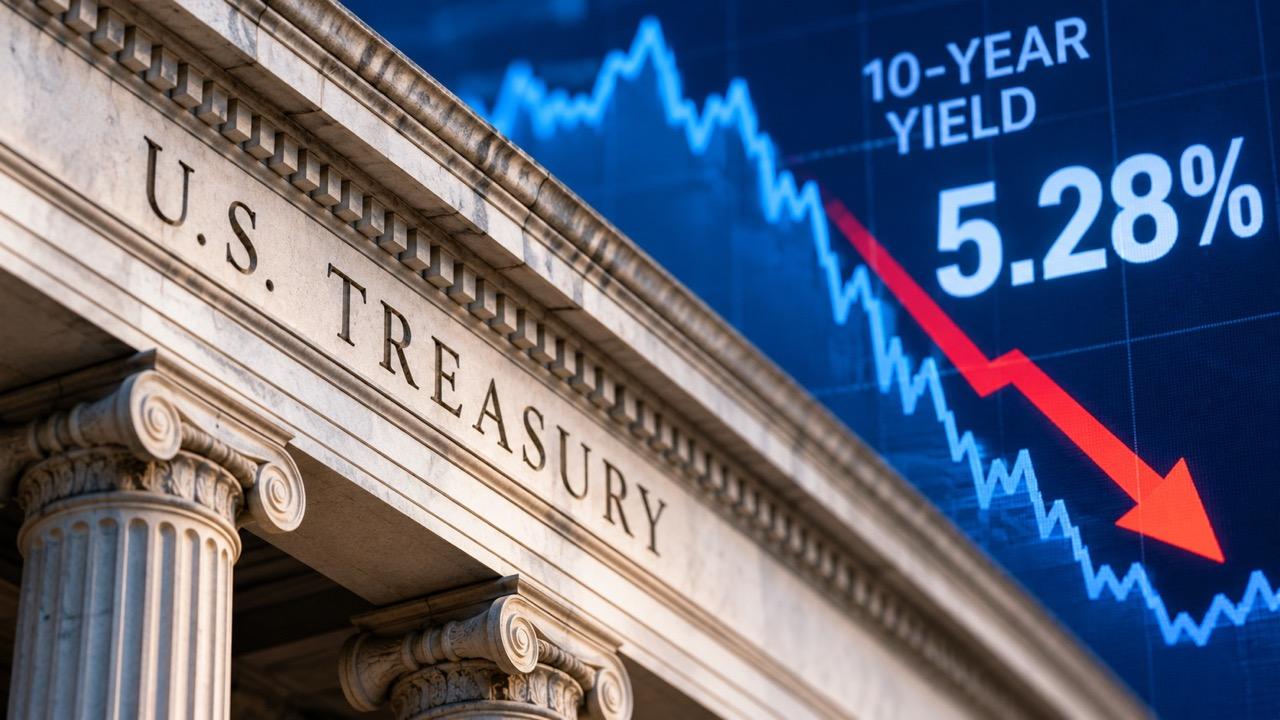
- The 10-year Treasury yield pulled back from a 24-year high after strong demand at a $39 billion auction eased concerns about continued selling of US government bonds.
The 10-year US Treasury yield retreated from its highest level since 2002 on Wednesday as investors stepped back into the bond market following a strong auction of benchmark government debt. The yield briefly climbed to 5.364% during the session before easing as Treasury prices recovered. Reuters reported that the move lower was supported by a $39 billion sale of 10-year notes, which showed that demand for longer-term US government debt remained firm despite the recent selloff.
The retreat does not mark a return to low borrowing costs. The 10-year yield remained around 5.28% later in the session, keeping it close to its highest levels in more than two decades. The move also follows a sharp rise in long-term Treasury yields during the third quarter. Wealthier Today’s coverage of the Treasury selloff showed how inflation concerns, government borrowing needs and changing Federal Reserve expectations have pushed yields higher.
Why Treasury Yields Pulled Back From Their Highs
The strongest signal from Wednesday's trading came from the Treasury auction. The US Treasury sold $39 billion of 10-year notes at a yield of 5.30%. The auction attracted a bid-to-cover ratio of 2.77, above the six-auction average of 2.54, according to Reuters. Primary dealers received only 2.5% of the offering, the smallest share since the aftermath of the global financial crisis.
The results suggested that investors were willing to buy government debt at elevated yields without requiring an additional premium. That helped ease concerns that demand for longer-term Treasuries was weakening as the US government continues to borrow heavily.
Falling oil prices also helped the bond market recover during the session. Brent crude declined to around $100 a barrel after the International Energy Agency agreed to accelerate an oil-stock release, reducing some immediate pressure on inflation expectations.
The Federal Reserve remains another important variable. Minutes from the central bank's September meeting showed policymakers divided over the reasoning behind the latest rate increase, with some officials concerned about energy-driven inflation and others focused on broader demand pressures.
The Federal Reserve's latest interest-rate data showed the 10-year Treasury constant maturity rate at 5.27% on Oct. 6, compared with 4.79% for the two-year note. That gap has widened as longer-term yields have risen more sharply than short-term rates.
What Lower Treasury Yields Mean for Investors
For investors, the latest decline is important because Treasury yields influence borrowing costs and valuations across financial markets. Bond prices and yields move in opposite directions. When demand for existing Treasury securities increases, their prices rise, and their yields generally fall. The latest move therefore indicates that some investors are finding the higher yields attractive enough to buy after weeks of selling pressure.
That does not necessarily mean the broader bond selloff is over. The 10-year yield remains substantially above the levels seen earlier in the year, while inflation, oil prices, government borrowing and Federal Reserve policy remain key drivers of the market.
Higher long-term Treasury yields can also put pressure on stocks because they raise the return investors can obtain from relatively low-risk government debt while increasing the discount rate applied to future corporate earnings. Recent Wealthier Today analysis of stocks exposed to rising Treasury yields highlighted the risks for highly leveraged companies, utilities, REITs, and businesses that depend heavily on financing.
The housing market is another area where the Treasury market matters. Long-term mortgage rates tend to move more closely with the 10-year Treasury than with the Federal Reserve's overnight policy rate. Wealthier Today's coverage of the Fed's latest rate increase explains why elevated Treasury yields can keep mortgage borrowing costs high even when expectations for the federal funds rate change.
For bond investors, however, higher yields have a different implication. New buyers can potentially lock in higher income than was available when Treasury yields were lower, although prices of existing bonds can remain vulnerable if yields rise further.
The immediate message from Wednesday's market action is therefore limited but significant: demand for long-term US government debt remains strong enough to absorb a large Treasury auction, even after yields reached their highest levels in 24 years.
Investors will continue watching oil prices, inflation expectations, Federal Reserve policy, and upcoming Treasury auctions to determine whether the latest retreat develops into a broader stabilization of the bond market.