
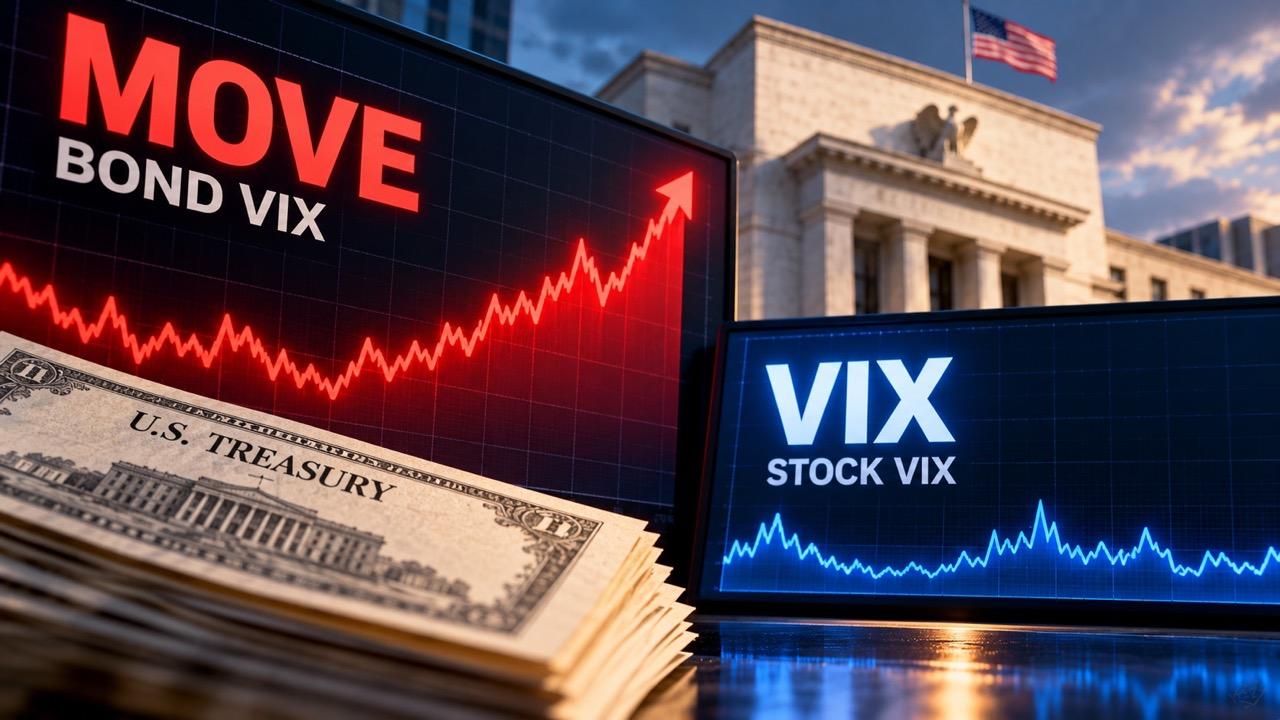
- Treasury-market volatility has risen sharply while stock-market volatility remains relatively low, creating a notable divergence that investors are watching as US bond yields reach multi-decade highs.
The bond market is sending a much louder warning than the stock market. The ICE BofA MOVE Index, often described as the “Bond VIX,” measures expected volatility in the US Treasury market. It has risen sharply in recent weeks even as the Cboe Volatility Index (VIX), which measures expected S&P 500 volatility, remains near historically calmer levels.
According to ICE's description of the MOVE Index, the gauge is designed to measure volatility in US bond yields. The VIX, meanwhile, measures expected 30-day volatility in the S&P 500 based on options prices, according to Cboe.
The divergence has become more striking as Treasury yields have climbed. The 10-year US Treasury yield reached about 5.36% on Oct. 7, its highest level since 2002, while the 30-year yield climbed to roughly 5.73%.
Stocks initially absorbed the move. But the market began pulling back Wednesday after the S&P 500 and Nasdaq reached records the previous session.
Why the Bond VIX Is Rising While the Stock VIX Stays Calm
The latest move in bond volatility reflects several pressures hitting fixed-income markets simultaneously. Reuters reported that the US Treasury term premium, or the additional compensation investors demand to hold longer-dated government debt, has risen to its highest level in 12 years. The increase reflects concerns surrounding inflation, fiscal conditions and the supply of government debt.
Oil prices are adding another layer of uncertainty. Brent crude moved above $100 a barrel this week as disruptions in the Middle East raised concerns about global energy supplies. Higher energy costs can feed directly into inflation expectations and make it more difficult for central banks to ease monetary policy.
The global bond selloff has therefore become more than a Treasury-market story. Higher government yields influence mortgage rates, corporate borrowing costs and the discount rates used to value stocks. Yet equity investors have remained comparatively calm.
Barron's reported that the MOVE Index had risen 43% year to date while the VIX remained near one of its lowest levels of 2026. The S&P 500 has also continued to trade close to record highs, helped by expectations for strong third-quarter earnings and continued enthusiasm around artificial intelligence.
That gap does not automatically mean stocks are about to fall. The MOVE index measures the expected size of moves in Treasury yields, not whether yields will rise or decline. Similarly, the VIX measures expected stock-market volatility rather than predicting whether the S&P 500 will rise or fall.
Recent market history illustrates the difference. A September analysis cited by Seeking Alpha's discussion of the MOVE-VIX divergence argued that the unusually wide gap could indicate that equity investors were underpricing macroeconomic risks. However, a subsequent historical analysis of previous episodes found that a spike in bond volatility by itself was not a reliable predictor of a major equity selloff.
What Could Make the Bond Shock Spread to Stocks?
The bigger risk would come if higher Treasury yields begin changing corporate earnings expectations or equity valuations rather than simply remaining a bond-market phenomenon. The latest stock-market pullback shows how sensitive different parts of the market can be to rates. Companies whose valuations depend heavily on future earnings can face greater pressure when the risk-free rate rises because future cash flows become less valuable at higher discount rates.
The effect can also reach the credit market. Cboe reported earlier this month that implied volatility in both investment-grade and high-yield corporate bonds had increased sharply. Investment-grade volatility moved into the 79th percentile of its historical range, while high-yield volatility reached the 84th percentile. That suggests the stress is broader than Treasury securities alone.
The bond-market selloff has already pushed long-term borrowing costs to levels that can affect businesses and households. Freddie Mac's 30-year mortgage rate was already above 7% at the start of October, adding another channel through which higher yields can affect the economy.
The Federal Reserve is another critical variable. The Fed raised its target range by 25 basis points at its September meeting, marking its first rate increase since 2023. Investors are now waiting for the meeting minutes for additional clues about how policymakers view inflation, economic growth, and the possibility of further rate increases.
A sustained rise in yields accompanied by stronger inflation would present a more difficult environment for stocks than higher yields caused primarily by stronger economic growth. That is why the next phase of the bond-market move matters more than the current divergence itself.
If Treasury yields stabilize while corporate earnings remain strong, equities could continue absorbing higher rates. If yields keep rising, oil prices remain elevated, and credit spreads widen, pressure could spread across stocks, corporate bonds, currencies, and other risk assets.
The best long-term investments also do not necessarily change because the MOVE Index rises. But higher bond volatility can be a reason to reassess duration exposure, portfolio concentration, and how much short-term market volatility an investor can tolerate.
For now, the data show a clear divergence: bond markets are pricing substantially more uncertainty than equity markets. Whether that gap closes through falling bond volatility, rising stock volatility, or simply continued resilience in equities remains unresolved.
The Bond VIX is therefore a warning signal worth watching, but it is not, by itself, evidence that a stock-market crash is imminent.