
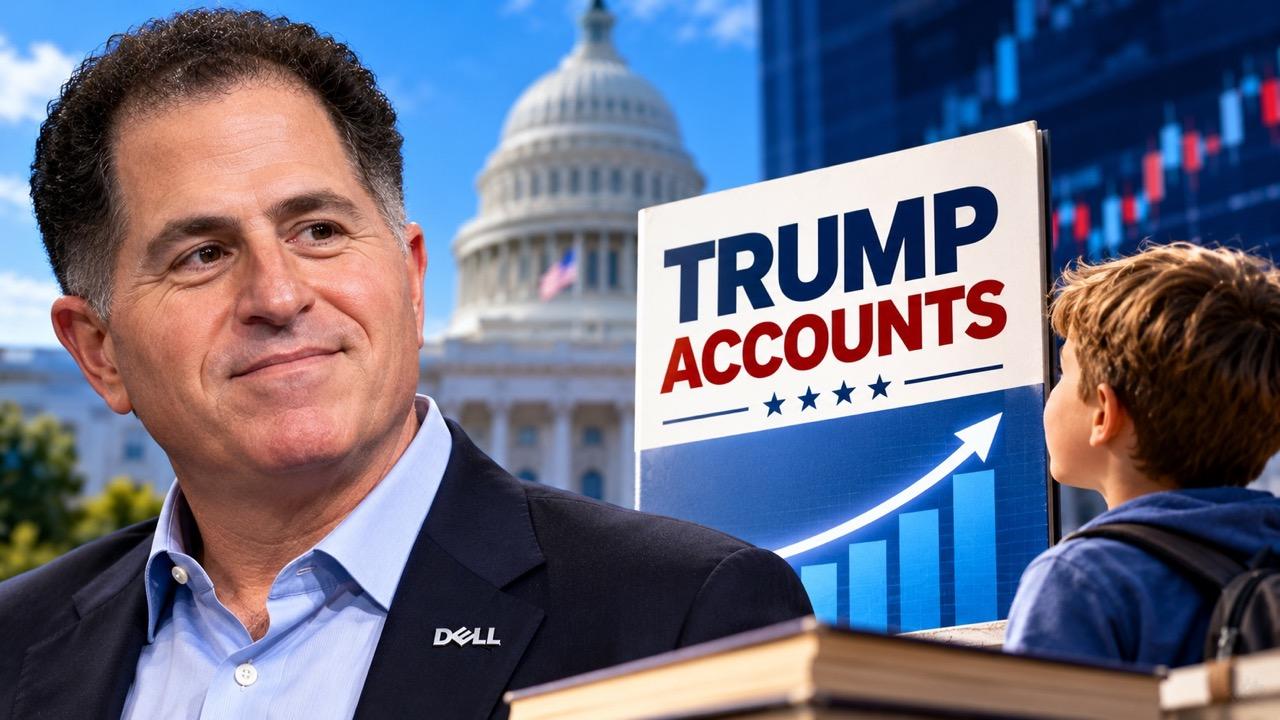
- Michael Dell says early exposure to investing could give children a stronger understanding of ownership and compounding as Trump Accounts expand to roughly 70 million automatically enrolled children.
Michael Dell is arguing that the biggest potential benefit of Trump Accounts may extend beyond the money deposited into them. The Dell Technologies Inc. (NYSE: DELL) founder said the accounts could give children an early connection to investing, ownership, and compound growth as the federal program expands and private donors gain new ways to contribute.
His comments came as Trump Accounts underwent a major expansion. Treasury and the IRS began automatically establishing accounts for eligible children in October, taking the program from a voluntary investment initiative to one with accounts created for nearly every eligible child under 18 with a valid Social Security number.
The Treasury's automatic-enrollment announcement said more than 60 million additional children received accounts through the change. The White House has since put the total at roughly 70 million. The expansion is happening alongside another significant change: certain qualifying publicly traded stocks can now be contributed directly to Trump Accounts as philanthropic donations.
Dell's $6.25 Billion Pledge Reaches Millions of Children
Dell's involvement in the program predates the new stock rules. Michael and Susan Dell committed $6.25 billion to provide $250 investments for as many as 25 million children. Michael Dell said Oct. 7 that more than 10 million of those accounts had already received the contribution and that the full 25 million target was expected to be reached by the end of the week.
The Dell Foundation's update said the commitment is intended to give millions of children an investment of their own rather than simply providing a traditional cash benefit. Dell's latest comments focus on what children may learn from having money invested in the market.
He has argued that an account established during childhood can provide a practical introduction to concepts such as compounding, investing, and corporate ownership. In his remarks at the White House, Dell said he hoped the children receiving the contributions would eventually become owners and participants in the US economy.
The timing is significant because the accounts are now available on a much larger scale. Automatic enrollment, however, does not mean every child immediately receives the federal government's $1,000 contribution. Treasury says a parent or guardian must claim an automatically created account, and eligible children must have their accounts claimed to receive the one-time government contribution.
The IRS rules also establish Trump Accounts as a special type of traditional IRA with restrictions that generally prevent withdrawals during the child's growth period. The program therefore combines a long investment horizon with restrictions designed to keep the money invested while the child is young.
Why Individual Stock Donations Are Changing the Program
The newer stock rules create a different path for money to enter these accounts. Treasury and the IRS now permit certain qualified stock contributions, meaning qualifying publicly traded stock issued by a domestic corporation can be donated for the benefit of a designated class of Trump Account beneficiaries.
The Sept. 30 temporary regulations say the stock is transferred directly into the accounts rather than being purchased with money already held by the children. The rules also impose a minimum holding period. Qualified stock generally cannot be sold before the earlier of five years after the contribution or the end of the beneficiary's growth period.
The change creates an important difference between ordinary contributions and donated shares. Regular money contributed to a Trump Account is generally invested through the program's permitted investment options, including low-cost funds designed to provide broad US equity exposure. A qualifying stock donation, by contrast, can leave the account exposed to the performance of one company.
SpaceX President and Chief Operating Officer Gwynne Shotwell has already announced plans involving more than 2 million shares for children in lower-income communities. The contribution illustrates how the new mechanism can allow a company or donor to connect a specific corporate asset with a large group of young beneficiaries.
The Treasury's original stock-contribution announcement said the policy was intended to create a practical mechanism for large philanthropic contributions. The potential advantage is scale. Donors holding large stock positions can contribute shares without first selling them for cash.
The potential drawback is concentration. A diversified index fund spreads exposure across many companies, while a donated individual stock can rise or fall independently of the broader market. The five-year restriction also means the recipient generally cannot simply sell the position if the company subsequently performs poorly.
Treasury's regulatory analysis acknowledges the additional investment risk but argues that permitting stock donations could attract more private contributions than a cash-only system.
For children, the program could therefore produce two very different investing experiences: diversified market exposure through ordinary contributions and potentially concentrated company exposure through philanthropic stock donations.
The Trump Accounts rules are consequently becoming an important part of the wider discussion about how children can participate in long-term investing.
The development also makes diversification more relevant. A donated share may provide an introduction to owning a business, but a single-company position is not the same as a diversified investment strategy. The principles behind index-fund investing remain relevant for families making additional contributions.
With roughly 70 million accounts now established, the scale of the program is far larger than when Trump Accounts launched in July. Michael Dell's contribution demonstrates how private philanthropy can rapidly add money to the system. The new stock rules could bring additional corporate assets into children's accounts.
The long-term question is whether those contributions simply create early investing habits or whether concentrated stock donations become a meaningful part of children's portfolios.