

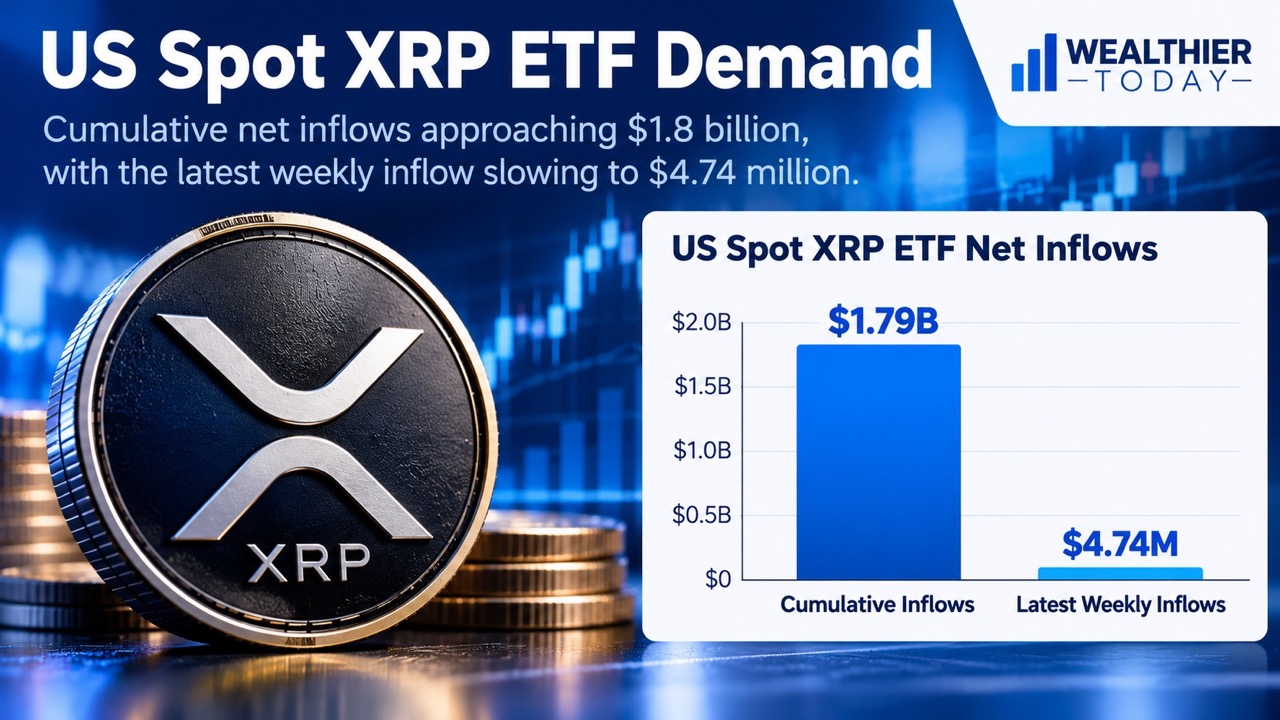
- US spot XRP ETFs have accumulated nearly $1.8 billion in net inflows, giving the token a growing institutional investment channel despite recent price volatility.
XRP is gaining a more established route into traditional investment portfolios as US spot exchange-traded funds continue to attract capital. The latest data show cumulative net inflows of about $1.79 billion as of Oct. 6, while the funds held roughly $1.7 billion in net assets, according to market-flow data.
The numbers add to the case that regulated investment products are becoming an important part of the XRP market. Spot ETFs allow investors to obtain exposure through conventional brokerage and investment accounts without directly purchasing and storing XRP.
The development extends a broader expansion of crypto-focused ETFs beyond Bitcoin and Ethereum and gives XRP another channel through which professional investors can allocate to the digital asset.
XRP ETF Inflows Continue Despite Slower Recent Demand
The latest figures also show why the institutional-demand story needs some qualification. US spot XRP ETFs recorded approximately $3.14 million in combined net inflows on Oct. 6, according to data reported by TokenPost. Bitwise's XRP ETF led the session with about $10.55 million of inflows, while Franklin Templeton's XRP ETF recorded approximately $4.07 million in outflows. Other funds also experienced withdrawals, leaving the group with a modest net gain.
The Oct. 6 result followed roughly $4.74 million of net inflows during the Sept. 28-Oct. 2 trading week. Weekly inflows had fallen sharply from the $75.59 million recorded during the previous five-day period, according to market-flow reports.
That slowdown is important because ETF assets and new ETF inflows measure different things. The roughly $1.7 billion held by the funds represents accumulated assets at a particular point in time, while daily and weekly flow figures show the more recent balance between creations and redemptions.
The latest data therefore show continued positive demand, but not a straight-line acceleration in institutional buying. XRP's market performance has also demonstrated that ETF inflows do not automatically translate into higher prices. XRP fell from around $1.52 to roughly $1.46 on Oct. 6, even as the ETFs posted a net inflow that day. Broader weakness across digital assets coincided with the decline.
The token was trading around $1.43 on Oct. 7 after the wider crypto market came under pressure. Recent XRP market coverage has also highlighted the difference between growing institutional access and claims about future price targets.
Institutional access is nevertheless expanding. The Securities and Exchange Commission's filings show that spot XRP products are structured to hold XRP and provide investors with exposure to the asset through exchange-traded shares. Bitwise's latest SEC filing, for example, says its XRP ETF holds XRP and references the CME CF XRP-Dollar Reference Rate for pricing.
Wall Street Access Adds to XRP's Institutional Case
The ETF market is only one part of the broader institutional expansion surrounding XRP. Regulatory filings have shown investment firms holding shares of XRP-related exchange-traded products. The SEC's database includes XRP ETF positions in institutional 13F reports, providing a clearer picture of how some professional investors are gaining exposure through regulated securities rather than direct token ownership.
CoinDesk reported in September that US spot XRP ETFs had recorded 11 consecutive trading sessions of inflows, bringing cumulative inflows to about $1.68 billion at the time. The report also identified Goldman Sachs, Jane Street and Millennium among major disclosed institutional holders.
The institutional story also extends beyond ETFs. Ripple has expanded into prime brokerage, clearing and financing through Ripple Prime, while the company has continued developing financial-market infrastructure around digital assets. Ripple said in August that its Delta One business would provide institutional clients with access to total-return swaps across US-listed equities, indexes and digital assets.
At the network level, XRP Ledger activity is also moving into areas such as tokenized financial assets. A recent Brazilian tokenization project involving Ripple and CSD BR is using the XRP Ledger to mirror ownership records for investment-fund shares while existing official records remain in place.
Ripple has also been expanding financial partnerships in Asia, including projects involving cross-border payments and digital-asset infrastructure in South Korea. These developments do not prove that institutional demand will continue increasing at the current pace, nor do ETF inflows establish a particular future XRP price. They do, however, provide measurable evidence that XRP now has a broader regulated-investment infrastructure than it did before the spot ETF market emerged.
The next test is whether the products can maintain positive flows as crypto markets face higher volatility and whether the roughly $1.7 billion already held by XRP ETFs continues to grow. For now, the data point to sustained institutional access, although recent inflows suggest that demand has moderated rather than accelerated.
The trend is also relevant alongside the growing XRP institutional adoption story, where companies and financial firms are exploring ways to hold, deploy, or build services around the asset.