
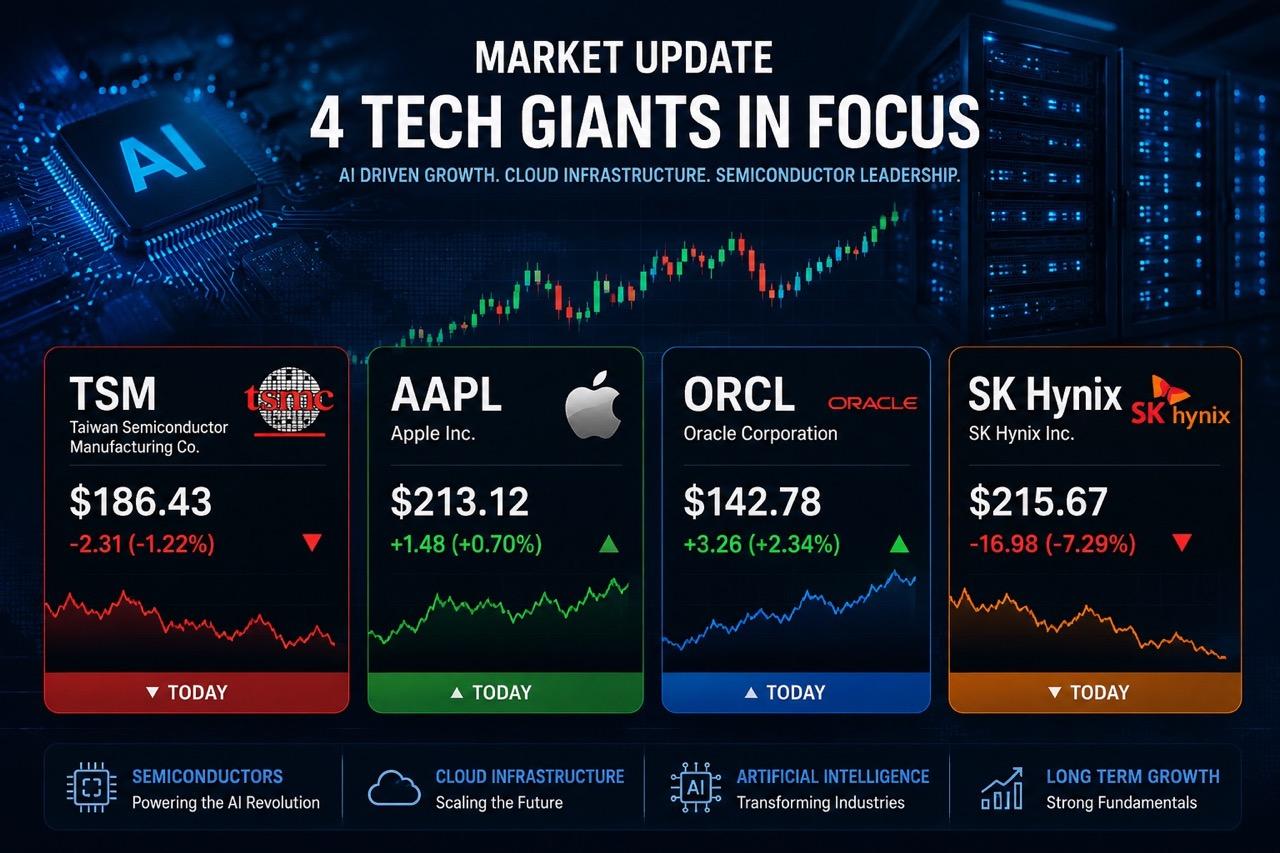
TSM, AAPL, ORACLE, and SK Hynix are among the most closely watched technology stocks today as investors react to AI-driven semiconductor demand, major corporate developments, earnings expectations, and geopolitical risks. Together, these four companies represent hundreds of billions of dollars in annual revenue and play critical roles across the global artificial intelligence supply chain, from chip manufacturing and cloud computing to smartphones and high-bandwidth memory.
However, TSM, AAPL, Oracle, and SK Hynix are not being driven by one single macro headline. Instead, traders are reacting to a mix of fresh revenue updates, record highs, credit concerns, and sharp post-listing volatility. Who benefits most from the AI buildout, and who is carrying the most valuation and execution risk?
TSM Starts Moving Amid Record AI Demand
Taiwan Semiconductor Manufacturing Company Limited (NYSE: TSM) is trending because Taiwan Semiconductor Manufacturing Co. reported second-quarter revenue of NT$1.27 trillion on July 13, 2026. The Taipei Times reported that the company saw a 36% year-over-year increase and a new quarterly record, according to the company’s update. June revenue alone jumped 67.9% from a year earlier, reinforcing the view that AI orders are still flowing through the foundry pipeline.
The bigger story for TSM is scale. Reuters reported that TSMC shares were up about 57% year to date before the latest update. Meanwhile, the company’s full-year 2026 revenue forecast remains for more than 30% growth in U.S. dollar terms. This combination of growth and market leadership helps explain why TSM keeps drawing attention even after a strong run.
From a trading perspective, TSM’s recent pattern has been steady rather than explosive. The stock rose about 1% after the revenue report, which is modest for a name tied to the hottest AI supply chain. Over the last month, the stock has mostly traded as a momentum leader with occasional pullbacks on broader tech weakness. Over the last year, the trend has been decisively higher as investors priced in AI-led wafer demand, advanced packaging, and the company’s 2-nanometer roadmap.
Apple’s AAPL Rewards Cash Flow Over AI Spending
Apple’s AAPL is back in the spotlight after MacRumors reported on July 13, 2026, that Apple shares had rallied 15% since June 25 and added nearly $600 billion in market value, sending the stock back toward record highs. In the same report, Apple was described as trading in record territory because investors are increasingly skeptical of large AI infrastructure budgets at other firms.
This helps explain why the AAPL stock is behaving differently from many other mega-cap tech names. Rather than rewarding the biggest spender, the market is favoring Apple’s relative restraint. The company is also seen as benefiting from stronger pricing power, a huge installed base, and expectations for fresh product catalysts, including a potential foldable iPhone later in the year.
The short-term performance picture matters here. Apple shares were up 16% in 2026 in the MacRumors report, making AAPL the strongest performer among the “Magnificent Seven” at that point. Bloomberg coverage also said Apple had climbed back toward a prior all-time high near $317.40. In other words, AAPL’s one-day move may not look as dramatic as a smaller AI stock, but the one-week, one-month, and year-to-date trend has been powerful.
Apple’s longer history is also part of the appeal. AAPL has spent decades turning hardware sales, software, services, and buybacks into a compounding cash machine. However, Apple’s weak spot remains AI execution and component costs, especially memory pricing, but for now, investors appear willing to pay for consistency.
Oracle And SK Hynix Cloud And Memory Stories Come Under Pressure
Oracle is trending for a different reason than the others, and that is due to risk. CNBC’s page for ORCL showed the stock near $131.86, down 6.24% on the session, and marked a fresh 52-week low of $131.35 on July 13, 2026. This is a sharp reversal for a company that has been one of the market’s main AI-cloud beneficiaries.
The problem is that Oracle’s growth story now comes with heavier debt and higher CAPEX. Recent reporting has highlighted S&P Global Ratings’ downgrade of Oracle’s long-term issuer rating to BBB-, just one notch above junk, amid concerns about customer concentration, funding needs, and free cash flow. On top of that, analysts have pointed to a massive $638 billion backlog and a jump in expected capital spending tied to AI infrastructure. That is impressive on paper, but it also means the market is now asking how quickly Oracle can convert promise into profit.
SK Hynix, on the other hand, is the clearest example of AI euphoria turning into volatility. Yahoo Finance reported on July 13 that SK Hynix’s Seoul-listed shares dropped as much as 15.37% after its Nasdaq debut, while the U.S.-listed ADRs fell 7.9% in early trading after jumping 12.8% in the debut.
The stock’s history matters because SK Hynix has been one of the biggest winners in the AI memory trade. It leads the high-bandwidth memory market, but that also means expectations are sky-high. In the very short term, the Nasdaq listing gave investors a new way to trade the story. In the medium term, though, the stock now has to prove that demand for HBM can stay hot enough to absorb future capacity.