

JetBlue (NASDAQ: JBLU) opened the latest debate around the JBLU stock with a familiar split as the shares look inexpensive, but the fundamentals still look fragile. This tension is exactly why the stock has become a battleground for investors. On one side, JetBlue has been showing stronger demand, better revenue per seat, and a valuation that screens cheap. On the other hand, the airline still posted a wide quarterly loss, carries billions in debt, and remains highly exposed to fuel costs and industry pricing pressure.
JetBlue Earnings, Debt, and Valuation Signal a Split Story
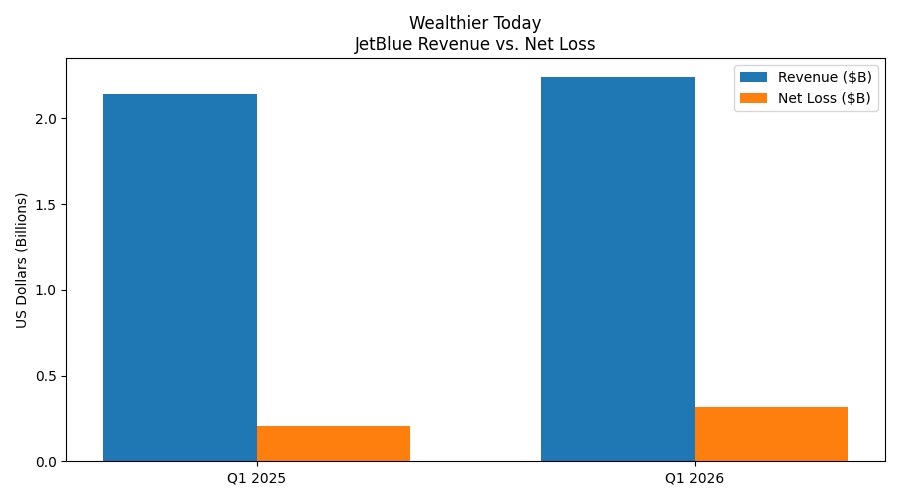
JetBlue reported its first-quarter 2026 results on April 28, 2026, saying operating revenue rose 4.7% year over year to $2.24 billion. But the same release showed that JetBlue posted a net loss of $319 million, versus $208 million a year earlier, while operating loss widened to $224 million from $174 million. This data reveals that the revenue side was clearly better than the profit side.
JetBlue said RASM, or revenue per available seat mile, increased 6.5%, while passenger revenue rose to $2.048 billion from $1.969 billion. Average fare also edged up to $219.49, compared with $212.58 in the prior-year quarter. But costs still climbed faster than the business could absorb. Its total operating expenses were $2.464 billion, up 6.5%, and aircraft fuel expense alone jumped to $573 million from $511 million. Meanwhile, JetBlue’s average fuel price rose 15.2% to $2.96 per gallon.
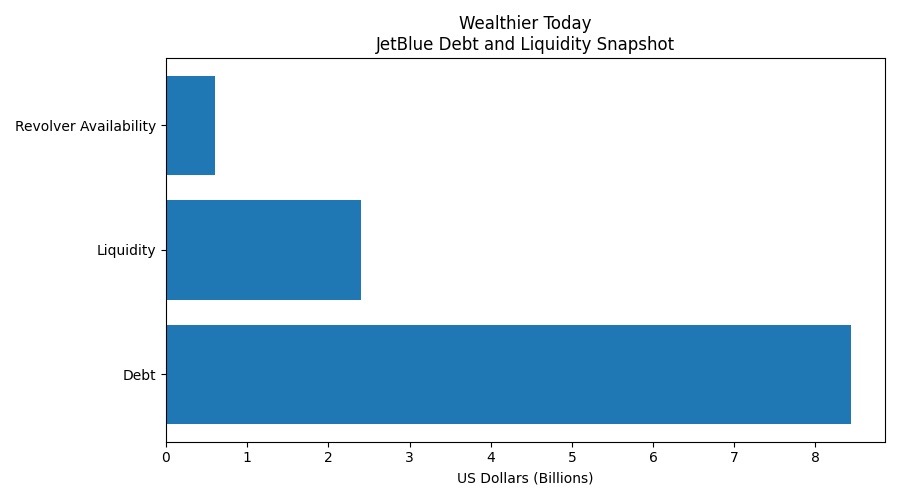
This matters because airline earnings can swing quickly when fuel and labor rise at the same time. JetBlue’s balance sheet also leaves less room for error. The company said it ended the quarter with $2.4 billion in liquidity and about $8.435 billion in total debt. The airline also disclosed $6.0 billion+ of unencumbered assets and a $600 million undrawn revolving credit facility, which helps, but does not erase the leverage issue.
A July 2026 Yahoo Finance report shows that the JBLU stock price had fallen about 61% over five years and still looked cheap on several valuation checks due to this. This includes a price-to-sales ratio around 0.2x versus a broader industry average closer to 0.6x. The only problem now is that low valuation is not the same as a margin of safety. If earnings remain negative, a discounted stock can stay discounted.
Guidance Shows Improvement, But Not Enough To Remove Downside Risk For JBLU
JetBlue’s own guidance suggests the business is improving operationally, but not enough yet to eliminate the bear case for its JBLU stock price. In its June 1, 2026 Form 8-K update, JetBlue said it had maintained a 99.8% completion factor quarter to date and saw strong travel demand across the booking curve.
The company also said in an SEC filing that routes previously operated by Spirit had been outperforming after Spirit’s shutdown, a sign that network disruption can create near-term opportunities. The airline had recently shut down operations out of Manchester and is now looking to fill the Fort Lauderdale gap left by Spirit Airlines' shutdown, Wealthier Today reported.
Still, the numbers in that filing point to a business that is improving from a weak base rather than powering ahead. JetBlue raised its second-quarter 2026 outlook for RASM to 9.0% to 12.0%, compared with the prior 7.0% to 11.0% range. However, the company also lifted its expected fuel price to $4.26 to $4.36 per gallon from $4.13 to $4.28. It cut expected capital expenditures to about $225 million from $275 million, which signals discipline, but also hints management is still protecting cash.
The key issue for JBLU shareholders now remains that the stock’s upside depends on JetBlue translating better demand into sustained profitability before another shock hits fuel, fares, or the economy. Recent brokerage commentary has included price-target moves, but the overall stance remains mixed. A Yahoo Finance-linked summary cited Raymond James lowering JBLU to Underperform and Goldman Sachs raising its target to $4.50 while keeping a Sell rating, which shows how divided Wall Street remains on this airline stock.
For investors, the bull case is that JetBlue’s demand trends keep improving, its costs are stabilizing, and the company is using its liquidity to keep reshaping the network. The bear case scenario, though, is that margins stay thin, debt remains heavy, and the stock keeps drifting lower if investors decide the turnaround will take too long.
Bottom line is the JBLU may be a good stock buy only if JetBlue’s management can convert its revenue strength into durable profit improvement. If not, JBLU may still have room to fall.
Market activity
JetBlue Airways Corporation
Market data and charting provided by TradingView. Data may be delayed depending on exchange availability.