

Several high-profile CEOs have sold significant amounts of company stock this year, prompting investors to ask whether insiders are signaling caution or simply managing their personal finances. Some of these sales were as recent as this week, as several high-profile executives disclosed sales that ranged from routine diversification to large, timed exits under pre-arranged trading plans.
The filings matter because insider sales can have significant implications for the stock prices. The SEC filings show that while these CEOs have sold stocks worth millions of dollars, the transactions represented relatively small portions of their overall ownership stakes. This report shows the numbers.
CEOs Who Have Sold Company Stocks In July
George Kurtz Of CrowdStrike
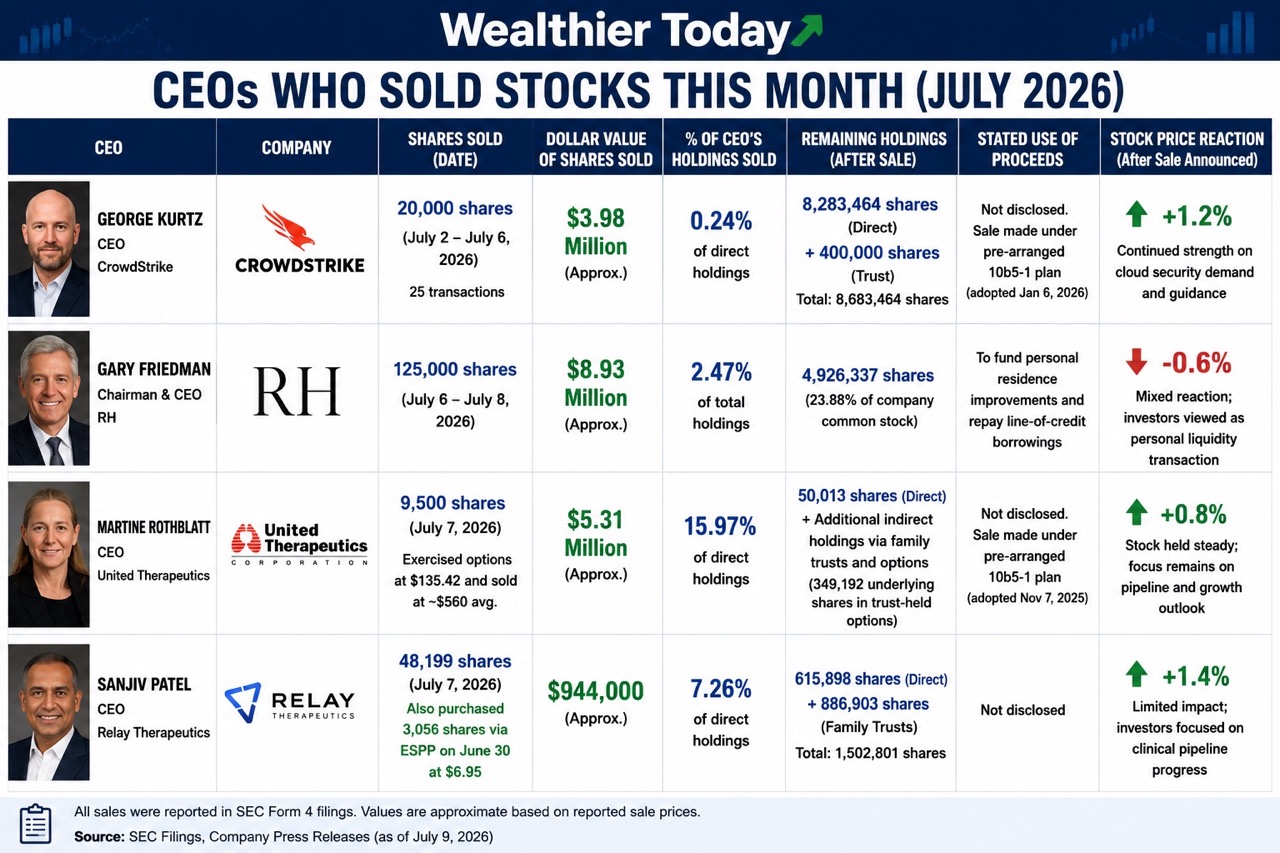
At cybersecurity company CrowdStrike Holdings, Inc. (NASDAQ: CRWD), CEO George Kurtz sold 20,000 shares between July 2 and July 6, 2026. This was not a single sale as it spanned across 25 transactions priced between $189.22 and $209.26 per share. The transactions generated approximately $3.98 million in proceeds for the CEO, but represent only a small portion of his holdings. Despite the sale, Kurtz still directly owns 8,283,464 shares and has another 400,000 shares held through the Kurtz Family Dynasty Trust.
Based on his direct holdings, the sale represented only about 0.24% of his stake, leaving him heavily exposed to CrowdStrike's future performance. The company disclosed that the sales were executed under a Rule 10b5-1 trading plan adopted on January 6, 2026. So, the transactions were pre-arranged rather than a reaction to company developments.
The market reaction was relatively muted following the sale. CrowdStrike shares remained supported by strong demand for cloud security services, new product launches, and continued enterprise cybersecurity spending. Investors largely interpreted the transaction as portfolio management rather than a negative signal since it represents such a small portion of his holdings.
Gary Friedman Of RH
Chairman and CEO of luxury home furnishings retailer RH (NYSE: RH), Gary Friedman, reportedly sold 125,000 shares from July 6 through July 8. In a statement, RH said that the proceeds would be used to fund improvements to personal residences and repay balances on personal lines of credit.
Following the sale, Friedman still beneficially owned 4,926,337 shares, representing approximately 23.88% of RH's outstanding common stock. The transaction accounted for only a small part of his stock holdings (about 2.47%), meaning he continues to have substantial economic exposure to the company.
RH shares initially experienced mixed trading following the filing, showing some volatility. However, the company quickly reassured investors with the company's explanation that the sale was tied to personal financing obligations and that Friedman remains one of the company's largest shareholders.
Martine Rothblatt Of United Therapeutics
CEO Martine Rothblatt reported an exercise-and-sell transaction on July 7. The executive at biotechnology company United Therapeutics Corporation (NASDAQ: UTHR) exercised 9,500 stock options at $135.42 per share and simultaneously sold 9,500 shares in multiple open-market transactions at weighted average prices ranging from the mid-$550s to low-$560s. The transactions generated gross proceeds of roughly $5.31 million.
Despite the large sale, Rothblatt still directly holds 50,013 shares of United Therapeutics stock. She also has significant indirect exposure to the company’s stock through trusts and family entities. The SEC filings also disclosed 349,192 underlying shares held through trust-related option positions. Using direct ownership alone, the transaction represented approximately 15.97% of her directly held shares, though her total economic exposure remains considerably larger when trust holdings are included.
On the market side, investors generally viewed the transaction as an options monetization event rather than a bearish call on the business. United Therapeutics shares continued trading largely in line with broader biotech sector sentiment and company-specific pipeline developments.
Sanjiv Patel Of Relay Therapeutics
Precision medicine company Relay Therapeutics, Inc. (NASDAQ: RLAY), CEO Sanjiv Patel, sold 48,199 shares on July 7 at a weighted average price of $19.58 per share, generating proceeds of approximately $944,000. But it didn’t end there. The same filing also showed Patel acquired 3,056 shares through the company's employee stock purchase plan at $6.95 per share. After the transaction, Patel directly held 615,898 shares, while family trusts controlled another 886,903 shares. Based on direct ownership, the sale represented roughly 7.26% of his stake.
The stock price’s reaction to the sale was relatively muted as well. This is because investors remained more focused on Relay Therapeutics' drug development pipeline, clinical trial updates, and cash position than on the insider movements themselves.
What Investors Should Expect When CEOs Sell Stocks
For investors, the key questions remain whether sales are planned, whether executives retain substantial ownership stakes, and whether company fundamentals continue supporting long-term growth. In these instances, the market largely interpreted the insider transactions as liquidity and portfolio-management decisions rather than clear warnings about the companies' prospects.
When CEOs sell company stocks, context matters. A CEO selling 5% or 10% of personal holdings while retaining a multibillion-dollar stake usually indicates portfolio diversification rather than concern about the company's future. Therefore, investors should pay closer attention when multiple executives sell unusually large portions of their ownership simultaneously or when sales occur alongside weakening business fundamentals.
In all four cases, the CEOs retained significant ownership positions even after selling shares. The transactions ranged from approximately 0.24% to 15.97% of their direct holdings, and several were conducted under pre-arranged trading plans or tied to personal financing needs, so they were either expected or were a need.