
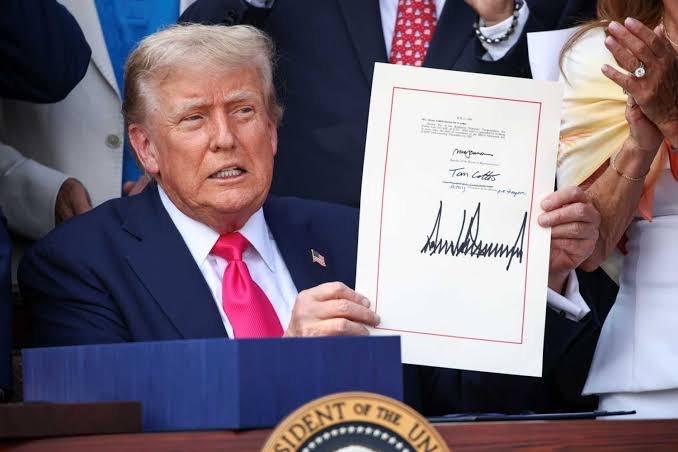
Donald Trump's One Big Beautiful Bill Act is already changing how some workers, families, and businesses think about withholding, deductions, and year-end tax bills. The law, signed on July 4, 2025, as Public Law 119-21, is broad. But for most households, the practical question is narrower, what changes actually show up in a paycheck, and how does it affect the taxes of the average American?
The short answer here is that the One Big Beautiful Bill Act does not create one universal wage hike or one uniform tax cut. Instead, it mixes permanent tax extensions, temporary deductions, and new reporting rules that can affect take-home pay in uneven ways. However, what it affects depends on things like income, as well as job type and tax filing status of the individual. The IRS stated that the law “significantly affects federal taxes, credits, and deductions” and has already issued guidance and withholding tools tied to the new rules.
One Big Beautiful Bill Act And The Paycheck Effect
For American workers, the biggest near-term change brought about by Donald Trump's One Big Beautiful Bill Act is not necessarily a higher gross paycheck. Rather, it is the possibility of lower federal income tax withholding on certain earnings categories, especially overtime and tips, if payroll systems and withholding tables reflect the new law.
This comes into play because ‘withholding’ here refers to the amount your employer sends to the IRS on your behalf during the year. Thus, if the One Big Beautiful Bill Act lowers the tax burden on part of your earnings, your payroll withholding can decline too, raising your net pay each pay period. But if your employer has not updated systems yet, the change may not appear right away.
The IRS said on March 18, 2026, that its updated Tax Withholding Estimator reflects the new law. This is a clue that taxpayers should not assume their old W-4 settings still produce the right result.
Two provisions stand out about the amended guidance:
- No Tax on Overtime: The One Big Beautiful Bill Act creates a new deduction for qualified overtime compensation for tax years 2025 through 2028. But the overtime premium remains subject to payroll taxes such as Social Security and Medicare, according to congressional and IRS guidance.
- No Tax on Tips: The bill also creates a deduction for qualified tip income for tax years 2025 through 2028, again with payroll tax rules still applying.
Differentiating between both is important because if you were expecting the One Big Beautiful Bill Act to make overtime and tip income entirely tax-free, that is not what the law does. It mainly shifts part of the income tax burden, not payroll taxes, and the benefit can depend on occupation, reporting, and SSN requirements. For example, the IRS and congressional materials say tip income must be reported separately, and overtime deductions apply only to qualified overtime compensation. In other words, not every extra dollar worked or every gratuity received will qualify automatically.
Regardless, the result of this could still be meaningful. For a worker in a tipped job or a role with frequent overtime, even a modest reduction in federal income tax withholding can add up to hundreds or even thousands of dollars a year. But the exact figure depends on pay levels, hours, tips, and other deductions on the job.
Donald Trump, Tax Brackets, And What To Expect From The Bill
President Donald Trump has framed the One Big Beautiful Bill Act as a working-family tax package. But much of the law is also about extending or locking in changes that were already set to expire. The IRS says the act affects deductions, credits, and reporting across many areas, from child-related benefits to business investment and rural lending.
For many households, the biggest question is whether the law changes their refund or their paycheck more. That answer depends on whether they are overwithheld today, whether they claim the standard deduction, and whether they qualify for new deductions tied to tips, overtime, or other provisions. There is also a timing issue. Several benefits began only after July 4, 2025, while others apply for tax years beginning in 2025, 2026, or 2027. That staggered rollout makes it easy to miss the law’s impact if you look only at this month’s pay stub.
For middle-income earners, the legislation could preserve or extend lower marginal tax rates that otherwise may have been scheduled to expire. In this case, even a reduction of one or two percentage points in effective tax rates can translate into hundreds or thousands of dollars in annual savings for many families.
Now, consider a household earning $80,000 annually. A tax reduction equal to just 2% of taxable income could potentially preserve approximately $1,600 each year. Spread across 26 biweekly pay periods, that equates to roughly $61 in additional take-home pay per paycheck. For higher-income households, they could experience even larger dollar savings because many tax provisions scale according to taxable income levels. The IRS also says taxpayers can use its Working Families Tax Cuts hub to track guidance, FAQs, and notices as the law continues to be implemented.
The One Big Beautiful Bill Act also includes measures intended to encourage business investment and economic growth. Supporters argue that lower business taxes and investment incentives could stimulate hiring, increase wages, and support broader economic expansion.
CBO’s earlier scoring of H.R. 1, the One Big Beautiful Bill Act, underscores the scale of the package. In its June 2025 estimate, the agency said the bill would increase the primary deficit by $2.4 trillion over 2025-2034 before macroeconomic effects, and by $2.8 trillion after dynamic effects and debt-service assumptions in the House estimate.
This may not directly tell you how much more cash will hit your checking account this year. But it does show that the bill is not a small tweak in legislation. It is actually ya major rewrite of the federal tax code’s near-term incentives, especially for wage earners, gig workers, parents, seniors, and small businesses.
Closing Remarks
Donald Trump’s One Big Beautiful Bill Act is likely to change many Americans’ take-home pay, but not in a single, simple way. Some workers may see smaller federal income tax withholding, while others may see little immediate difference until they file. The biggest gains are most likely for workers with qualified overtime or tips, but the details matter, and the payroll impact may lag behind the law itself. For taxpayers, the safest move is to treat Donald Trump’s signature tax package as a prompt to recheck withholding, not as an automatic raise.