
Some top companies are in the news for bankruptcy and financial trouble in 2026, but with muted attention to the issues. Interestingly, these issues are showing up across retail, payments, industrials, and telecom as companies confront weaker cash flow, heavier debt loads, and tighter financing conditions. This means that it is not limited to one ‘struggling’ industry alone.
The latest examples of companies facing bankruptcy and financial trouble span South Korea, Japan, and the U.S., and the numbers are hard to ignore. These top companies are showing billions of dollars in debt, four- and five-digit employee counts, and, in several cases, store closures or court-supervised restructurings that could wipe out equity holders. In most cases, the companies say they are trying to preserve value, but the filings also show how quickly a liquidity crunch can become a full-blown bankruptcy case.
Bankruptcy Pressures Are Spreading Across Sectors
One of the clearest signs of stress comes from Homeplus, South Korea’s second-largest hypermarket chain. On July 3, 2026, the Seoul Bankruptcy Court terminated the retailer’s rehabilitation proceedings after it failed to secure at least 200 billion won (about $130 million) for its self-rescue plan. On July 13, 2026, Yonhap reported that Homeplus said it would temporarily close outlets because it had run out of operating capital and could no longer reliably pay suppliers or keep stores open.
This shows that what Homeplus is dealing with is not just a legal problem, but it is also an operational one. Homeplus reportedly asked creditor Meritz Financial Group for another 200 billion won in working capital, but had not yet received approval. When a large retailer such as Homeplus loses funding, the shock can spread well beyond the balance sheet. This means that the company’s fate matters to roughly 12,000 employees and thousands of suppliers and contractors.
Japan is seeing a similar strain in its payments ecosystem as a major player faces off with the bankruptcy process. The Japan Times reported on July 8, 2026, that Osaka-based payment processor Zentoshin filed for bankruptcy with liabilities of about ¥115.2 billion (roughly $710 million). The company had served around 200,000 shops, many of them small restaurants and retailers. As of now, banks are taking write-downs, and merchants that depended on their terminals are scrambling for replacement systems.
A major financial player such as Zentoshin being in this kind of financial trouble can trigger a second wave of damage. The Japan Times quoted a Teikoku Databank manager warning about the risk of “secondary bankruptcies” among restaurants and retailers if remittances are delayed or payment systems go offline. In other words, one collapse like Zentoshin can create several more that could lead to a major ripple effect.
Across the pond and in the U.S., the latest large bankruptcy filing came from Trinseo, the specialty materials company. The company announced on May 26, 2026, that it and certain subsidiaries had filed Chapter 11 bankruptcy cases. In its SEC filings, Trinseo said the restructuring is expected to cut about $2 billion in debt and lower annual interest expense by roughly $140 million. The company also said it had support from holders of a significant majority of its debt and that it expected to keep operating in the ordinary course.
Financial Trouble Forces Companies To Choose Between Survival And Scale
A second major stress point in 2026 is retail, where there has been a fair share of companies facing bankruptcy and financial trouble. Claire’s, the accessories chain, filed for Chapter 11 again in 2025 and is still part of the broader cautionary tale around mall-based companies. Reuters reported on August 6, 2025, that the company had $690 million in debt and planned to close hundreds of stores while seeking a buyer for about 800 remaining locations. The repeat filing underscores how quickly financial trouble can return if sales do not recover fast enough.
Another recent headline is DISH DBS / DISH Wireless. On June 30, 2026, the company announced a prepackaged Chapter 11 restructuring. In that filing, the company said more than 88% of secured and unsecured noteholders, and more than $8.8 billion of DISH Wireless debt holders, supported the plan. The goal is to complete the transition of the wireless business and repay debt early, rather than run the company into a messy liquidation.
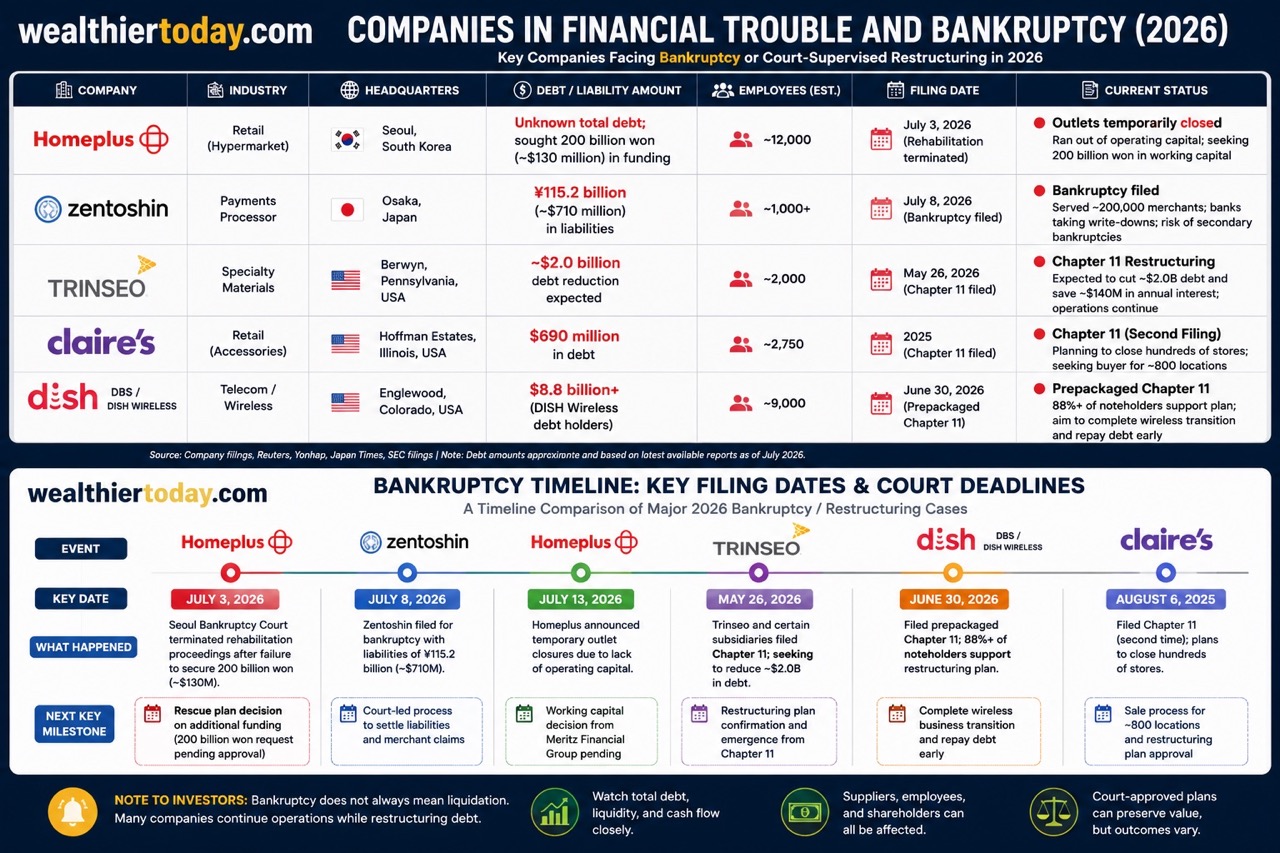
The pattern here shows that a lot of modern bankruptcy filings are really negotiations over timing, collateral, and who absorbs the losses. For investors, the bankruptcy is only the start. The real questions are whether the company still has enough cash to operate, whether suppliers will keep shipping, and whether lenders will accept less than they are owed.
For this reason, investors should track total debt, near-term liquidity, and the minimum cash needed to keep the business alive for these companies in order to make informed decisions. In Homeplus’ case, that number was 200 billion won. In Trinseo’s case, it was about $158 million in debtor-in-possession financing. In Zentoshin’s case, it was the scale of its liabilities and the speed of merchant disruption.