The Bureau of Labor Statistics released the US jobs report on Thursday, July 2, 2026, and the headline numbers point to a job market that is still expanding, but at a much slower pace than earlier this year. The report also showed major revisions to prior months, with April payrolls now at 148,000 after a downward revision of 31,000, and May payrolls revised to 129,000 after a reduction of 43,000. Combined, those revisions left employment in the two months 74,000 lower than previously reported.
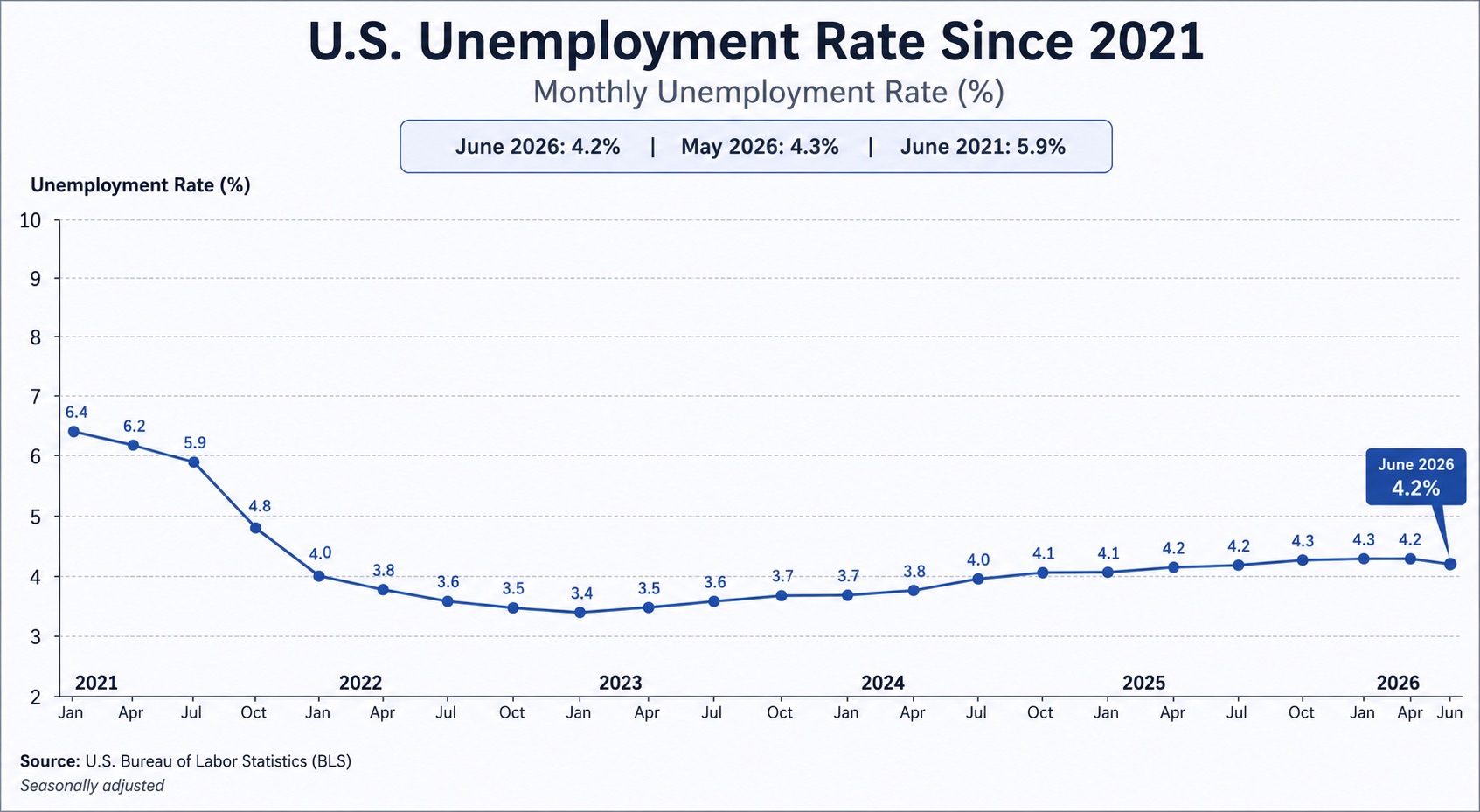
The jobs report for June 2026 shows that the US labor market has cooled down more sharply than economists expected. So far, there have been 57,000 non-farm payrolls added, well below the 115,000 Dow Jones consensus estimate and the 113,000 median forecast. At the same time, the unemployment rate fell to 4.2%, down from 4.3% in May, but the dip was driven in part by a smaller labor force rather than stronger hiring.
The jobs report matters because it touches everything from consumer spending to Federal Reserve policy. Below are the key figures from the June jobs report release:
- Non-farm payrolls: +57,000
- May payrolls, revised: +129,000
- April payrolls, revised: +148,000
- Consensus forecast: +115,000 jobs, according to Dow Jones
- Bloomberg survey forecast: +113,000 jobs
- Unemployment rate: 4.2%
- May unemployment rate: 4.3%
- Number of unemployed people: 7.1 million
- Labor force participation rate: 61.5%
- Participation rate change: down 0.3 percentage points
- Broader unemployment measure (U-6): 7.9%
- Household employment change: down 507,000
- Professional and business services: +36,000
- Social assistance: +25,000
- Health care: +22,000
- Hospitals: +9,000
- Leisure and hospitality: -61,000
- Average monthly payroll gain over prior 12 months: 36,000
- Health care average monthly gain over prior 12 months: 38,000
- Social assistance average monthly gain over prior 12 months: 16,000
- Professional and business services jobs added since October 2025's low of 172,000
The BLS reported that the total non-farm payroll employment “changed little” in June and that job growth remained roughly in line with the average monthly change over the prior 12 months, which it put at 36,000. Interestingly, this is a much slower trend than the post-pandemic hiring boom, and it helps explain why markets reacted quickly to the downside surprise.
The jobs report also showed the unemployment rate’s decline was not a simple sign of strength. The labor force participation rate dropped to 61.5%, which is its lowest level since March 2021. Meanwhile, household employment fell by 507,000. In other words, fewer people were counted as working, and fewer people were participating in the labor force.
Market Reacts To Disappointing Jobs Report
This jobs report saw the strongest gains come from professional and business services, social assistance, and healthcare. At the same time, leisure and hospitality lost 61,000 jobs because of what the BLS described as weaker-than-usual seasonal hiring. This is interesting because the United States is currently co-hosting the FIFA World Cup 2026, and the majority of the games are being played in the country. So it was expected that the hospitality industry would see a surge, but that has not been the case.
This jobs report matters because the Federal Reserve has said it is focused on both inflation and labor-market resilience. A 57,000 gain is not recessionary on its own, but it is weak enough to raise questions about whether hiring momentum is fading across the board. The fact that the unemployment rate fell to 4.2% does not fully offset that concern, especially given the drop in participation and the fact that the figure was 4.1% at the same time last year.