
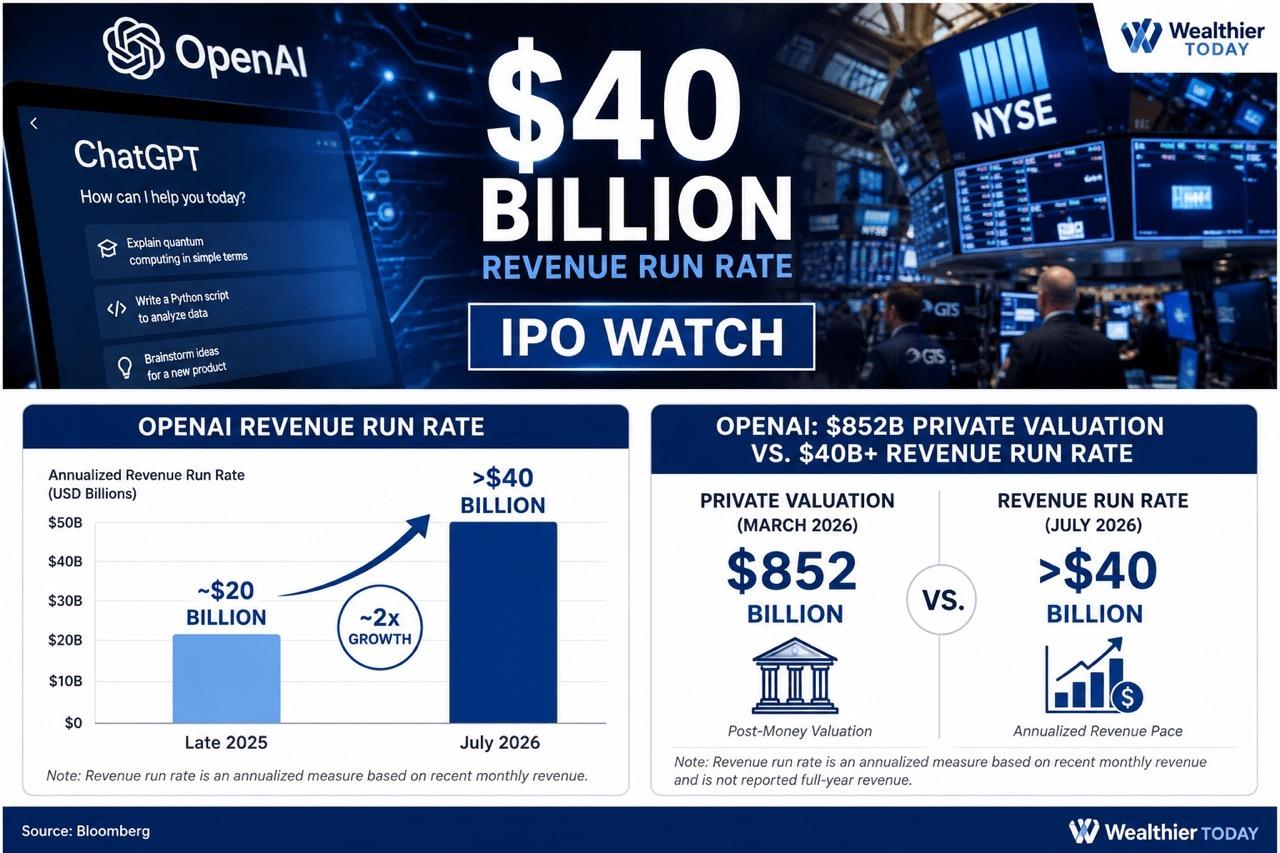
OpenAI is now generating revenue at an annualized pace of more than $40 billion, according to people familiar with the company’s finances, giving the ChatGPT creator another major milestone as it prepares for a potential initial public offering.
The figure, reported by Bloomberg, represents roughly a doubling of OpenAI’s revenue run rate from the end of 2025.
The acceleration gives investors a fresh indication of the scale of demand for OpenAI’s products as the company moves closer to the public markets. It also provides an important financial benchmark for investors who will eventually have to determine how much the company is worth.
OpenAI has not yet become a publicly traded company, meaning there is currently no OpenAI stock ticker. However, the company’s latest private-market valuation already gives investors a sense of the expectations surrounding a future IPO.
In March, OpenAI announced that it had secured $122 billion in committed capital at an $852 billion post-money valuation.
OpenAI Revenue Has Accelerated Rapidly
The $40 billion figure is a revenue run rate, rather than reported annual revenue. A run rate takes the company’s recent pace of revenue generation and annualizes it. It does not mean OpenAI has already booked $40 billion in revenue during the current year.
Bloomberg reported that OpenAI's monthly revenue increased sharply in July, with growth coming from several parts of the business. Demand for its AI coding products has been particularly strong, while subscriptions, advertising and enterprise services have also contributed to the increase.
The company's growing commercial business is important because OpenAI is no longer relying solely on individual consumers paying for ChatGPT.
Businesses are increasingly paying for access to its AI models and software, creating a larger revenue base that could become increasingly important if OpenAI moves ahead with an IPO.
Codex Becomes an Important Growth Driver
One of the products helping drive OpenAI’s growth is Codex, its AI coding agent. The product allows developers to use OpenAI's technology for software development tasks, giving the company another way to monetize the growing demand for AI beyond its traditional ChatGPT subscriptions.
That matters because coding is one of the areas where companies have been willing to spend heavily on AI tools.
OpenAI has also been expanding its enterprise offerings, including ChatGPT Work, as it attempts to capture more spending from businesses adopting AI across their operations.
The combination gives OpenAI several avenues for revenue growth as the company prepares for a potential transition to public markets.
The $852 Billion Valuation Faces a New Test
OpenAI's latest private valuation of $852 billion provides a useful reference point for understanding what the company could be worth in an IPO.
At a $40 billion annualized revenue pace, that valuation would represent roughly 21 times annualized revenue.
That is not a conventional valuation multiple because run-rate revenue is not the same as actual annual revenue, and OpenAI's costs remain extremely high. Nevertheless, the calculation illustrates the expectations investors are already placing on the company.
The bigger question for public-market investors will be whether OpenAI can continue increasing revenue quickly enough to justify its valuation while controlling the enormous costs associated with developing and operating advanced AI systems.
OpenAI Is Spending Aggressively to Expand
Revenue growth is only one side of the equation.
OpenAI is also committing enormous sums to the computing infrastructure needed to train and operate its AI models. The company has entered major partnerships and infrastructure agreements as it seeks access to more computing power.
That creates a difficult balance for investors.
Faster revenue growth makes the business more attractive, but the company also needs to spend heavily to support that growth. If expenses rise almost as quickly as revenue, a large revenue number alone will not necessarily translate into strong profits.
That will likely be one of the central questions in any eventual OpenAI IPO filing.
OpenAI's IPO Could Be One of the Biggest Ever
OpenAI's size means its eventual public offering could become one of the largest technology IPOs in history.
The company has reportedly been preparing for a potential Wall Street debut while working through leadership and corporate changes. OpenAI also confidentially filed IPO paperwork with US regulators in June, according to recent reporting.
A $1 trillion valuation has been discussed as a potential target, although the eventual IPO valuation and timing remain uncertain. At that valuation, the current $40 billion-plus revenue run rate would give investors a clearer basis for judging whether OpenAI's private-market valuation can translate into public-market demand.
OpenAI Faces Growing Competition
OpenAI is also entering the IPO process at a time when competition in AI is intensifying. Anthropic has been growing rapidly and is also preparing for a potential public listing. Recent reports put Anthropic's annualized revenue pace at about $47 billion, putting it ahead of OpenAI on that measure despite OpenAI's latest acceleration.
If both companies reach the public markets, investors will have a much easier way to compare their revenue growth, margins, spending and valuations.
For OpenAI, the challenge will be showing that its enormous user base and growing enterprise business can translate into durable financial performance.
What the $40 Billion Revenue Run Rate Means for Investors
The latest figure changes the conversation around OpenAI's potential IPO. A company generating revenue at a $40 billion-plus annualized pace is operating on a very different scale from the OpenAI that entered the public spotlight through ChatGPT's explosive consumer growth.
The company now has a large commercial business, growing enterprise demand and increasingly valuable software products. But investors will ultimately need more than revenue growth.
They will want to know how much of that revenue OpenAI can retain as profit, how quickly its costs will rise as its models become more capable, and whether competitors can erode its market position. Those questions will determine whether OpenAI can justify the enormous valuation expectations surrounding its potential IPO.
The Bottom Line
OpenAI's revenue run rate surpassing $40 billion marks another major step in the company's rapid expansion and gives investors a new benchmark ahead of a potential IPO.
The number is particularly notable because it has roughly doubled from late 2025, showing that demand for OpenAI's products continues to grow rapidly.
The bigger test will come when investors can finally examine the company's financial statements in a public filing.
Until then, OpenAI remains privately held, with no stock ticker, but its growing revenue and $852 billion private valuation are already setting the stage for what could become one of the most closely watched IPOs in the technology sector.