
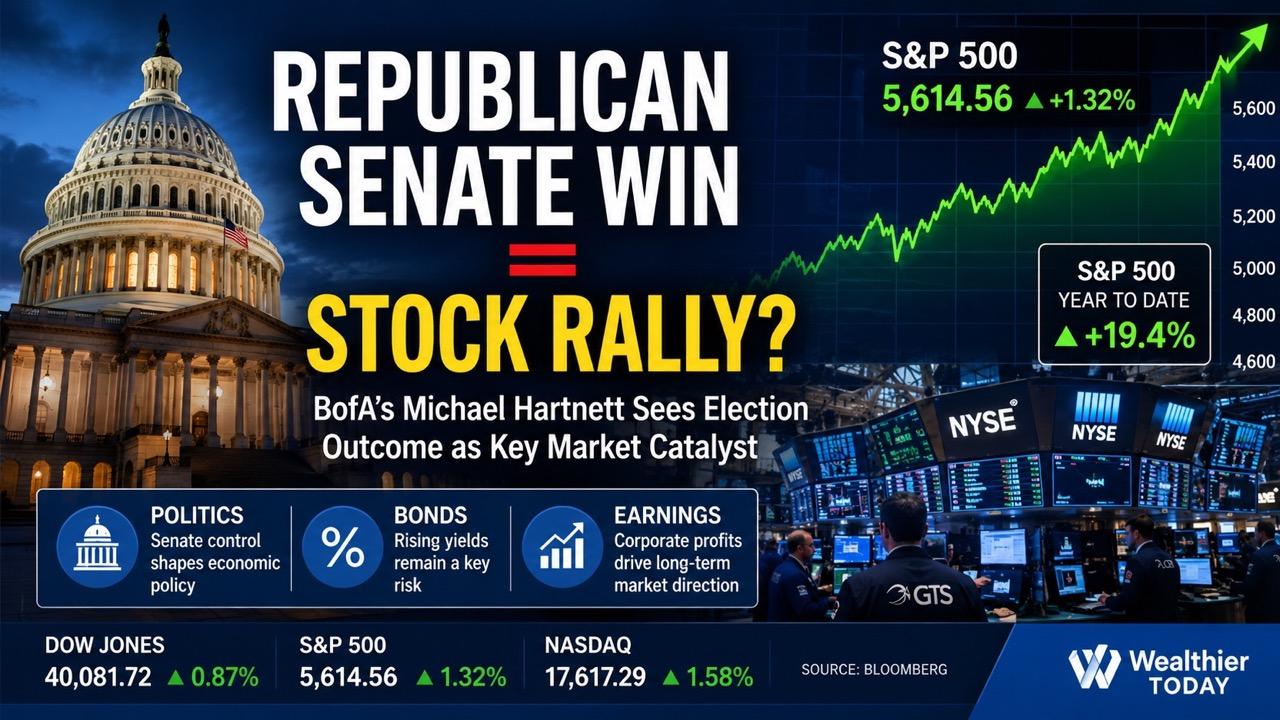
A Republican victory in the US Senate in November could give the stock market another boost, according to Michael Hartnett, chief investment strategist at Bank of America (NYSE: BAC).
Hartnett's latest view, reported by Bloomberg, puts the 2026 midterm elections at the center of the outlook for US stocks. Investors are already looking beyond the immediate earnings and interest-rate backdrop toward what the election could mean for taxes, government spending and economic policy.
The argument comes with an important caveat. Hartnett has also warned that a Democratic sweep could produce the opposite result, particularly if investors begin to worry about higher taxes, weaker corporate profitability or a shift in economic policy.
That makes the November vote an increasingly important event for markets that are already trading at elevated levels.
Why a Republican Senate Win Could Be Bullish for Stocks
A Republican-controlled Senate would make it easier for President Donald Trump's administration to pursue its economic agenda, particularly if Republicans retain control of the House as well. For investors, the potential market benefit would come from greater policy continuity and the prospect that business-friendly measures remain in place.
A Republican victory could also reduce some of the uncertainty surrounding tax and regulatory policy. Markets generally prefer greater visibility because companies can make investment and hiring decisions with a clearer understanding of the rules they will face.
Hartnett's view therefore goes beyond the election itself. The strategist is looking at what the result could mean for the broader economic cycle and corporate earnings.
The Bigger Risk Is a Democratic Sweep
Bank of America's outlook is more cautious if Democrats make significant gains in November. The bank previously warned that a Democratic sweep could produce a sharp stock-market reversal. In an earlier note, Hartnett and his team described the midterms as a potential referendum on the direction of US economic policy.
That concern is particularly relevant because US equities have already benefited from strong investor expectations. A political outcome that challenges those expectations could cause investors to reassess stock valuations quickly.
The potential impact would not necessarily be limited to technology stocks. Changes in tax policy, government spending and regulation could affect companies across the market, while shifts in Treasury yields could influence how investors value future corporate earnings.
Hartnett’s Warning Comes as Markets Look Overheated
Hartnett's bullish election scenario should not be interpreted as an across-the-board endorsement of US stocks at current prices.
Bank of America has simultaneously warned about elevated investor optimism and the risk that higher bond yields could eventually undermine the equity rally.
The bank's August outlook has highlighted a growing gap between strong market performance and concerns among households about inflation, employment and the cost of living.
Stock prices can continue rising when household sentiment is weak if corporate earnings remain strong and financial conditions support asset prices. But if economic dissatisfaction begins to influence voting behavior and policy expectations, markets could become more sensitive to political developments.
Bond Yields Remain a Key Market Risk
One of Hartnett's most important warnings concerns the bond market. The strategist has argued that rising Treasury yields could eventually become a much bigger problem for stocks. Higher yields increase the return investors can receive from relatively safer government debt while also raising the rate used to value future corporate earnings.
The 10-year Treasury yield was recently around 4.67%, according to reporting on Hartnett's outlook. That puts it above the 4.5% level that investors have been watching closely.
If yields continue climbing because of inflation or concerns about the US fiscal position, the effect could spread across equities.
That is why the election cannot be viewed in isolation. A Republican Senate victory could support stocks if investors believe it will preserve favorable economic policies, but a simultaneous rise in Treasury yields could limit how far the rally can go.
The 2026 Midterms Could Set the Market’s Next Direction
Historically, midterm election years can produce greater stock-market volatility as investors wait for the political outcome and reassess what it could mean for the economy.
Goldman Sachs has previously noted that the S&P 500 has historically produced a median return of around zero from the beginning of August through Election Day during midterm years. Oppenheimer has likewise warned that second-term midterm years can bring a third-quarter correction.
That history does not determine what will happen in 2026, but it illustrates why investors may become more cautious as November approaches.